Karnataka SIR: Journalist Finds Name on Draft Roll, Yet Gets Hearing Notice; Questions Process
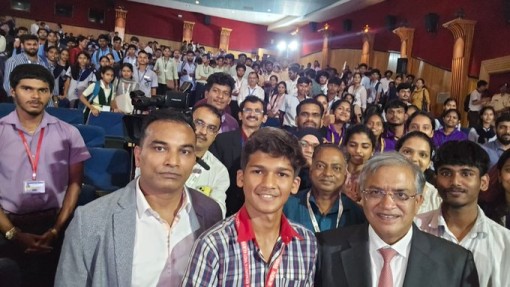
CEC Gyanesh Kumar at electoral literacy programme (Image ECI on X)
By TRH News Desk
After finding his own and 90-year-old mother’s names on the draft electoral roll, journalist Samar Harlankar says he was still asked to appear for a hearing, raising questions over notices, documentation and accessibility.
Bengaluru, September 5, 2026 — Journalist Samar Harlankar has raised questions over the ongoing Special Intensive Revision (SIR) of electoral rolls in Karnataka, saying that even after locating his and 90-year-old mother’s voting records from 2002 and finding both names in the draft roll published on August 24, he was asked to appear for a hearing.
In a thread posted on X, Harlankar said he initially believed he had completed everything required under the SIR process after tracing the 2002 voting details of himself and his mother through online and offline searches, with help from neighbours on WhatsApp.
“Both our names appeared on the draft roll on 24 Aug,” he wrote.
His account comes amid a wider scrutiny of Karnataka’s SIR exercise. The draft electoral roll published on August 24 contained about 4.47 crore electors, compared with more than 5.54 crore electors on the roll when it was frozen in June. More than 1.07 crore electors were placed under the Absent, Shifted, Dead, Duplicate and Other (ASDDO) category during the revision exercise, reported The New Indian Express.
Harlankar said concern grew in his neighbourhood after residents began receiving notices asking them to appear before an authority with documents relating to family links or birth credentials.
He said he felt relatively secure because his name was present on the electoral roll and he had located his earlier voting details.
“I was wrong,” he wrote.
According to Harlankar, he subsequently found his name and that of his mother among people listed for hearings. He said the mapping category against his name was “SELF” and questioned why he had nevertheless been called for a hearing.
He said a Google search led him to understand that “self” indicated that his current electoral-roll entry had been matched with the 2002 electoral roll. The Election Commission’s voter service portal does provide a facility for voters to search their names in the last SIR electoral roll, including by elector details and other identifying information.
Harlankar said he wondered whether a spelling discrepancy could have triggered the notice but added that, in his case, the spelling of his name had remained unchanged for 24 years.
Hhe further alleged that the Booth Level Officer (BLO) in his area had not personally delivered the notice or explained why he had been flagged, saying the officer had told residents that it was impossible to do so.
Harlankar said he planned to locate the BLO and obtain the notice ahead of his scheduled hearing on September 28.
NRC, NPR, SIR: India’s Citizenship Debate and What Comes Next
Documents and citizenship concerns
The journalist also raised questions over the documents that voters may rely upon during the verification process.
He said he had a Class 10 marksheet and passport but did not possess a birth certificate. According to his account, he understood that the government does not treat a passport as proof of citizenship, while the verification exercise involves establishing eligibility for inclusion in the electoral roll.
The Election Commission’s official SIR portal currently provides a facility for voters to submit documents against notices issued during SIR, alongside facilities to search names and access electoral-roll services.
Harlankar said many people in his neighbourhood work outside Bengaluru or abroad and may not be aware that their electoral status could require verification. He also expressed concern about people who are not part of local WhatsApp groups and therefore may not learn about notices that are not easily accessible to them.
“I don’t know what’s happening in the poorer parts of our constituency,” he wrote.
Accessibility concern for 90-year-old mother
One of the strongest concerns in Harlankar’s account relates to his elderly mother.
He said the hearing for September 28 was scheduled at a local government college at the end of a dug-up lane that, according to him, could be accessed only by two-wheelers.
Harlankar said his 90-year-old, wheelchair-bound mother would not be able to reach the venue and that he had not been informed of any special arrangement for voters unable to appear physically.
He said the BLO had told people who had spoken to him that physical presence was mandatory, prompting him to ask what would happen to voters who could not attend a hearing.
The Election Commission itself lists the Saksham App among voter services intended to provide services for persons with disabilities.
Harlankar’s account therefore raises a broader accessibility question: how should the SIR process accommodate elderly, disabled or otherwise vulnerable voters who cannot reasonably reach a hearing venue?
Larger debate over SIR
Harlankar framed his experience as part of a broader concern about whether a bureaucratic voter-verification exercise could become difficult for citizens to navigate.
He said his own circumstances gave him access to identity documents and other resources and that he expected to be able to establish his eligibility. But he questioned whether people from poorer or disadvantaged communities would have the same ability to respond to notices and produce documents within the required process.
“Millions will not, especially if they are from minorities or from disadvantaged or dispossessed communities,” he wrote.
His comments come as Karnataka’s SIR process faces wider public scrutiny. Civil society groups and activists have raised concerns over the transparency and implementation of the exercise, while the Election Commission and state election authorities have continued the revision process and provided online facilities for voters to check their records and submit claims or documents.
The issue is particularly significant because electoral rolls determine who can exercise the constitutional right to vote. The challenge for the authorities is therefore to balance the objective of cleaning and verifying electoral rolls with ensuring that eligible voters are not inadvertently excluded because they cannot navigate the verification process.
Harlankar ended his thread by questioning whether the SIR process was turning into a test of citizens’ ability to establish their right to vote and, in his words, their right to belong.
His account remains a personal account of the process and the concerns he encountered. The Election Commission’s ongoing claims, objections and verification mechanisms will ultimately determine how individual cases are resolved.
Follow The Raisina Hills on WhatsApp, Instagram, YouTube, Facebook, and LinkedIn




About The Author