West Bengal’s Missing 91 Lakh Voters: Who Gains, Who Bleeds
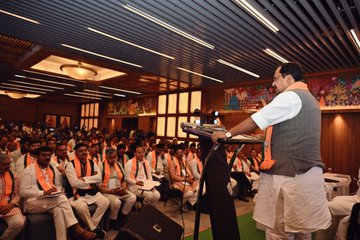
BJP president Nitin Nabin in West Bengal (Image X.com)
Here’s why BJP sees electoral advantage and why Trinamool Congress is alarmed, with a district-by-district breakdown of who loses what.
By NIRENDRA DEV
KOLKATA, April 8, 2026 — It is the number that is reshaping the arithmetic of West Bengal’s 2026 assembly elections before a single vote has been cast. Nearly 91 lakh voters have been deleted from the electoral rolls in West Bengal following the Special Intensive Revision exercise, with the final deletion figure standing at just over 90.83 lakh — representing more than 11.85 per cent of the state’s pre-SIR electorate of 7.66 crore. The voter base has shrunk to approximately 6.77 crore.
According to official data released on February 28, 63.66 lakh names — around 8.3 per cent of the electorate — were deleted since the SIR process began in November last year, reducing the voter base from about 7.66 crore to just over 7.04 crore. Over 27.16 lakh of 60.06 lakh voters placed in the “under adjudication” category were subsequently deleted during scrutiny by judicial officers. An additional five lakh voters were deleted from the final rolls published on February 28, bringing the cumulative total to just below 91 lakh.
The political fallout is immediate, fierce, and deeply asymmetric — with the BJP sensing an opening it has not had in years, and the Trinamool Congress scrambling to frame a counter-narrative before polling day.
The Seats That Decide Everything: 89 Constituencies Under a Microscope
The political significance of the deletions can only be understood through the lens of constituency-level arithmetic from the 2024 Lok Sabha polls. In that election, there were 89 assembly segments where the victory margin between the TMC and BJP was less than 10,000 votes — a razor-thin battleground covering nearly a third of the state’s 294 assembly seats.
Of those 89 seats, 51 went in favour of Mamata Banerjee’s party and 38 went to BJP. Here is where the deletion data becomes explosive: among the 51 TMC-won seats, 49 now have between 10,000 and 30,000 deleted voter names — numbers that, in almost every case, exceed or closely match the margin by which TMC won.
Local political experts estimate that around 70 to 75 per cent of the deleted voters from these constituencies are Muslims and women — two demographic blocs that have historically voted for Trinamool in large, consolidated numbers. If even a fraction of these deletions translates into reduced turnout or disenfranchisement of pro-TMC voters, the impact on tight races could be decisive. Based on 2024 vote share projections, analysts suggest the BJP’s tally could significantly cross 120 to 130 seats — potentially enough to challenge TMC’s majority in a 294-seat house.
The BJP’s position in the 89 contested seats adds further texture. In 33 of those seats, the BJP had “taken lead” in 2024 Lok Sabha counting. Of these, in as many as 28 segments, the number of voters deleted actually outnumbers the difference in votes polled between the two parties in 2024 — meaning the SIR has, on paper, removed more names than the gap BJP needs to bridge to win.
The District-by-District Data: Where the Deletions Are Heaviest
The geographic concentration of deletions follows a clear pattern that tracks closely with Muslim-majority and minority-heavy districts:
– Murshidabad: 4,55,137 deleted — the highest in the state, with nearly 4.5 lakh names deleted out of roughly 11 lakh cases reviewed, in a Muslim-majority district
– North 24 Parganas: 3,25,666 deleted
– South 24 Parganas: 2,22,929 deleted
– Malda: 2,39,375 deleted
– Nadia: 2,08,626 deleted — where post-adjudication deletions reached 77.86 per cent, the highest percentage in the state, in a district with a substantial Matua Hindu population
– Purba Bardhaman: 2,09,805 deleted
The Nandigram data is particularly pointed. A total of 2,826 names have been deleted from the electoral rolls in Nandigram in the supplementary lists — and of these, 2,700 are Muslims, meaning over 95 per cent of the deletions in that single, symbolically critical constituency are from one community. Nandigram is where Mamata Banerjee won by a narrow margin in 2021 and has since become a prestige battleground.
West Bengal is also among 12 states and Union Territories where the special intensive revision of the electoral roll was undertaken — the first of its kind since 2002.
The Percentages That Add Another Dimension
In terms of percentage, post-adjudication deletions in Nadia and North 24 Parganas — districts perceptibly dominated by the Hindu Namasudra Matua community — were at a whopping 77.86 per cent and 55.08 per cent respectively. Over 28,000 voters were deleted in Kolkata South, which comprises Chief Minister Mamata Banerjee’s Bhabanipur assembly constituency, with a deletion percentage during adjudications at 36.19.
In nine districts, after the SIR, the number of ineligible voters exceeded eligible voters in some segments — an extraordinary statistical outcome that points to the scale of the revision’s reach.
Furthermore, in the draft rolls published on December 16, 2025, over 58 lakh registered voters were marked under four categories: Absent, Shifted, Dead, and Duplicate (ASDD). Muslims accounted for around 33 per cent of those on this ASDD deletion list — a share broadly consistent with their proportion of the state’s population but concentrated in specific high-stakes districts.
What the Trend Lines Say: 2021 to 2024 to 2026
The broader vote-share trajectory between TMC and BJP over the last two election cycles is the backdrop against which the SIR data acquires full significance.
In the 2021 assembly polls, the total difference in votes polled between TMC and BJP was 60 lakh — a comfortable TMC cushion. By the 2024 Lok Sabha polls, that gap had narrowed to 42 lakh, reflecting BJP’s rising vote share across the state. The 2026 contest, with 91 lakh names removed from rolls in a pattern that disproportionately affects TMC’s core constituency, may compress that gap further still — or eliminate it.
The Clashing Narratives: TMC Cries Foul, BJP Claims Mandate
Chief Minister Mamata Banerjee has accused the BJP of targeting Matuas and minorities, while opposition leader Suvendu Adhikari claimed the exercise had merely exposed “Muslim infiltrators” protected by the ruling TMC.
Banerjee has broadened the charge beyond Muslim voters. She has pledged support to all affected voters and claimed her Supreme Court intervention helped reinstate some names earlier flagged for deletion, telling affected constituents: “I approached the Supreme Court and managed to restore some of your names. I assure all affected voters that we will help them appeal.”
The BJP, for its part, is framing the election not as a contest over deleted names but as a battle over identity, citizenship and illegal immigration — attempting to project the SIR as an overdue cleansing exercise rather than a disenfranchisement scandal.
The TMC’s counter-narrative will bank on a familiar but powerful frame: that BJP is a Hindi-Hindu party run by Gujaratis that has deliberately deprived Muslim voters of their franchise. This argument has electoral traction in a state where pluralism and Bengali identity have historically complicated Hindutva’s appeal.
Indeed, the BJP carries its own electoral liabilities. Its brand of Hindutva has limited resonance among West Bengal’s Hindus, many of whom prefer pluralism. Mamata Banerjee remains a formidable grassroots politician — mercurial but deeply embedded, and one of the few regional leaders still mounting credible resistance to BJP’s national dominance.
As retired banker Aurobindo Sen observes, while the Left is remembered for ideological rigidity and economic decay, the TMC is increasingly accused of cultivating a “threat culture” marked by political violence and the erosion of free expression — troubling continuity from the Left era. West Bengal’s industrial investment deficit and cultural stagnation remain unaddressed by either party. The central question for 2026 is whether ‘ashol poriborton’ — real change — is still possible, or whether Bengal is simply exchanging one form of political dominance for another.
The Election Commission has now frozen the voter list, effectively barring any further additions or deletions until the completion of elections. The Supreme Court has ruled out interim restoration of names, making clear that voters who failed verification cannot be re-added provisionally. Those deleted can appeal to 19 tribunals, but with polling on April 23 and April 29, the timelines are extraordinarily tight.
The 2026 West Bengal assembly election was always going to be a contest of arithmetic. The SIR has made it one before a single ballot is cast.
(This is an opinion piece. Views expressed are the author’s own.)
West Bengal: Women’s Quota Bill Puts TMC in Political Crossfire
Follow The Raisina Hills on WhatsApp, Instagram, YouTube, Facebook, and LinkedIn




About The Author