Who Won? Ceasefire Ignites Hormuz, US Power Debate
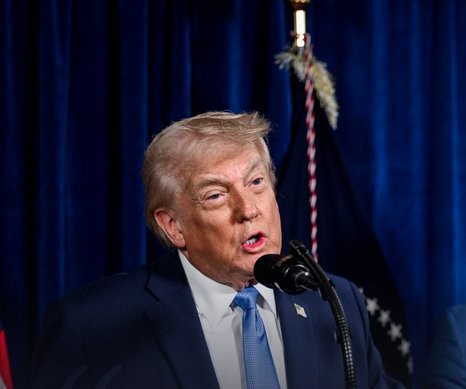
US President Trump delivers remarks on Operation Epic Fury from the White House.
Ceasefire Triggers Fierce Reckoning Over the Strait of Hormuz and American Power
By TRH World Desk
New Delhi, April 8, 2026 — Crowds poured onto the streets of Tehran on Wednesday as Iranian state television broadcast news of the ceasefire agreement with the United States and Israel, scenes of jubilation forming a stark contrast to the smouldering infrastructure and weeks of devastation that preceded them. But as Iranians celebrated, a furious debate erupted in Washington and across global commentary networks over the fundamental question the two-week truce leaves unanswered: what, precisely, did the United States just agree to — and at what cost?
The answers emerging from analysts, lawmakers, and diplomats are deeply uncomfortable for the Trump administration.
The Ceasefire on the Ground: Fragile but Holding
Iran’s explanation of the 10-point plan included its claim that the Strait of Hormuz would be subject to “regulated passage under the coordination of the Armed Forces of Iran,” thereby conferring upon Iran a unique economic and geopolitical standing, with full sanctions relief also demanded.
The White House was still calibrating its public posture as the ceasefire took hold. Al Jazeera reported that the White House is considering in-person talks with Iran but they have not been finalised, with US Press Secretary Karoline Leavitt speaking cautiously after Tehran said it agreed to talks with the US to begin Friday in Pakistan. The gap between what Iran has announced and what Washington has officially confirmed is itself a window into the diplomatic ambiguity that lies at the heart of this agreement.
Despite the announced ceasefire, Israel and the United Arab Emirates sounded missile alerts shortly after the announcement, and it remained unclear what was being targeted. Throughout the war, Iran’s paramilitary Revolutionary Guard had been making its own decisions on what to strike and when, with the nation’s political leadership sidelined — raising serious questions about whether IRGC field commanders would fully comply.
US–Iran Ceasefire: Trump Blinks as Tehran Gains Edge on Hormuz
Murphy’s Warning: “Cataclysmic for the World”
The harshest American reaction came from Senator Chris Murphy, Democrat of Connecticut, who went directly to CNN with a blistering assessment. “He’s not telling the truth,” Murphy said of Trump. “But if you accept even part of the Iranian statement, Donald Trump has agreed to give Iran control of the Strait of Hormuz. That is extraordinary and cataclysmic for the world.”
The senator’s alarm centres on a genuine and unresolved ambiguity in the ceasefire terms. Iran’s 10-point proposal calls for a permanent rather than temporary end to the war, and Iranian officials have emphasised that the Strait of Hormuz would be reopened under Iranian-coordinated protocols — a framework that, if accepted, would formalise Iranian authority over a waterway through which 20 percent of the world’s oil and gas passes.
The US had earlier put forward a 15-point framework through Pakistani intermediaries that included the dismantling of Iran’s nuclear facilities, limits on Iran’s missiles, and the reopening of the Strait of Hormuz — conditions Iran rejected as “maximalist” and “unreasonable.” That Iran’s far more ambitious counter-proposal is now the “workable basis” for negotiation represents a significant shift in the starting position from which the Islamabad Talks will proceed.
The Iranian Reading: A Historic Resistance Victory
Iranian geopolitics commentator Hassan Ahmadian offered a point-by-point account of the ceasefire’s meaning from Tehran’s perspective that is, in its confidence, almost a mirror image of Murphy’s alarm — reaching similar conclusions from the opposite direction.
“What comes after the war is never the same as before it,” Ahmadian wrote on X. He argued that aggressors were prevented from achieving their war objectives; that Iran was struck in ways it never imagined, yet did not relent; that it responded with “no” to all conditions while continuing to strike back; and that aggressors were ultimately “forced to accept the fait accompli in Hormuz and on other issues” and “reluctantly accepted Iran’s paper as a basis for negotiations to end the war.”
Ahmadian’s concluding warning was equally unambiguous: Iran would not back down on any of its main conditions — economic, security, and regional — and if war resumed, it would respond in kind.
Whether or not this reading overstates Tehran’s gains, it accurately reflects the political reality that Iran’s negotiating paper — not Washington’s — is now the declared foundation for further talks.
Pape’s Verdict: America’s Biggest Loss Since Vietnam
The most sweeping strategic assessment came from Professor Robert A. Pape of the University of Chicago, one of America’s foremost scholars of air power and coercive strategy, who described the 10-point plan Trump found “acceptable” as representing a “huge strategic defeat for the US, biggest loss since Vietnam,” and evidence of “the surge of Iran as the emerging 4th centre of world power.”
Pape’s Vietnam comparison is not rhetorical — it is the throughline of his entire analytical framework applied to this conflict. Writing in Foreign Affairs, Pape had argued that Iran’s strategy represented “horizontal escalation — a bid to transform the stakes of a conflict by widening its scope and extending its duration,” and that such a strategy “allows a weaker combatant to alter the calculus of a more powerful foe,” explicitly drawing the parallel: “In Vietnam and Serbia, U.S. adversaries responded to overwhelming displays of American airpower with horizontal escalation, eventually leading to American defeat.”
In earlier CBS News commentary, Pape had warned that Iran “can do many things to prolong the war and hurt us and never fight a set-piece battle with us,” adding: “That’s how we lost the Vietnam War. And I’m sorry to say, we’re heading down a road where we don’t have a strategy to win.”
The ceasefire, in Pape’s reading, has confirmed that prediction. The US entered this conflict with maximalist demands — nuclear dismantlement, unconditional opening of the Strait, regime transformation — and has exited the first phase accepting Iran’s framework as the negotiating baseline.
Follow The Raisina Hills on WhatsApp, Instagram, YouTube, Facebook, and LinkedIn




About The Author