‘Bulldozer Baba’: Why Yogi Adityanath’s UP Policing Image Matters
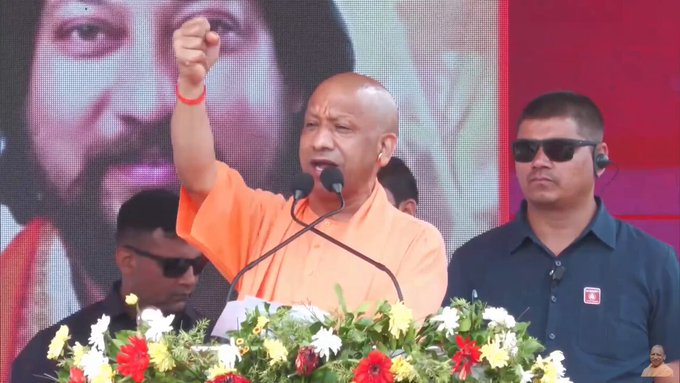
Uttar Pradesh CM Yogi Adityanath campaigns in West Bengal. (Image X.com)
By NIRENDRA DEV
Official figures show 17,043 police encounter operations in Uttar Pradesh since March 2017, while law and order remains central to Yogi Adityanath’s political image.
New Delhi, September 228, 2026 — The “Bulldozer Baba” image has become closely associated with Uttar Pradesh Chief Minister Yogi Adityanath, projecting a tough administrative approach to law and order and crime. He is set to complete 10 years in office in March next year, which would make his tenure one of the longest continuous chief ministerial tenures in Uttar Pradesh.
The UP-112 emergency response system has been presented as a major policing reform, with the system designed to provide prompt integrated emergency response across the state. The UP Police says the system serves more than 22 crore citizens and has a statewide network of control rooms and response personnel.
Police manpower in Uttar Pradesh has also increased substantially since 2017, with a major emphasis on recruitment, including women personnel.
Uttar Pradesh has long struggled with concerns over law enforcement, organised crime and political patronage. The Yogi Adityanath government has made crime control and law and order central themes of its administration.
The “Bulldozer Baba” imagery became particularly prominent during the 2022 local and Assembly election campaigns. The bulldozer came to symbolise the government’s approach of using demolition and enforcement action against properties linked by authorities to alleged illegal activity. Supporters presented it as a symbol of decisive administration, while critics have raised questions about due process and selective enforcement.
Adityanath is the head priest, or Mahant, of the Gorakhnath Temple, making the “Baba” description a natural reference to his religious background. His supporters have combined this image with an emphasis on strong administrative action.
Defence Minister Rajnath Singh has also spoken publicly about the symbolism of the bulldozer, presenting it as more than an instrument of demolition and linking it with decisive governance, infrastructure and action against wrongdoers.
Uttar Pradesh is India’s most populous state and sends 80 members to the Lok Sabha. Its political importance has been reflected in Narendra Modi’s decision to represent Varanasi in Parliament. Muslims constitute a significant minority of the state’s population.
At the same time, the state’s record on crime against women remains an important part of any assessment of law and order. NCRB data for 2024 recorded 66,396 crimes against women in Uttar Pradesh, while 3,209 rape cases were registered in the state.
NCRB data also showed that Uttar Pradesh accounted for 92 of the 275 custodial rape cases registered nationally between 2017 and 2022, the highest number among states, followed by Madhya Pradesh with 43.
The constitutional and political debate surrounding Uttar Pradesh extends beyond the state. Encounter policing, punitive demolitions and laws dealing with religious conversion have increasingly become part of political discourse.
The encounter figures are particularly significant. According to official figures released by the Uttar Pradesh government in May 2026, the state police conducted 17,043 encounter operations between March 2017 and 2026. The operations resulted in 289 alleged criminals being killed, 34,253 arrests and 11,834 injuries. Eighteen police personnel were killed and 1,852 were injured during these operations.
The 17,043 operations over roughly nine years work out to an average of about five encounter operations a day. The figure refers to encounter operations, not five people killed every day. The 289 deaths amount to roughly one death in an encounter every 11–12 days.
The government has described the policy as part of its “zero tolerance” approach to crime. The scale of the encounter operations has nevertheless generated continuing debate about policing, accountability and due process.
In 2018, 48 people were reported killed in encounters, of whom 30 were Hindus and 18 Muslims. In 2020, 120 people were killed, including 47 Muslims. By 2024, police data showed 67 Muslims among 205 people killed in encounters.
The government and BJP have maintained that police action is determined by alleged criminal conduct rather than religious or caste identity. The broader political debate, however, continues to examine the manner in which encounter policing is used and the safeguards surrounding such operations.
There has also been controversy around enforcement of Uttar Pradesh’s anti-conversion law. According to reports citing government figures, 833 people were arrested under the law between January 2021 and April 2026. Christian groups monitoring the law reported 475 cases and 855 arrests in 2025 alone, although these figures come from different sources and should not be treated as directly comparable.
The law-and-order record therefore remains central to the political image built around Yogi Adityanath. The encounter figures, police recruitment, emergency-response infrastructure and enforcement measures are among the statistics cited by the government and its supporters, while crime against women, custodial offences, encounter deaths and questions of due process remain part of the wider public debate.
Fact sheet
- In 2017-18, the CAG reported significant shortages in police infrastructure and manpower in Uttar Pradesh.
- Forensic Science Laboratories in Lucknow, Agra and Varanasi had more than 15,000 pending cases, according to the figures cited in the original material.
- The 2013 Muzaffarnagar riots resulted in deaths, displacement and extensive social disruption.
- The BJP came to power in Uttar Pradesh in March 2017 after campaigning on, among other issues, a promise to end “Gundaraj”.
- Since March 2017, official figures cited by the state government show 17,043 encounter operations, 289 deaths, 34,253 arrests and 11,834 injuries.
(This is an opinion piece. Views expressed are the author’s own.)
Follow The Raisina Hills on WhatsApp, Instagram, YouTube, Facebook, and LinkedIn




About The Author