Bullet Train Project: Is Frequent Change of MD Slowing the Pace?
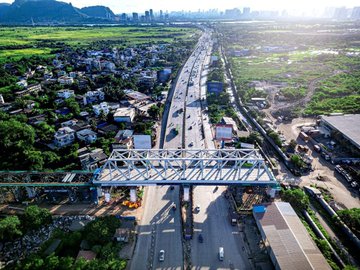
Leadership continuity has emerged as another issue in the implementation of India's Mumbai-Ahmedabad Bullet Train project. (Image Railways)
By Gulshan Rai Khatri
NHSRCL is set to get a full-time MD after more than a year, raising questions about leadership continuity in the Mumbai-Ahmedabad Bullet Train project.
New Delhi, September 28, 2026 — The Mumbai-Ahmedabad Bullet Train project has often been in the news for delays and controversies, besides its technological and infrastructure ambitions. Now, the National High Speed Rail Corporation Limited (NHSRCL), the company implementing the project, is set to get a full-time Managing Director again after nearly one-and-a-quarter years.
The Government of India has recently ordered the appointment of Anjum Parvez, who has been holding the post as an additional charge, as the full-time Managing Director for two years from October 1. Interestingly, Parvez will be the fifth Managing Director of the company in nine years. On average, this means an MD has had a tenure of only around one-and-a-half years.
Delays in land acquisition, the Covid-19 pandemic and other obstacles have often been cited as reasons for the slow progress of the bullet train project. However, frequent changes at the top of the implementing agency can also affect continuity and decision-making, potentially becoming one of the factors behind delays.
NHSRCL has seen frequent changes at the top
The National High Speed Rail Corporation was incorporated by Indian Railways on February 12, 2016, to implement high-speed rail projects. After its formation, Achal Khare became its first Managing Director and assumed charge on April 18, 2017. He remained in the position until June 30, 2021.
During Khare’s tenure, the initial work on the project progressed, including designing and the land acquisition process. Despite several hurdles, efforts were made to move the project forward. Tendering began for locations where land was available, and construction of pillars also started.
However, Khare’s tenure was not extended in 2021. Satish Agnihotri was appointed Managing Director on July 1, 2021. He took charge but was removed from the post after around a year, despite having been appointed for three years. At the time, allegations of corruption against Agnihotri were cited as a reason for his removal.
After Agnihotri, Rajendra Prasad, then the company’s Project Director, was given charge of the organisation on July 7, 2022. He continued to hold additional charge as Managing Director until February 2024.
Vivek Kumar Gupta was appointed Managing Director on February 5, 2024, but his tenure lasted only until July 2025. After Gupta’s departure, Project Director Anjum Parvez was given additional charge of the MD’s post. He has continued in that role since then.
The government has now decided to appoint Parvez as full-time Managing Director for two years from October 1.
In the nine-year history of NHSRCL, Khare remains the only Managing Director to have completed a five-year tenure. None of the subsequent MDs completed a three-year term, while two of them held the post only as an additional charge.
Why continuity at the top matters
In large infrastructure projects, the Managing Director plays an important role as a link between the implementing company and the government. The MD is responsible not only for the organisation’s day-to-day functioning but also for monitoring the project, identifying obstacles and suggesting measures to address them.
A stable leadership structure can provide continuity in decision-making and execution. Conversely, frequent changes at the top can require new leadership to familiarise itself with ongoing decisions, priorities and challenges.
The question, therefore, is whether the frequent changes in leadership at NHSRCL have had an impact on the pace of the bullet train project.
Delhi Metro offers a contrasting example
The Delhi Metro Rail Corporation (DMRC) provides a contrasting example of leadership continuity. DMRC was incorporated in 1995, at a time when India had limited experience with metro systems of this scale, particularly in densely populated urban areas. Sreedharan was appointed Managing Director on November 4, 1997. His tenure was extended several times, and during his leadership the first phase as well as lines under the second phase were constructed.
Sreedharan remained MD for nearly 14 years. He eventually sought to step down citing his advancing age. The government accepted his decision and also considered his recommendation for his successor. He was subsequently retained as an adviser to the Delhi Metro.
Mangu Singh succeeded Sreedharan and took charge on January 1, 2012. He remained Managing Director until March 31, 2022—nearly ten years. Vikas Kumar has been serving as MD since April 1, 2022.
Thus, over more than three decades, DMRC has had only three Managing Directors.
Two government companies, different leadership patterns
Both NHSRCL and DMRC are government-owned companies, although they operate under different administrative structures. NHSRCL is a company of Indian Railways, while DMRC comes under the Ministry of Housing and Urban Affairs.
The difference in the tenure patterns of their top executives raises a larger administrative question: for complex, long-term infrastructure projects, does continuity in leadership contribute to more consistent execution?
The bullet train project has faced several documented challenges, including land acquisition and the disruption caused by Covid-19. But leadership stability is another factor that deserves examination when assessing the pace of a project expected to transform India’s high-speed rail network.
Mumbai-Ahmedabad Bullet Train: Is Japan’s Tied Loan a Benefit or a Burden?
Follow The Raisina Hills on WhatsApp, Instagram, YouTube, Facebook, and LinkedIn




About The Author