Modi’s Diwali Milan With Delhi Journalists: When Access to Power Replaces Accountability
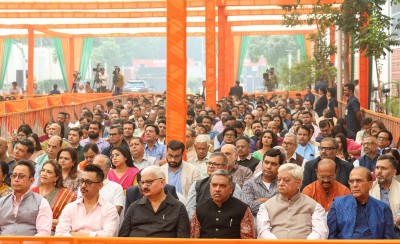
Modi’s interaction with journalists at the BJP’s Diwali Milan has prompted questions about media independence and political accountability. (Image Modi on X)
By MANISH ANAND
Political analyst questions the culture of political proximity at the BJP’s Diwali Milan, arguing that journalists missed an opportunity to confront the Prime Minister and Home Minister on pollution, press freedom and democratic accountability.
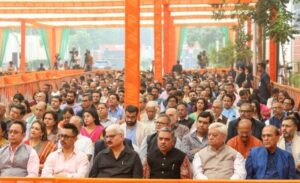
New Delhi, November 12, 2026 — A few days ago, an editor-ranked journalist at a Diwali Milan, hosted by Delhi unit of the BJP, showed a state of ecstasy after dragging hookah deep to the amazement of accompanying ministers in Delhi government. On Thursday, the BJP beat reporters and editors in Delhi showed their indulgences in admiration of Prime Minister Narendra Modi, almost copying behaviour of Bhakts of Baba Bageshwar and others of his tribe, at the Diwali Milan hosted by the BJP at its headquarters.
Journalists sat in absolute devotional poses at the venue. When the Prime Minister walked around, through staged U-shaped bandobust, to apparently allow journalists to unleash their selfie animal instincts, Media’s men and women went overboard: making reels, capturing selfies, and expressing personal bonds with the prime minister with undiluted joys.
While a large sections of the attending journalists at the Diwali Milan rejoiced their fleeting moments with the prime minister, the air outside said: My Name is Grey.
The skyline in the national capital has been carpeted with thick smog, with air smelling foul. Stand in an open air for 10-minute and feel how Delhi seems in arms of depression.
Obedience should ideally be least of a virtue for journalists in countries where press lives by its mandate: working only for the people, for the right of freedom of speech and freedom is borrowed by the press from citizens. But journalists at BJP’s Diwali Milan showed an extraordinary scale of obedience: turning into an obedient listener and asking with devotional poses only what was seemingly desired by the host.
Modi told the faithful audience that the “media should focus on positive works of the government.” Journalists obediently didn’t bother to confront the prime minister on his government’s abundant failure in denying Article 21 of the Constitution, the Right to Life, to the people by being a mute spectator to Delhi’s air turning dangerous year after year since him assuming charge in the national capital.
Some of the faithfuls sat around a table with Union Minister for Home Affairs Amit Shah. This is a pattern in the BJP’s key media events where ministers take tables to allow access to journalists to ask gentle questions.
In place of asking why scores of journalists faced police detention while they covered protests in Delhi, they asked: when is the delimitation bill coming, per an X post shared by Congress leader Jairam Ramesh, who claimed that the Home Minister boasted of passing the women’s reservation bill with a margin of 16-18 votes.
Faithfully, the media reported a special session of parliament in the works, diligently arguing that Monsoon session isn’t yet prorogued, which allows summoning special session at a short notice.
The last press annual dinner in the US was cancelled due to a security breach. A few of the American journalists invited international opprobrium for carrying wine bottles after the event was cancelled.
In Delhi, a large section of media has abandoned their principal mandate long ago to become “Modi Bhakts” without inviting international opprobrium.
Possibly, the world already knows that Indian journalism shines in rarity, while the rot is already accounted for the near bottom ranking in the world press freedom ranking.
(This is an opinion piece. Views expressed are the author’s own.)
Follow The Raisina Hills on WhatsApp, Instagram, YouTube, Facebook, and LinkedIn




About The Author