Book Review: ‘When America Roared’ Makes a Sweeping Case for the 1980s as Our Origin Story
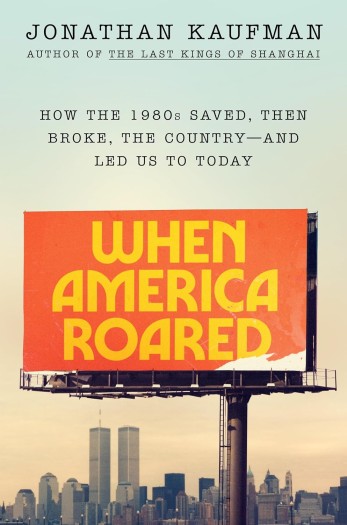
‘When America Roared’ by Jonathan Kaufman: Book Review (Image Amazon)
By TRH Book Desk
Pulitzer Prize-winning journalist Jonathan Kaufman argues the Reagan-era boom simultaneously saved and broke America, seeding both the country’s economic dynamism and its present-day inequality.
New Delhi, September 27, 2026 — “When America Roared: How the 1980s Saved, Then Broke, the Country—and Led Us to Today,” published by Viking on September 15, is Jonathan Kaufman’s attempt to locate the 21st century’s roots in a single, contradiction-filled decade — and its early reception suggests a book more admired for its ambition and reporting instincts than for breaking genuinely new ground.
Kaufman’s thesis, as laid out in publisher materials, is stark: America in January 1980 was a country in visible decline — inflation raging, interest rates above 20%, hostages held in Iran, the Soviet Union invading Afghanistan, Japanese manufacturing outcompeting American industry.
A decade later, the picture had inverted: the economy boomed, the Soviet empire was collapsing, and American business had regained its competitive edge.
Kaufman’s case is that “the market dynamism of the Reagan years broke the stagnation of the late 1970s, then generated the inequality and populist discontent that define the 2020s” — treating the decade’s triumphs and its long-term costs as two sides of the same transformation rather than separate stories.
The book builds that argument through a “character-driven narrative,” according to promotional copy carried by book blogger Bargain Sleuth Reviews, following figures across business, media, and politics — from corporate leaders reshaping American industry to organizers including Karen Nussbaum and Jane Fonda revitalizing the women’s movement, Evan Wolfson building the legal groundwork for the gay rights movement, and a young Barack Obama cutting his teeth as a Chicago community organizer.
Kaufman, whose reporting career included eyewitness coverage of Tiananmen Square and the fall of the Berlin Wall, folds those firsthand experiences into the book as well.
Where Critics Credit the Book
Kirkus Reviews’ assessment, cited across multiple retailer listings, praised specific reporting achievements even while withholding full-throated enthusiasm, singling out Kaufman’s portrait of Mark Fowler, Reagan’s first FCC chairman, as “his freshest and most interesting contribution.”
The New York Times Book Review offered a more general endorsement, describing how Kaufman “draws together a bushel of figures who thrived in one fateful decade,” providing “useful insights along the way.”
A review aggregated on Goodreads engaged with the book’s structure and its place among comparable works most substantively, situating it “in the nearest literary neighbourhood” alongside Gary Gerstle’s “The Rise and Fall of the Neoliberal Order” and George Packer’s “The Unwinding” — while distinguishing Kaufman’s approach as “more insistently reportorial” than either: “He wants the room where a decision is made, the person making it, then the jobs, contracts, audiences, courtrooms and communities altered outside the door.”
That reporterly instinct, the review argued, “gives ‘When America Roared’ much of its speed” — while also introducing what it called “occasionally its false confidence,” noting pointedly that “a room can show where a decision occurred more easily than it can prove where history began.”
The same review credited Kaufman specifically for how he handles the temptation to make the book a direct origin story for Donald Trump’s political rise, writing that “making Trump the destination would reduce the decade to another origin story about the present,” and that Kaufman instead “leaves him where he belongs in this book: not the answer, but evidence that several currents can meet without agreeing on who deserves credit for the river.”
Where Critics Pushed Back
The most consistent critical thread across reviews is scepticism about the book’s originality rather than its craft. Book Marks’ aggregation of reviews quoted one assessment stating plainly that “there are useful insights along the way, though none are mind-blowing, and some are banal; and some are incorrect” — a notably blunt formulation for a book otherwise generating warm coverage.
That same review was specific about where Kaufman’s account falters, writing: “it is frustrating, however, to see how much Kaufman gets wrong about one of the important consequences of this deregulation: the rise of right-wing shock jocks like Rush Limbaugh.”
Book Marks’ aggregation also surfaced a structural critique, arguing “When America Roared is best once Kaufman abandons the market-forged manacles of the ‘decade’ conceit and turns to his own life story” — suggesting the book’s strongest material may be its most personal rather than its most panoramic.
A related assessment, also aggregated by Book Marks, offered a measured summary verdict: Kaufman’s book is “a useful guide to the ‘80s impact on today, though not a notably novel one,” adding that “readers already familiar with the foregrounded people and trends will notice that he doesn’t find a plethora of original angles.”
Follow The Raisina Hills on WhatsApp, Instagram, YouTube, Facebook, and LinkedIn




About The Author