Book Review: ‘Supremacy’ Argues the Supreme Court’s Power to Overrule Congress Was Seized, Not Given — And Traces Two Centuries of Fights Over It
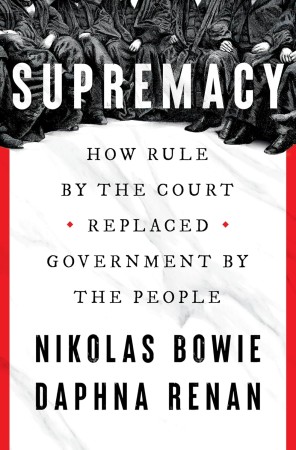
Two Harvard Law professors argue the Supreme Court’s power to strike down federal laws was never in the Constitution — it was seized. (Image Amazon)
By TRH Book Desk
Harvard Law professors Nikolas Bowie and Daphna Renan build a meticulously researched case that “judicial supremacy” has no constitutional foundation. Reviewers call the history genuinely revelatory — even as some note the authors’ own framework may be less sweeping in practice than its title suggests.
“Supremacy: How Rule by the Court Replaced Government by the People,” published September 15 by W.W. Norton, is the new book from Harvard Law professors Nikolas Bowie and Daphna Renan — a 320-page argument that the Supreme Court’s authority to strike down acts of Congress was never written into the Constitution, and that the modern assumption otherwise is the product of a specific, traceable historical struggle rather than a settled constitutional design.
The book’s central claim, as the publisher’s own description puts it, is that Americans widely assume the Supreme Court “has always had the power to decide what the Constitution means and to strike down any act of Congress that violates the justices’ dictates” — but that this assumption is historically false.
Bowie and Renan argue that what they call “judicial supremacy” gained real prominence specifically “in response to Reconstruction, when the Court took it upon itself to safeguard the interests of capital and white supremacy,” rather than emerging as a neutral, eternal feature of American constitutional design.
The New Republic’s review, by Eric Segall, traced the historical mechanics the book lays out: at the 1787 Constitutional Convention, “some Framers intended the Supreme Court to have this authority; others did not,” and delegates who carefully specified the president’s veto power “could not agree that justices should have similar authority” over Congress.
The Court, the review explains, effectively “seized this role early in the nineteenth century” — beginning with Marbury v. Madison in 1803 — “and we’ve accepted it since with only weak protest.”
A Sharper Distinction: “Horizontal” vs. “Vertical” Review
One of the book’s more analytically significant contributions, according to The New Republic’s review, is a specific distinction Bowie and Renan draw between two different things the Supreme Court does.
They label the Court’s power to invalidate acts of Congress “horizontal review” — which they argue has no constitutional basis — while treating the Court’s authority to review the constitutionality of state laws, which they call “vertical review,” as legitimate even when the Court gets a vertical ruling wrong.
That distinction matters for how the book’s argument actually applies to specific, famous cases: The New Republic’s review notes that because many of the Court’s most controversial recent rulings, including Dobbs v. Jackson Women’s Health Organization, concerned state laws rather than federal statutes, “Supremacy’s opposition to judicial review is less radical than it may appear” at first glance — under the authors’ own framework, the Court’s vertical review of Mississippi’s abortion law in Dobbs would have been within its legitimate authority, even if the outcome was wrong.
Book Review: ‘Supermajority’ by Adam Jentleson Makes a Provocative Case for Democratic ‘Heterodoxy’
Turning the Critique on Liberals, Too
Notably, the book doesn’t confine its argument to a simple partisan critique of the current conservative-majority Court. Multiple publisher and bookseller descriptions of the book emphasize that Bowie and Renan explicitly “challenge how even liberals understand the Court’s most celebrated rulings — including Brown v. Board of Education and Roe v. Wade — showing how the left has unwittingly subscribed to the very ideology that now threatens it.”
The New Republic develops this point at length, describing a recurring historical pattern: “when justices were reactionary and cancelled laws that protected African Americans, workers, women, or immigrants, progressives denounced not only the decisions’ substance but the court’s right to make them,” while conservatives made the mirror-image argument whenever liberal justices held sway — meaning both sides have historically invoked and rejected judicial supremacy opportunistically, depending on which outcomes it happened to protect.
Where the Book Sits in the Scholarly Conversation
A review published on Bunk History situated “Supremacy” within a longer academic lineage, noting it “follows the tracks of important works like Larry D. Kramer’s ‘The People Themselves’ (2004), Keith E. Whittington’s ‘Political Foundations of Judicial Supremacy’ (2007), and Barry Friedman’s ‘The Will of the People’ (2009)” — books that have made related arguments about the historically contingent nature of judicial power.
What Bowie and Renan add, according to that review, is a specific observation about who has historically raised these objections: “the loudest protests against horizontal review historically came from abolitionists, labour organizers, suffragists, and civil-rights activists.”
The review credits the authors with sidestepping a common weakness in this genre of argument — “most critics of judicial supremacy stumble over the fact that a strong Court sometimes benefits their side” — by instead “identifying a consistently conservative power of the Court” across two centuries, which the review says allows Bowie and Renan to “vault that obstacle” more convincingly than earlier critiques.
The Constitutional Alternative: Congress, and a “Sleeping Giant” Clause
The book doesn’t stop at historical critique; it also proposes an affirmative alternative. The New Republic highlights the authors’ attention to Article IV’s guarantee to every state of a “republican” form of government, which they — quoting 19th-century Massachusetts Senator Charles Sumner — call a “sleeping giant” clause with underused potential to support a more democratically accountable constitutional order.
More broadly, publisher materials describe the book’s proposed alternative as “democratic constitutionalism,” an approach that would “restore power to where the Constitution put it: Congress,” building on what the authors describe as a “lost constitutional tradition” forged specifically by abolitionists, labour leaders, suffragists, and civil rights pioneers, rather than by sitting judges.
Strong Praise from Legal and Historical Peers
The book has drawn enthusiastic advance praise from prominent voices in law and history. Historian Annette Gordon-Reed, author of The Hemingses of Monticello, called it “essential reading for all who care about our country’s future,” while civil rights lawyer Sherrilyn Ifill praised it as “meticulously researched, powerfully presented, and theoretically sound,” adding that the authors “offer not only irrefutable truth, but a way forward towards a reset of our constitutional order.”
The Authors’ Standing
Both authors bring direct experience inside the institution they’re critiquing. Bowie, the Louis D. Brandeis Professor of Law at Harvard Law School, previously clerked for Justice Sonia Sotomayor; Renan, the Peter B. Munroe and Mary J. Munroe Professor of Law at Harvard, previously clerked for Justice Ruth Bader Ginsburg.
In an interview with Harvard’s Graduate School of Arts and Sciences ahead of the book’s release, Bowie described the alternative framework the book proposes as “democratic constitutionalism” — one that would restore Congress’s central role “in defining and defending Americans’ rights,” rather than leaving that function to the judiciary by default.
Follow The Raisina Hills on WhatsApp, Instagram, YouTube, Facebook, and LinkedIn




About The Author