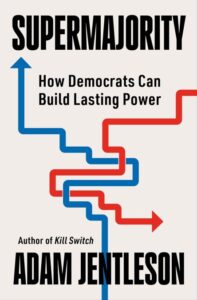
Book Review: ‘Supermajority’ by Adam Jentleson Makes a Provocative Case for Democratic ‘Heterodoxy’
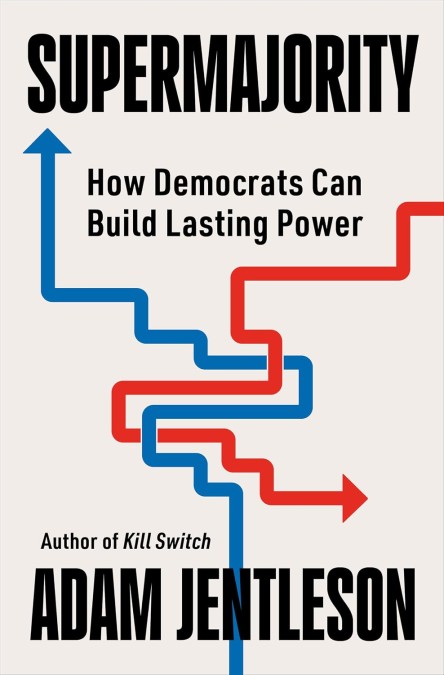
Adam Jentleson's new book argues Democrats need to embrace heterodox" candidates (Image Amazon)
By TRH Book Desk
The former Harry Reid and John Fetterman aide argues Democrats have forgotten how to build the kind of dominant, messy coalitions that once passed the New Deal and the Great Society. His prescription — embracing candidates who buck party orthodoxy — has already sparked a genuine intra-progressive argument before most readers have finished the book.
New Delhi, September 2026 — Adam Jentleson’s “Supermajority: How Democrats Can Build Lasting Power,” published by W.W. Norton, arrives as the follow-up to his well-received 2021 book “Kill Switch,” and has quickly become one of the more argued-over political books of the season — not for its historical research, which reviewers broadly credit as rigorous, but for the contemporary political strategy Jentleson builds on top of it.
According to the publisher’s own description, Jentleson — a two-decade party insider who served as deputy chief of staff to Senate Majority Leader Harry Reid and later as chief of staff to Senator John Fetterman — argues that “periods of stasis almost always break and give way to dominant one-party rule,” and that Democrats, rather than accepting nail-biter elections as the new normal, should be actively building toward the kind of commanding majorities that produced Social Security, the Civil Rights Act of 1964, and the Affordable Care Act.
Bookshop.org notes Jentleson walks readers through earlier Democratic supermajorities — not just Barack Obama’s, but FDR’s in the 1930s and LBJ’s in the 1960s — arguing these coalitions “were messy, never pure,” and that Democrats today have mistakenly convinced themselves ideological purity, rather than big-tent pragmatism, is the path to durable power.
The “Heterodoxy” Thesis, in the Author’s Own Words
The book’s central strategic claim rests on a specific read of the American electorate. In an interview with Washingtonian, Jentleson laid out the concept directly: “A supermajority requires winning moderate voters, but data suggests that moderate voters aren’t centrists. They’re not taking the middle position in the left-right binary. Instead… most moderate voters are ‘heterodox,’” meaning they hold “an eclectic mix of positions from different ideological poles” rather than consistently centrist views.
Jentleson’s own example, given in that interview, illustrates the point: a voter might simultaneously believe “all CEOs who caused the 2007 financial crisis should be thrown in jail” and that “all immigrants should be deported immediately” — two individually extreme positions that, combined, don’t fit a simple left-right spectrum.
His prescription is for Democrats to recruit and embrace candidates who reflect that same ideological unpredictability, rather than demanding uniform adherence to the party platform.
Real-World Test Cases
The book grounds this argument in contemporary examples rather than purely historical ones. Gabe Fleisher’s Wake Up To Politics newsletter, covering an interview with Jentleson for its Book Club series, reported that Jentleson points to Democratic primary voters in swing states already nominating more heterodox candidates — citing Rob Sand and Josh Turek in Iowa and Mary Peltola in Alaska as examples of candidates who’ve broken with party consensus on issues like transgender rights or fossil fuels.
Fleisher’s own assessment framed 2026 as a genuine, falsifiable test of Jentleson’s thesis: “If these candidates win, it might point the way towards a more ideologically fluid party. But if they lose, it suggests the party will have to stretch even further to achieve Jentleson’s hopes” — and Fleisher raised a pointed structural question of his own: “If a coalition from AOC to Fetterman already feels unstable, can it really survive expanding even more in either direction?”
The Pushback from the Left
Where the book has generated its sharpest disagreement isn’t from conservative critics, but from writers who share Jentleson’s basic Democratic sympathies while rejecting his strategic prescription.
A review published on the newsletter Off Message, headlined “This Is How Democrats Talk Themselves Out Of Wielding Power,” pushed back directly on the book’s premise, arguing that Jentleson’s call to “shift our focus to building a supermajority” describes something Democrats are, in the reviewer’s assessment, “already doing” — and that where a genuine tension exists between maximizing electoral breadth and being prepared to actually use power once in office, “democracymaxxing should take precedence” over simply chasing the largest possible coalition.
Journalist Jesse Singal offered a more personal, though still substantively engaged, critique in a widely-discussed Substack post, describing Jentleson as “well-positioned” to offer insight on party strategy while arguing that Jentleson’s own past conduct — specifically citing an episode in which Jentleson had publicly criticized Singal’s own reporting on youth gender medicine — sat in tension with the pluralistic, big-tent openness the book itself advocates for.
Building on a Well-Regarded Foundation
Jentleson’s prior book gives “Supermajority” a credible foundation to build from. “Kill Switch,” his 2021 examination of the modern Senate filibuster, received a generally positive critical reception; Kirkus Reviews described that earlier book as “astute,” “maddening,” and “provocative,” while The Wall Street Journal was more critical, arguing Jentleson’s advocacy against the filibuster during the Biden presidency sat uneasily alongside his former boss Harry Reid’s own use of the same procedural tool while in the Senate majority — a critique of consistency that echoes, in different form, some of the pushback “Supermajority” has now drawn from the left.
Follow The Raisina Hills on WhatsApp, Instagram, YouTube, Facebook, and LinkedIn




About The Author