Trump’s Midterm Defeat Is a Warning for Modi, Not a Victory for India

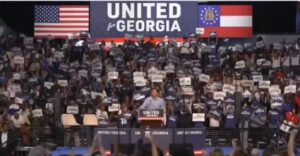
Democrats win US Mid Term elections, wresting back Republican strongholds. (Image video grab.)
By TRH Op-Ed Desk
Manish Anand argues that economic distress, inflation and unemployment—not Indian-American voters—explain the Republican setback, warning that Trump’s foreign policy towards India may become more aggressive.
New Delhi, November 4, 2026 — The Republican Party’s defeat in the US midterm elections should not be celebrated in India as a victory over Donald Trump’s policies. Instead, it offers a political warning to Prime Minister Narendra Modi and the BJP, according to geopolitics analyst Manish Anand.
In a monologue for The Raisina Hills, Anand challenged the argument that Indian-Americans played a decisive role in punishing Trump’s party over its policies on H-1B visas, immigration, tariffs and purchases of Russian and Iranian crude oil.
He described this interpretation as factually incorrect, arguing that Indian-origin Americans constitute only a small proportion of the US population and have limited electoral participation. Indian-American candidates, meanwhile, contested across both Republican and Democratic platforms.
Anand cautioned against assuming that the Republican setback would fundamentally alter Trump’s foreign policy towards India.
Although Congress and the Senate could constrain presidential appointments and budgetary decisions, the US presidency retains substantial executive authority. Consequently, Trump’s defeat would not automatically translate into a significant foreign policy shift.
Anand argued that India’s strategic importance to Washington had already diminished as the US increasingly prioritised managing its relationship with China over military confrontation in the Indo-Pacific. The Middle East, particularly the escalating confrontation with Iran, has become a more prominent focus of Trump’s foreign policy.
He warned that domestic political weakness could encourage Trump to adopt a more aggressive international posture to consolidate Republican support ahead of the 2028 presidential election. India could face renewed tariff or economic pressure as a result.
Anand identified inflation, rising energy costs, unemployment and economic insecurity as the principal reasons behind the Republican setback.
He connected the electoral outcome to a broader international pattern of political instability and electoral reversals affecting governments in several countries.
According to Anand, the lesson for Modi and the BJP is that emotional and rhetorical politics cannot indefinitely substitute for economic performance.
Rising living costs, expensive transportation, healthcare and education, inadequate employment generation and declining affordability could increasingly undermine public support in India.
Anand argued that economic growth must become more inclusive, with tangible improvements in ordinary citizens’ living standards rather than benefits concentrated among industrialists and wealthy sections.
His warning to Modi is clear: Trump’s electoral defeat demonstrates the limits of ideological mobilisation. Unless governments address inflation, employment and everyday economic hardship, political setbacks could eventually reach India as well.
Follow The Raisina Hills on WhatsApp, Instagram, YouTube, Facebook, and LinkedIn




About The Author