Balen Shah’s India Visit: Sidelining the Thorns for Pragmatism
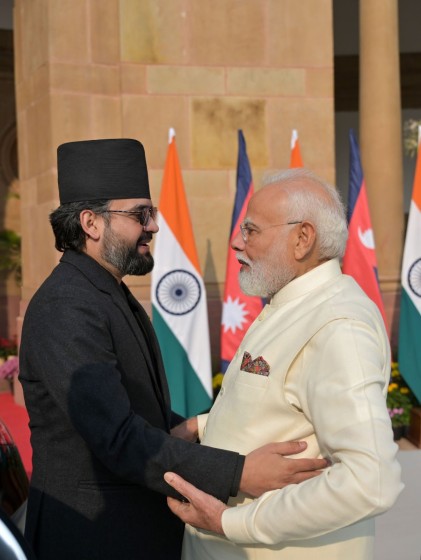
Balen Shah's New Delhi visit places economic cooperation and connectivity at the centre of India-Nepal relations. (Image Modi on X)
Editorial
Nepal’s Prime Minister prioritises economic assistance, trade and connectivity over contentious border issues during his first overseas visit, as Kathmandu confronts financial pressures and China’s growing economic footprint.
Nepal Prime Minister Balen Shah’s first overseas visit followed custom. He chose New Delhi. Shah broke from the recent regional trend seen in Dhaka—where consecutive leaders turned to Beijing early—by choosing New Delhi for his first bilateral trip. Shah ticked all the boxes for good relations between India and Nepal, with 1800-km open border and the people bound by culture and history.
Shah may be critiqued for dropping his earlier hawk image. As a mayor in Kathmandu, Shah amplified Greater Nepal narrative, displaying an ambitious map. He berated Nepali politicians for not sufficiently pressuring India to hold serious border talks. In New Delhi, Shah did not raise sensitive issues and focussed on the economy.
The Nepali Prime Minister chose pragmatism over rhetoric in New Delhi. Reasons may not be visible but they’re well known. The US has chosen to abandon its responsibilities for aid for many nations, including Nepal.
Shah may also be watching Bangladesh closely. Students’ protests ousted Sheikh Hasina, but the street in Dhaka is still squirming. Economy is driving the unrest, as past norms of the global trade and free movement of the professions are ruptured.
Priority for Shah-led dispensation in Kathmandu is to pay attention to the state of the economy. That too when the Himalayan nation has just recently been rocked by devastating earthquakes. The cost of the reconstruction is indeed overwhelming.
Nepali commentators rightly expected that Shah will raise border issues with Prime Minister Narendra Modi. Shah had mainstreamed Lipulekh, Kalapani, and Limpiyadhura as cornerstones of India and Nepal relations. As the mayor of Kathmandu, Shah may not have been aware of the exceedingly slow wheel of border talks. India and China border talks could be an exemplar, which cannot be even compared to a snail’s pace.
Hawks in Kathmandu also wanted Shah to hit the deck hard in New Delhi on other sensitive issues such as revision of the 1950 Treaty of Peace and Friendship, stalled Pacheshwar project, tariff barrier, air connectivity to airports at exorbitant costs in Nepal, including Pokhara and Bhairahawa. Nepal is saddled with huge debts to China in building these airports, which commentators have described as a text-book case of Beijing’s debt-trap policy.
But India has agreed for making Kathmandu-Bhairahawa-Lucknow route bidirectional. Pokhara stays out of focus. India has concerns on some of the segments of Nepali exports.
India’s Parliament had released a report by a standing committee which had documented challenge to Indian tea growers because of counterfeit exports from Nepal. China’s capacity to make bases in other nations when faced with tariff barriers is well-known in the global trade. The shadow of China looms large in Nepal, in commerce and goods.
Yet India by announcing a ₹240 billion package for Nepal has provided a major relief to Shah. ₹56 billions come as grants, which must ease economic tensions in Kathmandu.
Also, India offered access to Kandla and Paradeep ports, with the caveat that connectivity is sorted out. A train from Ayodhya in India to Janakpur in Nepal adds to the package.
Shah was accorded guard of honour by the Gurkha regiment of the Indian Army. The message is clear: the people on both sides of the border are blood-brothers. New Delhi’s message to Kathmandu also seems clear: Be a brother and not an enabler of geopolitical stress.
Follow The Raisina Hills on WhatsApp, Instagram, YouTube, Facebook, and LinkedIn




About The Author