China’s Cold Shoulder to Sanae Takaichi at APEC: Airport Reception Sparks Internet Storm
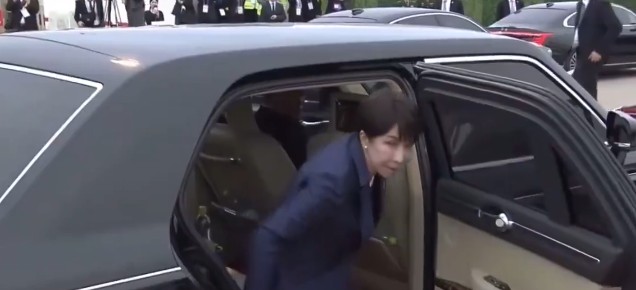
Sanae Takaichi's subdued arrival in Shenzhen has drawn scrutiny amid strained China-Japan relations. (Image video grab)
By TRH World Desk
Japan PM’s quiet arrival in Shenzhen, a retired diplomat’s reception and viral footage of aircraft boarding stairs have fuelled questions over whether Beijing deliberately humiliated Tokyo at APEC.
New Delhi, November 23, 2026 — A diplomatic reception can sometimes say more through what is missing than what is displayed. Japanese Prime Minister Sanae Takaichi’s arrival in Shenzhen for the APEC summit has become a viral talking point, with social media users scrutinising everything from the absence of cheering crowds to the official who greeted her and even the aircraft boarding stairs.
Videos comparing airport receptions for visiting leaders have drawn massive online interest, with the Japanese prime minister’s arrival standing out for its conspicuously subdued atmosphere.
On November 18, leaders from several countries arriving in Shenzhen were welcomed with groups of young people, music, flowers and enthusiastic displays. Russian President Vladimir Putin, South Korean President Lee Jae-myung, Australian Prime Minister Anthony Albanese and other visiting leaders received visibly more elaborate receptions.
Takaichi, by contrast, arrived to a relatively quiet scene. She was greeted by former Chinese ambassador to Greece Zhang Qiyue, rather than the senior serving provincial officials who received several other visiting leaders.
The contrast with South Korea’s Lee was particularly striking. Lee was welcomed by Lin Keqing, chairman of Guangdong’s provincial committee of the Chinese People’s Political Consultative Conference, alongside other officials. Takaichi’s reception was markedly less prominent in diplomatic protocol.
Japanese and international media highlighted the disparity. Fuji News Network and other broadcasters showed footage of the different airport arrangements, bringing the issue into wider public discussion. The reception was interpreted as a visible reflection of the deterioration in China-Japan relations.
But the controversy did not end with the reception.
Footage attributed to Japanese broadcaster Fuji TV circulated online, with users claiming that the boarding stairs positioned beside Takaichi’s aircraft were unusually short, leaving a conspicuously larger gap between the aircraft door and the top of the stairs. The visual comparison triggered allegations that the arrangement was deliberate and potentially disrespectful.
While the footage has fuelled speculation about the intent behind the stair positioning, the allegation that Chinese ground personnel deliberately lowered the stairs to insult or endanger the Japanese leader remains unverified. The images alone cannot establish intent.
The political backdrop, however, is unmistakable.
China-Japan relations have deteriorated following Takaichi’s parliamentary remarks concerning a possible Taiwan contingency and Japan’s potential response. Beijing reacted sharply to her comments, which it interpreted as interference in a sensitive sovereignty issue. The controversy has spilled into diplomatic exchanges, public rhetoric and growing nationalist sentiment.
The reported threat made by a Chinese diplomatic official in Japan against Takaichi following her Taiwan remarks further intensified the political atmosphere, although the airport reception itself is a separate episode.
In diplomacy, silence can sometimes be louder than a speech. In Shenzhen, the silence around Takaichi’s arrival became the story.
Key Takeaways:
Protocol as political messaging: The rank and status of airport greeters can carry diplomatic significance.
A stark visual contrast: Takaichi’s arrival lacked the crowds and musical welcome seen in footage of several other leaders.
The Lee comparison: South Korea’s presidential reception made the differences more visible and amplified online attention.
The staircase allegation remains unverified: Viral footage raises questions but does not establish deliberate lowering or hostile intent.
Taiwan is the underlying fault line: Takaichi’s remarks on a possible Taiwan contingency have contributed to deteriorating relations.
A viral diplomatic moment: Airport footage and short clips transformed protocol details into a worldwide political discussion.
Xi Jinping’s Shenzhen Vision: China Pitches Asia-Pacific Integration Amid Global Fragmentation
Follow The Raisina Hills on WhatsApp, Instagram, YouTube, Facebook, and LinkedIn




About The Author