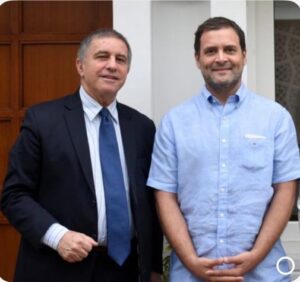
Gaza, Israel and Congress: Why Rahul Gandhi’s Statement Has Triggered Political Storm
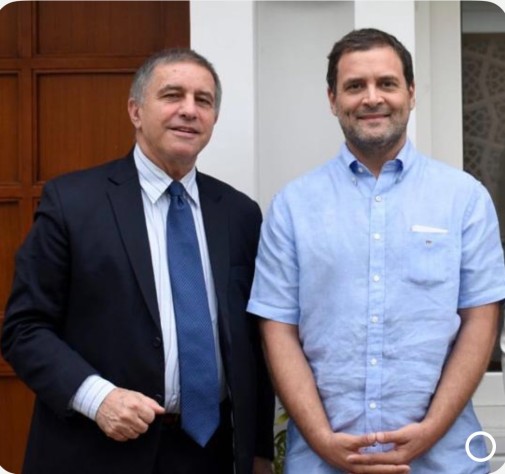
Rahul Gandhi's Israel remarks have sparked a political debate within the opposition over strategic partnerships, Gaza and India's foreign policy. (Image Carmon on X)
By AMIT KUMAR
Rahul Gandhi defended India’s strategic relationship with Israel while condemning the October 7 attacks and the war in Gaza, drawing sharp criticism from Pinarayi Vijayan and Dipankar Bhattacharya and reopening debate over Congress’s own Israel policy legacy.
New Delhi, November 23, 2026 — Rahul Gandhi’s defence of India’s strategic ties with Israel, alongside a call to keep speaking out on Gaza, has opened a fault line in the opposition. The Left is attacking him, and critics are asking whether Congress’s rhetoric matches its record.
At the University of Chicago, Rahul said India should keep a strong relationship with Israel, including on defence procurement, without letting strategic interests silence criticism of the Gaza war. He condemned the October 7 attacks and said one wrong cannot justify another. Defence cooperation and condemnation of civilian suffering, he argued, are not mutually exclusive.
The criticism is awkward for the party. P.V. Narasimha Rao’s Congress government established full diplomatic ties with Israel in 1992, and cooperation on defence, agriculture, technology and intelligence deepened under the UPA. Rahul’s stance echoes a continuity that has survived changes of government. Yet Congress messaging on Gaza has stressed Palestinian rights and humanitarian concerns, leaving a gap between legacy and rhetoric.
Kerala Chief Minister Pinarayi Vijayan accused Rahul of hypocrisy, calling stronger defence ties indefensible amid Gaza’s devastation. Invoking Nehru’s anti-imperialism, he said there could be no diplomatic balancing when humanity was on trial. The attack has an electoral edge, since Congress and the Left compete directly in Kerala.
CPI(ML)’s Dipankar Bhattacharya went further, arguing India cannot have an independent foreign policy while courting what he called a genocidal regime. He compared such ties to partnerships with Nazi Germany or apartheid-era South Africa. He cited arms supplies, Adani-group trade and Israeli surveillance technology as damaging India’s credibility and democratic institutions.
The divide is clear. Rahul says strategic partnership can coexist with moral criticism. Bhattacharya says the partnership itself undermines the moral position.
Priyanka Gandhi Vadra’s visible Palestine advocacy, including the “Palestine” handbag she carried into Parliament, makes the contrast easy to exploit. Yet the two positions can coexist: backing Palestinian rights while keeping diplomatic and defence ties. The charge is that Rahul sounded too cautious when opponents wanted unequivocal condemnation.
Commentator Saba Naqvi reads, as shared in a post on X, the remarks as deliberate: a signal to Israel and its US supporters that a Congress-led government would not dismantle strategic ties.
Does Congress want to present itself as a governing alternative with a foreign policy built on national interest and strategic autonomy, or define itself by ideological opposition to the Modi government’s partnerships? Israel is a hard test. On one side are defence, intelligence, technology and agriculture. On the other are Gaza’s humanitarian crisis and calls for stronger condemnation.
The irony is that Rahul is attacked for a position resembling the bipartisan direction of India’s Israel policy for three decades. He must now explain whether this is a defence of strategic autonomy or a balancing act that leaves both sides unconvinced.
Follow The Raisina Hills on WhatsApp, Instagram, YouTube, Facebook, and LinkedIn




About The Author