Palestine ‘36 — Film Review: A Film That History Demanded
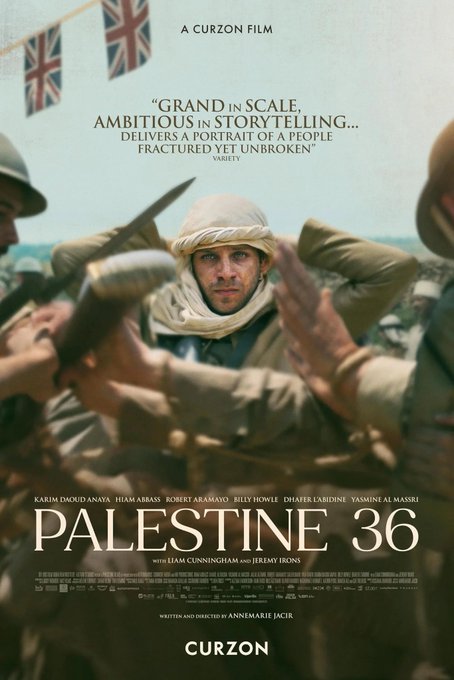
Palestine ‘36 film poster.
★★★★ | A Courageous, Overdue Act of Historical Memory
Directed by Annemarie Jacir | 1hr 59min | Historical Drama | 2025
By TRH Entertainment Desk
Mumbai, April 30, 2026 — There are films that arrive at exactly the right moment, and then there are films that were always necessary — films that history demanded, even if the world took decades to commission them. Annemarie Jacir’s Palestine ‘36 belongs firmly in the second category. Set in 1936, as villages across mandatory Palestine rise against British colonial rule, it follows Yusuf, a young man who drifts between his rural home and the restless energy of Jerusalem, longing for a future beyond the growing unrest. What unfolds over nearly two hours is not merely a period drama but an act of cinematic defiance — a people telling their own story, on their own land, in their own words.
That the film exists at all is something close to miraculous. Production began in early 2023 in the Palestinian territories, moved to Jordan after the October 7 Hamas attacks on Israel, and returned to the territories in 2024 to finish its shoot, becoming the first feature film made by Palestinians since the beginning of the war. The film had its world premiere at the 2025 Toronto International Film Festival, receiving a 20-minute standing ovation. That reception was not mere festival enthusiasm — it was recognition of something profound and rare.
A Tapestry of Lives Under Siege
Jacir wisely resists the temptation to funnel this sprawling historical moment through a single protagonist. The film follows a tapestry of characters from distinct walks of life — Khalid (Saleh Bakri), a humble worker turned revolutionary; Khouloud (Yasmine Al Massri), a journalist from the upper class; and Yusuf (Karim Daoud Anaya), a gentle young man from a small village who works in the city and bears witness to the whole picture as he crosses checkpoints daily.
If there is one character closest to filling the role of protagonist, it is Yusuf. He inhabits multiple worlds within the Palestinian reality, eventually surrendering both pastoral life and urban prospects to take up arms. His journey is the film’s emotional spine — quiet, accumulative, and devastating.
The performances are uniformly excellent, with true ensemble work where each actor complements his screen partners. Hiam Abbass and Saleh Bakri, both luminaries of Palestinian cinema, bring lived-in gravity to every frame. Jeremy Irons and Liam Cunningham lend measured gravitas to the British imperial presence. The one casting misstep, as noted by several critics, is the portrayal of the British military antagonist — Robert Aramayo’s villainous British military captain is somewhat caricatured in both writing and performance. It is a rare blunt note in an otherwise finely calibrated ensemble.
Form and Technique
One of Jacir’s most inspired touches is her use of colourized and restored archival footage in long and medium shots, integrated with the new footage. The scenes in bustling city streets and seaside scenes remind us that Palestine was very much a land with a people. This choice is not merely aesthetic — it is political and philosophical. It insists on continuity, on the undeniable material reality of a civilization that existed, thrived, and was disrupted.
The presence of an antique Turkish pistol in Arab hands becomes a motif that ties several characters together and arrives late in the film with a Chekhovian flourish. Such moments of disciplined storytelling elevate the film beyond polemic into genuine drama.
The cinematography captures both the sun-bleached beauty of the Palestinian landscape and the creeping menace of colonial infrastructure with equal care. Jacir never lets her politics overwhelm her craft — though the film wears its perspective openly and unapologetically.
History as Mirror
The film zeroes in on how the British established the infrastructure for the oppression of Palestinians, and draws pointed parallels with British imperial tactics used in India and Ireland — pitting national groups against each other and terrorizing civilians. For contemporary audiences watching this in 2026, those parallels land with considerable force.
The title itself is a political statement. It situates the Palestinian plight not as a recent occurrence, but as a process of dispossession that has been in motion long before the Nakba in 1948. This contextualisation is the film’s most important contribution — it gives history a timeline that extends the conversation far beyond the familiar flashpoints.
The film has not been without controversy. It has been banned for screening in Jerusalem, and critics from certain quarters have argued that it reduces the complexity of the 1936 revolt into a morality play of colonial cruelty and Arab resistance, with Jewish characters in the background as largely voiceless figures. These are legitimate points of critical engagement, and the film does not pretend to offer every perspective with equal weight. Jacir has been transparent: this is, in her words, the Palestinian point of view of that period.
Verdict
Palestine ‘36 is not a flawless film. It can be didactic, its pacing occasionally sluggish, and its ensemble structure sometimes works against deep individual characterisation. As an overdue tale of history, it functions more as a blunt instrument than a novelistic endeavour. But its broad, rooted passions earn their place entirely.
On Rotten Tomatoes, 98% of critics’ reviews are positive, with the consensus calling it “a sweeping yet intimate historical epic that demands careful attention to its intricately woven storytelling, rewarding viewers with a humanist, clear-eyed act of remembrance.”
That assessment is fair. Palestine ‘36 is important cinema — not because importance excuses artistic shortcomings, but because here, importance and artistry genuinely coexist. It is a film about people who were told their story did not matter, made by people who refused to accept that verdict. In 2026, with the world watching Palestine again, it demands to be seen.
Cast: Karim Daoud Anaya, Hiam Abbass, Saleh Bakri, Yasmine Al Massri, Jeremy Irons, Liam Cunningham, Robert Aramayo, Dhafer L’Abidine
Director/Writer: Annemarie Jacir
Available on: Prime Video | Theatrical release ongoing
Follow The Raisina Hills on WhatsApp, Instagram, YouTube, Facebook, and LinkedIn




About The Author