EU Warns of Global Fallout from Strait of Hormuz Tensions
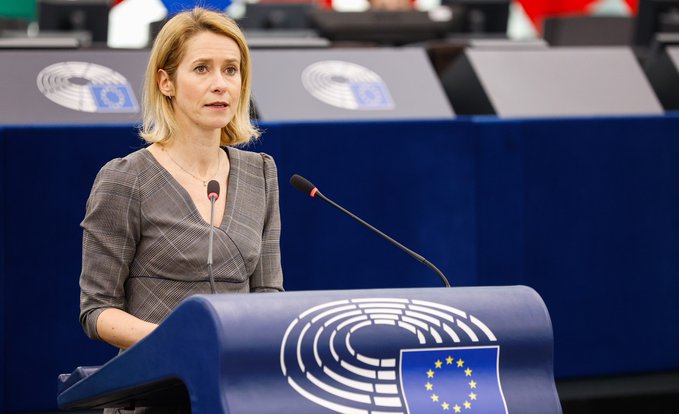
Kaja Kallas, EU High Representative for Foreign Affairs and Security Policy, speaks in EU Parliament (Image Kallas on X)
Kaja Kallas says freedom of navigation is “non-negotiable” as Europe eyes tougher sanctions on Iran and stronger defence posture against Russia
By TRH World Desk
New Delhi, April 30, 2026 — Kaja Kallas, the European Union’s High Representative for Foreign Affairs and Security Policy and Vice-President of the European Commission, has warned that escalating tensions in the Strait of Hormuz are having far-reaching global consequences, with no quick resolution in sight.
Speaking at a high-level meeting of EU foreign ministers, Kallas said the ongoing standoff is impacting the global economy, energy flows, and geopolitical stability. “There is no swift exit from the standoff in the Strait of Hormuz… and the consequences are negative across the board,” she said.
According to Kallas, disruptions in the vital shipping corridor are already reverberating worldwide. She noted that the global economy is “reeling,” while higher oil prices are benefiting Russia by boosting its revenues. At the same time, delays in US weapons deliveries to Nordic and Baltic countries are adding to Europe’s security concerns.
Emphasising the EU’s position, Kallas stated that “freedom of navigation is non-negotiable” for Europe. She confirmed that EU foreign ministers have agreed to expand sanctions against Iran over its actions affecting maritime movement. She also indicated that EU naval operations could be scaled up to help restore energy and trade flows through the region.
Kallas further underlined that concerns over Iran’s nuclear and missile programmes, along with its alleged support for militant groups, cannot be sidelined. “These issues cannot be put on the backburner,” she said, signalling a tougher European stance.
Turning to the war in Ukraine, Kallas reiterated the EU’s strong backing for Ukraine in its ongoing conflict with Russia. She said that with sustained Western support, Ukraine has managed to push Russian forces into a stalemate, fundamentally reshaping modern warfare.
“With the EU’s €90 billion loan and the 20 sanctions package, we have sent a clear message—we will provide Ukraine what it needs to hold its ground,” Kallas said. She added that Russia is suffering significant battlefield losses, with its war objectives increasingly failing to materialise.
Highlighting symbolic indicators of Russia’s challenges, Kallas pointed out that Moscow’s upcoming Victory Day parade is expected to take place without heavy military equipment. “This tells a lot about how the war is going for Russia,” she remarked.
Kallas also warned of the long-term threat posed by Russia, particularly through hybrid warfare tactics such as cyberattacks, disinformation campaigns, and sabotage. “Too often Moscow sees hybrid warfare as cost-free, but we need to change that calculation,” she said.
She outlined a multi-pronged EU response, including additional sanctions, accountability for war crimes, and further international isolation of Russia. Measures to restrict the movement of former combatants and strengthen cyber resilience are also under consideration.
According to Kallas, Russia is preparing for a prolonged confrontation with the West, making it essential for Europe to bolster its defence capabilities. “Deterrence works if it is credible. Showing weakness only invites aggression,” she said.
She stressed the need for increased defence spending, closing capability gaps, and expanding Europe’s defence production capacity. Calling for a stronger European role within NATO, Kallas said, “A more European NATO is long overdue.”
In a clear message on future relations, she asserted that there can be no return to normal ties with Russia, even after the war ends. EU foreign ministers are expected to continue discussions on long-term strategy towards Russia at an upcoming meeting in Cyprus.
As geopolitical tensions rise across multiple fronts, Kallas’s remarks underline Europe’s effort to navigate a complex global landscape marked by energy insecurity, military conflict, and shifting alliances.
Follow The Raisina Hills on WhatsApp, Instagram, YouTube, Facebook, and LinkedIn




About The Author