Mumbai’s Coastal Road was built for faster movement. It was never built for reckless speed
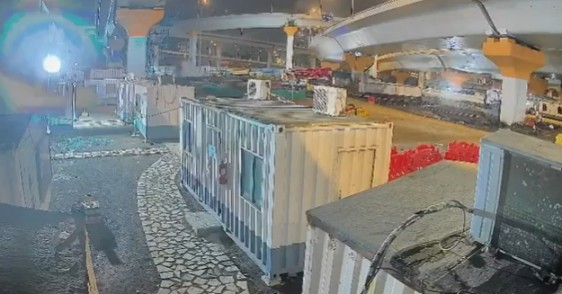
The latest BMW crash on Mumbai’s Coastal Road has renewed concerns over speeding and luxury-car driving. (Image video grab)
By AMIT KUMAR
The BMW crash that killed three young men exposes a recurring problem: luxury performance cars, open stretches of road and a culture that too often treats public roads as private racetracks
Mumbai, September 20, 2026 — Mumbai’s Coastal Road was conceived as an answer to congestion. But barely two years into its operation, the stretch is increasingly becoming a test of something else: whether speed, expensive performance cars and weak enforcement can coexist without eventually producing a fatality.
The latest warning came early Sunday.
Three people were killed and another critically injured after a BMW travelling from Marine Drive towards Haji Ali crashed near Lotus Jetty, opposite Lala Lajpatrai College. The vehicle reportedly lost control at high speed and plunged from the elevated section. The accident occurred at around 5.20 am on September 20.
The victims included 21-year-old Shanay Gajjal and 17-year-old Dhirya Seth. A third man, reported to be about 25, was also declared dead, while another 20-year-old remained critically injured, according to reports citing BMC and police sources.
Reports have also put the BMW’s alleged speed at more than 200 kmph. That figure should be treated as part of the investigation until supported by police evidence, vehicle data or forensic reconstruction. But even without settling the precise number, the central issue is clear: speed appears to have been a major factor under investigation.
And this is where the latest tragedy becomes more than another road accident.
The Coastal Road has already seen repeated luxury-car incidents
In March 2025, a BMW M340i crashed into the barriers of the Coastal Road near Worli after being filmed overtaking another vehicle at high speed. Police booked the driver for rash and dangerous driving.
In September that year, a Lamborghini skidded into a divider on the Coastal Road. Police cited the wet road as a possible factor and said the driver lost control.
In July 2026, a Porsche travelling at high speed hit the central divider, collided with an Ertiga and crossed into the opposite carriageway. A minor in the other vehicle was injured. Police booked the driver for rash and dangerous driving and ordered a blood test as part of the investigation.
Then, earlier this month, Mumbai Police registered a case after video footage allegedly showed six or seven high-end cars, including Lamborghinis and BMWs, racing or over speeding inside the Coastal Road tunnel.
These incidents do not establish that luxury cars as a category are responsible for Mumbai’s road-safety problem. Nor does every crash involving an expensive car have the same cause.
But taken together, they raise a legitimate question about behaviour behind the wheel.
When a public road starts looking like a racetrack
A high-performance car can accelerate far beyond what an ordinary urban road requires. That capability is not itself dangerous. The danger begins when the machine’s capability is combined with public traffic, limited reaction time, changing road conditions and a driver willing to push beyond safe limits.
The Coastal Road creates a particularly tempting environment.
It is relatively new, broad and visually open. At certain hours, traffic can be light. For someone behind the wheel of a powerful car, the psychological temptation to accelerate can be considerable.
But the road remains an urban public facility.
The documented speed limits reported for the Coastal Road are 80 kmph on straight stretches, 60 kmph in tunnels and 40 kmph at turns.
A road designed to permit smoother traffic is not automatically a road designed for unrestricted high-speed driving.
The answer cannot simply be another warning after another crash.
If videos of supercars racing on the same road can circulate before police action, the system needs stronger preventive mechanisms. Speed cameras, automatic number-plate recognition, average-speed monitoring, targeted night patrols and swift penalties can make enforcement less dependent on whether a police officer happens to witness the offence.
There is also a larger cultural problem.
A luxury car is increasingly marketed not merely as transport but as a performance object. Social media adds another layer, turning acceleration, speedometers and spectacular driving into content.
That creates an incentive structure in which speed can become a form of display.
The answer is not to demonise BMWs, Porsches or Lamborghinis. It is to insist that the performance of a machine does not override the rights of everyone else using the road.
Mumbai has seen this movie before
The concern is not limited to the Coastal Road.
The 2024 Worli BMW hit-and-run case became one of Mumbai’s most closely watched road-crime investigations after a BMW allegedly hit a couple on a two-wheeler, killing Kaveri Nakhwa. The case also intensified public scrutiny of the relationship between luxury vehicles, young drivers, privilege and accountability.
In September 2024, a BMW also struck Ganesh mandal volunteers in Mulund, killing one person and seriously injuring another; police later arrested the vehicle’s owner, according to contemporary reports.
The latest Coastal Road crash is therefore not an isolated conversation about one BMW.
It is about whether Mumbai’s roads are becoming an arena where engineering capability is advancing faster than driving discipline and enforcement.
Three lives have now been lost in a matter of seconds.
The Coastal Road was meant to save time.
It should not become a place where the pursuit of speed ends up costing lives.
Follow The Raisina Hills on WhatsApp, Instagram, YouTube, Facebook, and LinkedIn




About The Author