“The Industry Is On Fire”: Three Indian Semiconductor Stocks Riding the $2 Trillion Bet — And What the Numbers Actually Show
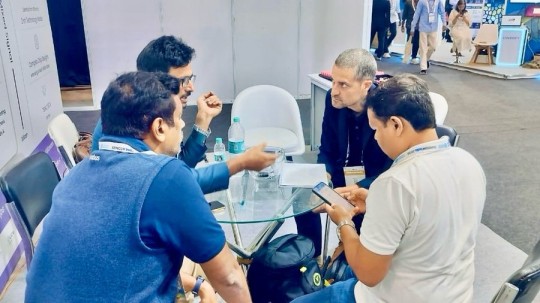
3 Indian Semiconductor Stocks Riding the $2T Chip Boom (Image Moschip on X)
By S. JHA
SEMI’s CEO just doubled his own forecast for the global chip industry. A forensic look at Kaynes Technology, CG Power, and MosChip Technologies — three of India’s most closely watched semiconductor-linked stocks — shows genuine momentum, but also very different risk profiles hiding behind a shared narrative.
Mumbai, September 20, 2026 — “I said the semiconductor industry would be worth $1 trillion by 2030. I was wrong. We already crossed $1 trillion last year. We’ll be at $2 trillion by 2030,” Ajit Manocha, President and CEO of industry body SEMI, told the audience at SEMICON India 2026 in New Delhi this week.
Manocha, who previously ran GlobalFoundries, said the global market could reach $1.3-1.4 trillion this year alone before doubling by 2030, driven overwhelmingly by AI-related demand for advanced processors and memory. That declaration, delivered as Prime Minister Narendra Modi inaugurated the September 17-19 event, sent a wave of buying through India’s listed semiconductor-linked stocks.
A closer look at three of the most prominent names shows that wave rests on genuinely different foundations.
Kaynes Technology: The Highest-Profile Bet, and the Most Volatile
Kaynes Technology India (NSE: KAYNES) rose 5.2% to ₹3,563 on the opening day of SEMICON India 2026 — but that gain came against a brutal backdrop: shares remain down 51% year-on-year from a peak of ₹7,705, even after the bounce.
The strength of Kaynes’s semiconductor story is concrete and forward-looking. The company is building an Outsourced Semiconductor Assembly and Test (OSAT) facility in Sanand, Gujarat, with an investment of ₹3,307 crore, focused on wire-bond interconnect and substrate-based packaging, according to Upstox.
Business Standard reported commercial production at the facility began in March 2026, with the company targeting over ₹1,500 crore in semiconductor-specific revenue by FY28 — meaning Kaynes has already moved past the announcement stage into actual output, a milestone several of its peers haven’t yet reached.
The weakness is transparency. IndMoney was direct on this point: “Kaynes does not yet provide semiconductor revenue and profitability as clearly as CG Power does. That means investors currently cannot easily determine how much of Kaynes’ growth is coming from the new semiconductor business” — a genuine limitation for anyone trying to value the stock specifically on its chip ambitions rather than its broader electronics manufacturing base.
Technically, analyst Pradip Halder of PHD Capital, quoted in Business Today, described the stock as having formed “a double bottom” after correcting sharply from its 2025 peak, and said he’s waiting for a weekly close above ₹3,915 — which would open targets of ₹4,560 and ₹5,700 — before turning “decisively bullish,” with a stop loss suggested at ₹3,165.
One governance positive: Kaynes’ monitoring agency reports on its QIP fund utilization, filed per SEBI regulations, confirmed “no material deviations” in how proceeds are being deployed.
Jefferies Picks 3 Stocks for India’s Industrial Boom: Kaynes, Bharat Forge, Siemens Energy
CG Power: The Diversified Giant With Semiconductor Optionality
CG Power and Industrial Solutions (NSE: CGPOWER) offers a fundamentally different risk profile — a large, established electrical equipment conglomerate with a semiconductor bet layered on top, rather than a company betting its identity on chips.
At a market capitalization of roughly ₹1,36,898 crore, per TradeBrains, CG Power dwarfs both Kaynes and MosChip in scale.
The company’s OSAT venture, run through subsidiary CG Semi in partnership with Japan’s Renesas Electronics and Thailand’s Stars Microelectronics, represents a ₹7,600 crore investment in Sanand, Gujarat, according to Upstox — and it’s further along than most competitors: Equitymaster noted pilot production had already begun, and Prime Minister Modi himself cited CG Semi, alongside Micron and Kaynes, as one of just three companies to have already commenced semiconductor production in India, in his August 15 Independence Day address.
Crucially, this bet sits on top of a genuinely healthy core business. Equitymaster reported CG Power’s Q3 FY26 consolidated net sales rose to ₹3,175.4 crore from ₹2,515.7 crore a year earlier, with net profit climbing to ₹283.9 crore from ₹237.9 crore — solid, double-digit growth in the company’s existing power and industrial systems business, independent of how the semiconductor bet plays out.
Upstox separately reported the company’s total order book stood at ₹14,953 crore as of Q2 FY26, driven by power systems demand. The trade-off for investors is clear: CG Power offers lower semiconductor-specific torque than a pure-play, but a much larger, cash-generating existing business cushioning the OSAT investment’s long gestation period.
MosChip Technologies: The Purest Play, With the Thinnest Margins
MosChip Technologies (NSE: MOSCHIP) is the smallest of the three by far — a market capitalization of roughly ₹4,067 crore, per Screener.in — and the most conceptually “pure” semiconductor stock, since it doesn’t carry the capital-intensive fab or OSAT manufacturing burden of the other two.
The Hyderabad-based company designs chips directly: turnkey ASICs, mixed-signal IP, and semiconductor engineering services, according to its own description via Yahoo Finance. Shares rose more than 6% to ₹212.95 on the opening day of SEMICON India 2026, and analyst Pradip Halder separately named MosChip his “preferred semiconductor pick” for investors specifically seeking design-side exposure rather than manufacturing exposure.
The financial picture, however, is decidedly mixed. Equitymaster shows MosChip’s Q3 FY26 revenue grew from ₹126.2 crore to ₹149.4 crore year-on-year — genuine top-line growth — but net profit fell sharply over the same period, from ₹11.1 crore to just ₹4.3 crore.
Investing.com shows some recovery, with net income rising from ₹4.34 crore to ₹7.95 crore quarter-on-quarter, but the company’s trailing twelve-month net profit margin remains thin at just 6.02%, with a gross margin of only 13.51% — notably low for a company positioning itself as a semiconductor design and IP business, where margins are typically much fatter than in manufacturing.
Screener’s data shows the stock trading at 9.89 times book value despite paying no dividend, and separately flags that promoter holding sits at just 39.3% — lower than many Indian small-caps in similarly narrative-driven sectors.
Perhaps most pointedly, financial analytics platform Tijori Finance’s independent assessment of the stock included a direct caution: “Retail has been buying the stock which is usually a sign of exuberance.”
(This article is intended for informational purposes only and is not investment advice. Readers should conduct their own due diligence or consult a SEBI-registered financial advisor before making investment decisions.)
Follow The Raisina Hills on WhatsApp, Instagram, YouTube, Facebook, and LinkedIn




About The Author