In 1962, Xi Jinping’s father was purged. The experience shaped the man who now leads China
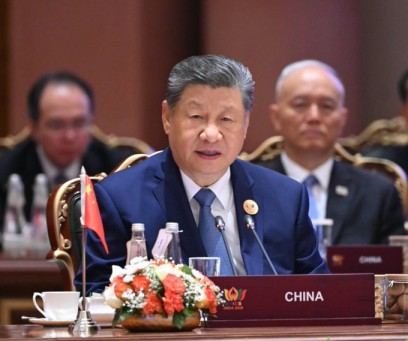
Xi Jinping's political worldview was shaped by his family's experience during Mao's era and his own years of rural hardship. (Image Xu Feihong on X)
By NIRENDRA DEV
Xi Jinping’s childhood was marked by political persecution, Cultural Revolution turmoil and the collapse of the Soviet Union — experiences that help explain his determination to protect the Communist Party from internal challenge
New Delhi, September 20, 2026 — A lot is being written and rewritten today about China. But the principal protagonist in the country’s geopolitical and political theatre remains President Xi Jinping. It is therefore important to take a closer look at the man, his upbringing and the political journey that brought him to the top.
Xi Jinping comes from a powerful political background. His father, Xi Zhongxun, was a senior Communist Party leader and later a vice-premier. But the family’s privileged position changed dramatically in 1962, when the elder Xi fell from political favour and was sent into internal exile. During the Cultural Revolution, he was publicly humiliated, interrogated and imprisoned for years.
The younger Xi was also caught in the turmoil.
At the height of the Cultural Revolution, Xi Jinping was denounced as a “counter-revolutionary”. His mother was forced to participate in the political denunciation of her own son, according to accounts of his childhood. His half-sister reportedly died by suicide after intense political pressure and persecution.
Xi was eventually sent to Liangjiahe in Shaanxi as part of Mao Zedong’s campaign to send young people to the countryside for “re-education”. He spent seven years there, doing hard manual labour and living in a cave dwelling. Xi later described those years as formative, saying that he went to the countryside confused but left with a clearer sense of purpose.
This background is crucial to understanding Xi Jinping.
Xi and his politics: knowing the man
Xi was not simply a beneficiary of Communist Party privilege. He was simultaneously a “princeling” — the son of a senior party leader — and a victim of the political upheavals that destroyed his family’s position.
That contradiction appears to have been important in shaping his politics.
Analysts have argued that Xi’s experience taught him a particularly powerful lesson: political survival depended on remaining within the Communist Party rather than challenging it from outside.
“His father was a liberal, but he went to jail. To avoid his father’s fate, Xi learned to do things in an opposite fashion,” China watcher Willy Lam was quoted as saying by The Guardian.
Prof Michel Bonnin, an expert on the Cultural Revolution, similarly argued that Xi learned that being a loyal Communist could provide a path to survival and advancement even after the party had inflicted suffering on his family.
Xi reportedly applied for Communist Party membership seven times before finally being admitted.
He did not turn against the organisation that had presided over some of the darkest experiences of his youth. Instead, he entered its ranks and steadily climbed the political ladder.
The Soviet lesson
There was another historical trauma that appears to have influenced Xi’s political worldview: the collapse of the Soviet Union in 1991.
Accounts of Xi’s thinking have pointed to the Soviet collapse as a warning about what happens when a Communist Party loses ideological control and political cohesion. Xi has therefore sought to strengthen, rather than loosen, the authority of the Communist Party.
In that sense, Xi Jinping has been determined not to become China’s Mikhail Gorbachev.
A campaign against corruption, combined with renewed ideological discipline and tighter party control, became central features of Xi’s leadership after 2012.
The political logic was straightforward: the party must remain stronger than the forces that could challenge it.
Xi Jinping Just Purged His Closest Military Ally. Why This Purge Is Different
The Bo Xilai episode and Xi’s rise
When Xi emerged as China’s next leader, the Communist Party was facing significant internal challenges.
The Bo Xilai scandal exposed serious weaknesses within the party’s political system and raised questions about corruption, elite rivalry and ideological divisions.
In 2012, Jean-Pierre Cabestan, a Hong Kong-based scholar, described China as being at a delicate moment, facing the need for an alternative growth model while the government confronted powerful economic and regional interests.
The question at that time was whether Xi could provide the strong leadership the party required.
In retrospect, the answer is clear in one respect: Xi rose through the system at precisely the moment when the Communist Party was looking for greater political discipline.
His national-level rise began to gather momentum in the 1990s. In 1997, at the 15th National Congress of the Communist Party, he became an alternate member of the Central Committee after finishing last in the election, according to contemporary biographical accounts. He subsequently moved through Fujian and Zhejiang, became Shanghai party chief in 2007 and entered the Politburo Standing Committee in 2007.
His background therefore worked in two directions.
It gave him access to the political elite, while his years in the countryside helped create an image of a leader who had experienced hardship.
From reform-era China to Xi Jinping Thought
By 2017, Xi’s politics and foreign policy were increasingly associated with a more activist posture.
The 19th National Congress of the CCP in October 2017 was widely interpreted as demonstrating the extraordinary concentration of political power Xi had achieved since taking office in 2012.
The phrase “Xi Jinping Thought” was incorporated into the party’s political doctrine, while Xi’s leadership increasingly departed from the collective-style politics that had emerged after Mao’s death.
Xi’s approach also reflected his determination to prevent what he regarded as the ideological and organisational failures that contributed to the Soviet collapse. His government strengthened ideological controls, tightened the party’s influence over society and sought to reinforce the Communist Party’s centrality in Chinese political life.
This was not simply a domestic political project.
It also had consequences for China’s foreign policy.
India and the question of strategic pressure
The tensions with India, particularly since the Doklam crisis in 2017 and the Galwan clash in 2020, need to be viewed against this larger backdrop.
It would be too simplistic to conclude that Xi “needed” a conflict with India merely to divert attention from domestic problems. Such a claim requires evidence about political intent that is difficult to establish.
But there is little doubt that Xi’s China has adopted a much more assertive approach to national security, territorial questions and China’s position in the region.
The disputes involving Taiwan and the South China Sea — including competing claims involving the Philippines, Vietnam, Malaysia, Brunei and others — form part of a much wider strategic picture.
For India, the lesson is important: Xi Jinping’s political upbringing and his understanding of Communist Party survival are relevant to understanding China’s strategic behaviour.
Xi Jinping vs Zhang Youxia: A Reckoning Inside China’s Military
“This shows the mind of the man”
Xi has repeatedly emphasised party discipline, constitutional authority and law-based governance. At the same time, under his leadership, political power has become increasingly concentrated around the Communist Party and Xi himself.
His anti-corruption campaign was one of the most visible instruments of this consolidation.
Xi once used a striking metaphor while discussing the need to constrain corruption: “One must build a good cage. If the cage is too loose … that is of no use.”
The metaphor captures an important element of Xi’s political philosophy: power must be disciplined, but discipline must operate within a system ultimately controlled by the party.
That is why Xi’s childhood and formative years matter.
He experienced the chaos of the Cultural Revolution. His father was purged. His family suffered. He himself was sent to the countryside. Yet instead of rejecting the Communist Party, he became deeply invested in preserving its authority.
The lesson, as some historians and analysts have interpreted it, was not that the party itself was the problem. It was that the party could not afford to lose control.
The man behind China’s rise
Xi married Ke Lingling in the early 1980s, but the marriage ended in divorce after several years. He later married the well-known singer Peng Liyuan, whose public profile added another dimension to Xi’s political image.
But the personal story is ultimately secondary to the political one.
Xi Jinping’s journey was shaped by privilege, persecution, rural hardship, ideological indoctrination and political survival.
His experience in Liangjiahe became part of the official narrative of endurance and service to the people. Yet independent accounts suggest that the formative lessons were considerably more complicated.
It is therefore difficult to understand today’s Xi Jinping without understanding the young Xi Jinping who witnessed the destruction of his family’s political standing.
He emerged from one of China’s darkest political periods not as an opponent of the Communist Party, but as one of its most determined defenders.
As Xi himself said in 2012, his responsibility was to lead the party and the country’s various ethnic groups while pursuing the “great revival of the Chinese nation”.
That remains central to understanding his politics.
For India and the wider world, underestimating Xi Jinping’s political will or his commitment to the Communist Party would be a mistake. His upbringing does not explain every decision he makes, nor does it prove the motives behind particular foreign-policy actions.
But it does provide an important window into the worldview of the man who has accumulated more political power in China than any leader since Mao Zedong.
And in the ultimate context of India’s relationship with China, one is reminded of a line often quoted from a Bengali play: “Every war or struggle is for power; and the power can never do good to anybody.”
Streaming in China Now: Glory of Xi Jinping’s Father Xi Zhongxun
Follow The Raisina Hills on WhatsApp, Instagram, YouTube, Facebook, and LinkedIn




About The Author