Mohan Bhagwat in New York: ‘Obey Us and We’ll Protect You’—A Veiled US Policy Dig?

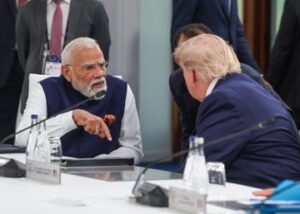
RSS chief Mohan Bhagwat in New York (Image RSS on X))
By NIRENDRA DEV
RSS chief Mohan Bhagwat’s New York address combined spiritual philosophy with a message on diaspora responsibility, pluralism, materialism and global fraternity, while his remarks on those who demand obedience raised questions about a possible geopolitical subtext.
NEW YORK: “Human beings can think. If you think the right way, you can go nearer to God,” Rashtriya Swayamsevak Sangh (RSS) chief Mohan Bhagwat said in New York, delivering a philosophical message on human responsibility, pluralism, materialism and the idea of India’s role in the world.
Bhagwat’s remarks, however, also contained a sharper political undertone when he contrasted two approaches to human society: “Live and Let Live” and the idea that only those who obey a particular power deserve protection.
“Those who say, if you obey us, we will protect you … they are Rakshashas (monsters),” Bhagwat said, drawing applause from the audience.
The remarks raise an obvious question: Was Bhagwat making a veiled reference to the coercive dimensions of great-power foreign policy, including the U.S. approach to international relations since the 1970s?
The speech itself does not identify the United States or any specific American foreign-policy doctrine in this context. Therefore, any connection to U.S. foreign policy remains an interpretation rather than an established reference.
Bhagwat: ‘Think Rightly’ and Move Towards the Divine
Bhagwat began with a distinction between human beings and the animal world.
“Human beings can think. If you think the right way, you can go nearer to God,” he said.
Conversely, he argued, wrong thinking could pull human beings towards their animal instincts.
He illustrated the point with the example of a cow grazing until it is full. The animal, he said, does not possess the human capacity to think about preserving resources for tomorrow.
The larger message was that human existence carries a responsibility that goes beyond immediate gratification.
Bhagwat invoked the Indian philosophical formulation: “Nar karni karey to Narayan ban jae … ulti karni karey toh kya ban jae”—underscoring that human action and direction determine the path one takes.
“A direction is important,” he said.
‘You Are America’: Bhagwat’s Message to the Indian Diaspora
In one of the clearest portions of his address, Bhagwat spoke directly about the responsibilities of Indians living overseas.
“You are in America. You live in America. You earn in America. So you are America, and you should behave true to America,” he told the audience.
The message was framed around the Indian concept of karmabhumi, or the place where one performs one’s work.
Bhagwat’s argument was that Indians living and working in other countries must respect and remain loyal to the societies in which they have made their lives.
The remark is significant because it places diaspora identity within a broader framework of civic responsibility: cultural roots can remain Indian while one’s obligations towards one’s country of residence must also be honoured.
‘Live and Let Live’ Versus ‘Obey Us’
Bhagwat then moved from individual responsibility to the nature of societies and nations.
“Everyone searches [in] pursuit of happiness, that is common for all,” he said.
According to Bhagwat, humanity has followed two broad tendencies.
One is “Live and Let Live.”
The other is “Live and let only those Live who Obey Us.”
It was in explaining the second tendency that Bhagwat used his strongest language.
“Those who say, if you obey us, we will protect you. Those will be protected who only obey … they are Rakshashas,” he said.
The line received applause.
Whether this was intended as a commentary on a particular country’s foreign policy is not clear from the speech. Yet the formulation inevitably invites a geopolitical reading because the language of obedience, protection and power is central to debates over international relations and great-power behaviour.
Was There a Message for Washington?
Bhagwat did not explicitly identify the United States as the target of this particular criticism.
That distinction is important.
His remarks can be read at two levels. At one level, they constitute a philosophical distinction between coexistence and domination. At another, the timing and location of the speech—New York—make it difficult to ignore the possible geopolitical implications.
The reference to those who promise protection only in exchange for obedience can be interpreted as a critique of any political or international system based on conditional allegiance.
But without a direct reference to Washington or a specific U.S. policy, it would be premature to describe the remarks as an explicit attack on American foreign policy.
What is clearer is Bhagwat’s preference for a world order based on fraternity, mutual respect and pluralism rather than coercion.
‘We Are One’: Bhagwat’s Message of Unity in Diversity
Quoting Swami Vivekananda, Bhagwat said every nation has its own unique destiny.
He argued that Bharat’s role is to realise the principle of unity in diversity and help the world understand it.
“We are one. And due to diversity, that oneness is decorated. So, diversity has to be celebrated,” he said.
This formulation lies at the centre of Bhagwat’s broader argument.
Diversity, in this worldview, is not necessarily a threat to unity. Rather, diversity gives expression to an underlying unity.
He contrasted this with approaches that judge individuals primarily on whether they obey, listen to or serve a particular authority.
“What you think about me, how much useful you are to me? These are very minor things. Major thing is we are all human beings,” Bhagwat said.
The emphasis was therefore shifted from utility and allegiance to fraternity.
Material Happiness Has a Limit
Bhagwat also turned his attention to another defining feature of contemporary life: material consumption.
Using an example that would resonate with his New York audience, he spoke about donuts.
“How many donuts I can have at a time, I don’t know,” he said, before adding that he is diabetic.
He used the exaggerated hypothetical example of consuming 50 donuts in one sitting to make a larger philosophical point: when does abundance stop producing additional happiness?
“The donut is the same, what changed?” he asked.
The point was not about donuts themselves but about the limits of material gratification.
According to Bhagwat, material happiness is transitory, and abundance eventually reaches a point where it cannot provide proportionately greater satisfaction.
The argument echoes a longstanding Indian philosophical emphasis on restraint and the distinction between material possession and inner fulfilment.
‘We Belong to Each Other’
Bhagwat’s alternative to materialism was not withdrawal from the world.
Instead, he emphasised interconnectedness.
“We belong to each other,” he said.
He argued that human life has a purpose beyond individual accumulation and personal achievement.
“In Bharat, the concept is you have been given life to utilise it to obtain the truth,” he said, invoking the spiritual idea of liberation.
He also referred to “Jagat Hitayo”—the welfare of the entire world—as a purpose of human life.
The message, therefore, was simultaneously spiritual and social: individual fulfilment should ultimately contribute to the welfare of the wider world.
Dharma Is More Than Religion
One of the most consequential portions of Bhagwat’s speech concerned the meaning of Dharma.
He argued that Dharma, in the ancient Indian philosophical understanding, should not simply be equated with religion or worship.
Rather, it is the principle that sustains the universe and helps human beings navigate the dualities of life.
“It is the rule by which the universe is sustained,” Bhagwat said.
He described it as a principle of balance—one that allows the individual, society and the surrounding environment to progress together.
This also formed the basis of his argument against two opposing extremes: the idea that an individual can prosper while society remains suppressed, or that society can progress only by suppressing individuals.
Individual and Society Must Progress Together
For Bhagwat, the ideal social order is one in which the individual, society and the environment progress together.
That formulation expands the meaning of development beyond economic growth.
An individual’s prosperity cannot be isolated from the wellbeing of society, just as collective progress cannot be achieved by suppressing individual freedom and dignity.
The principle of balance therefore runs through much of Bhagwat’s speech—from material consumption and spiritual satisfaction to individual rights and social responsibility.
Pluralism in America, Unity in Diversity in Bharat
Bhagwat concluded by drawing an interesting conceptual parallel between the United States and India.
“When discussing the United States of America, one word that frequently comes up in conversation is ‘pluralism’,” he said.
“For the people of Bharat,” he added, “both this unity and this diversity are ingrained in their very DNA.”
The formulation was significant in New York, a city that represents extraordinary demographic, cultural and religious diversity.
Bhagwat’s message was ultimately not framed as a rejection of diversity but as an argument for celebrating it.
His emphasis was that people should not be reduced to whether they obey a particular authority or serve a particular interest.
They are, first and foremost, human beings with a shared responsibility towards the world.
A Philosophical Speech With a Geopolitical Subtext?
Bhagwat’s New York address can therefore be read as more than a spiritual discourse.
Its central themes—think rightly, live and let live, reject coercion, celebrate diversity, limit materialism and work for the welfare of the world—form a philosophical argument about how individuals and societies should conduct themselves.
The “Rakshashas” remark is likely to attract the most political attention because of its language of obedience and protection.
But the speech itself does not establish that Bhagwat was specifically targeting U.S. foreign policy.
The more defensible reading is that Bhagwat was presenting an Indian philosophical framework in which power without fraternity, prosperity without restraint and unity without diversity are all incomplete.
And in a city at the heart of the global political and financial system, the message carried an unmistakable wider resonance: Human beings have the ability to think. The question is what they choose to do with that ability.
Mohan Bhagwat in America: Indian-American Democrats Split the Diaspora
Follow The Raisina Hills on WhatsApp, Instagram, YouTube, Facebook, and LinkedIn




About The Author