Mark Minervini Sees S&P 500 Rebound Ahead of Trump-Xi-Putin Summit
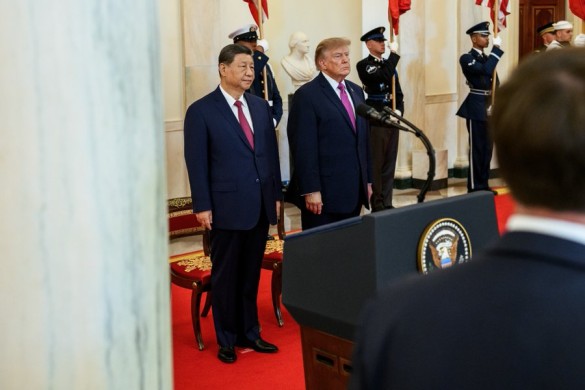
Chinese President Xi Jinping's state visit to Washington this week produced striking images, a handful of trade gestures (Image White House)
By S. JHA
The celebrated US trader sees year-end seasonality and presidential-cycle patterns supporting a potential market recovery, even as the S&P 500’s extended bull run raises questions about the durability of the rally.
Mumbai, November 17, 2026 — A potentially important shift in sentiment may be approaching on Wall Street. Mark Minervini, the US stock trader and market analyst, has indicated that he is looking for an opportunity to cover his profitable short position in the S&P 500, anticipating that the ongoing correction could give way to another upward move.
The timing is particularly interesting. Minervini believes that a combination of year-end seasonality, historical presidential-cycle trends and the upcoming meeting between US President Donald Trump, Chinese President Xi Jinping and Russian President Vladimir Putin could provide a favourable backdrop for equities.
In a post on X, Minervini said he remained short but was looking for an opportunity to take profits, possibly sooner rather than later. His reasoning was that the likelihood of an impending upward move was increasing.
A mature bull market, but historical tailwinds remain
Minervini acknowledges that the current bull market is already long in the tooth, describing it as the fifth-longest on record. Ordinarily, that would make investors cautious about assuming that the broader rally has much further to run.
However, he points to historical market behaviour during the US presidential election cycle.
According to the statistics cited by Minervini, the S&P 500 has not recorded a negative return in the calendar year following a midterm election since 1950. He also highlights the average 17.2% gain in presidential pre-election years, with a significant proportion of those gains historically concentrated in the first half.
The market’s seasonal performance is not uniform throughout the presidential cycle. If the historical pattern holds, the first half of a pre-election year could be stronger than the second.
Minervini argues that these trends, together with year-end seasonality, create a favourable environment for equities. His qualification is equally important: the Federal Reserve must not move into a rapid monetary tightening cycle. A sharp change in interest-rate expectations could undermine the bullish case.
The broader implication is that the current correction could prove relatively short-lived, provided monetary conditions remain supportive.
Trump, Xi and Putin’s Power Triangle: Is India Losing Its Strategic Space?
Can a superpower summit trigger a market rebound?
Minervini also draws attention to an unusual historical pattern involving major diplomatic meetings between world powers.
With Trump, Xi and Putin scheduled to meet in Shenzhen on Thursday, November 19, he revisits several important diplomatic encounters that were followed by gains in US equities.
The examples include the 1945 Yalta Conference involving Franklin D. Roosevelt, Winston Churchill and Joseph Stalin; Richard Nixon’s historic 1972 meeting with Mao Zedong in China; and the series of summits between Ronald Reagan and Mikhail Gorbachev during the 1980s.
Minervini points to market advances following the Geneva summit in 1985 and the Reykjavik meeting in 1986. Even though the Reykjavik summit ended without an agreement, he says the market gained approximately 5% over the following three weeks.
He also cites gains following the Washington summit in December 1987, where Reagan and Gorbachev signed the Intermediate-Range Nuclear Forces Treaty, and their Moscow meeting in 1988.
The pattern, in his assessment, suggests that markets have often responded positively to important meetings between major powers, even when diplomatic outcomes were uncertain.
But this is a historical observation, not a dependable trading indicator. The sample is small, and the economic, monetary and geopolitical circumstances surrounding each summit were different. A positive market reaction after earlier diplomatic encounters does not guarantee a similar response this time.
The Shenzhen meeting itself adds another layer of uncertainty. The three leaders are expected to discuss major international issues, including nuclear arms reduction, although the precise agenda and possible outcomes remain uncertain.
Quad Moves Beyond Security: $85 Million AI Push, Critical Minerals Deals and 2027 Business Forum
Follow The Raisina Hills on WhatsApp, Instagram, YouTube, Facebook, and LinkedIn




About The Author