RIC Bond: Modi’s Handshake with Putin, Xi Sends a Powerful BRICS Message
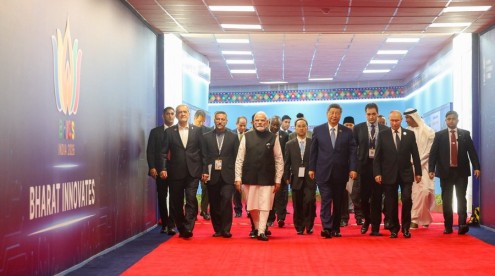
Modi’s Delhi BRICS diplomacy with Putin and Xi highlights India’s strategic autonomy as BRICS pushes for a larger role for emerging powers. (Image Modi on X)
By NIRENDRA DEV
At the Delhi BRICS Summit, Modi’s outreach to Xi and Putin, China-Russia support for a greater Indian role at the UN and consensus on terrorism point to a changing geopolitical landscape.
New Delhi, September 13, 2026 — Prime Minister Narendra Modi’s carefully choreographed engagements with Russian President Vladimir Putin and Chinese President Xi Jinping at the Delhi BRICS Summit have produced a powerful visual and diplomatic message: India is seeking to work simultaneously with Moscow and Beijing while retaining its strategic autonomy.
A photograph of Modi standing between Putin and Xi, holding hands with both leaders during a light-hearted moment, quickly became one of the defining images of the summit.
The image speaks beyond symbolism. It reflects the growing importance of the Russia-India-China (RIC) equation within a wider BRICS framework that is increasingly challenging assumptions about the existing global order.
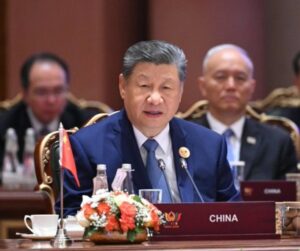
Chinese President Xi Jinping on Saturday, urged India and China to join hands to strengthen BRICS cooperation during bilateral talks with Modi.
There was also significant diplomatic messaging for India and Brazil.
China and Russia, both permanent members of the UN Security Council with veto power, reiterated support for India and Brazil to play a greater role in the United Nations, including at the Security Council.
According to the Delhi Declaration, BRICS leaders reiterated their support for a “comprehensive reform of the UN, including its Security Council.”
Former foreign secretary Kanwal Sibal described the development as “a big deal”, particularly in the context of China’s position and its implications for Pakistan.
The broader message is that Beijing appears willing, at least within the BRICS framework, to support language favouring reform of global institutions and a greater role for emerging powers.
Xi-Modi Meeting After Galwan
The Modi-Xi bilateral was particularly important because it marked their first bilateral meeting on Indian soil since the 2020 Galwan Valley clash.
Xi said India and China could learn from each other’s strengths and pursue shared development. Beijing, he indicated, viewed ties with New Delhi from a strategic and long-term perspective.
The two leaders also agreed that differences should not become disputes.
They discussed strengthening business ties, improving mobility and addressing concerns surrounding the structural trade imbalance and supply-chain issues. India also stressed the importance of “meaningful and predictable market access.”
The language reflects a cautious attempt to stabilise relations after years of tension.
Yet India’s engagement with China is not a strategic surrender.
New Delhi continues to maintain pragmatic partnerships with the United States, European countries, Japan and other Western partners.
BRICS Leaders Adopt New Delhi Declaration, Push UN Reform and Condemn Unilateral Tariffs
The RIC Equation Returns
The Modi-Putin-Xi photograph inevitably revived discussion about the RIC — Russia, India and China triangle.
The three countries have historically represented major poles of Eurasian power, although their strategic interests have frequently diverged.
India’s current approach is different from the alliance politics of the Cold War.
New Delhi wants Moscow and Beijing to remain important partners without allowing either relationship to dictate India’s wider foreign policy choices.
This is the essence of strategic autonomy.
The emerging BRICS architecture, therefore, may not represent a conventional anti-Western bloc. Rather, it is becoming a platform through which major emerging economies seek greater room for manoeuvre.
The shift has been visible since the 2024 BRICS Summit hosted by Russia and continued through Brazil’s 2025 presidency. Under India’s 2026 chairmanship, the Delhi Declaration has reinforced the importance of consensus despite deep differences among members.
India’s Balancing Act
The Modi government has repeatedly maintained that India stands for peace, dialogue and diplomacy while avoiding alignment with rival geopolitical camps.
That approach was visible again at the Delhi Summit.
A day earlier, Modi was photographed holding hands with Iranian President Masoud Pezeshkian. Putin and Xi were also central to the summit’s diplomacy.
The message was unmistakable: India intends to engage with different centres of power rather than choose one geopolitical camp.
Modi had earlier said that “this is not the era of war.” In August, he expanded that formulation while speaking with Putin, arguing that the world should move from an “endless war” towards an “end of war.”
The approach has helped India maintain dialogue across difficult geopolitical divides.
BRICS and the New Global Order
The larger question is whether BRICS is becoming an alternative pole in global politics.
The answer is more complicated than a simple yes or no.
BRICS members have different political systems, economic interests and strategic partnerships. Yet they share concerns about the concentration of economic and institutional power in Western-led structures.
The Delhi Summit has demonstrated that these countries can still reach consensus on selected issues.
India achieved a similar diplomatic feat at the 2023 G20 Summit, when members agreed on a consensus declaration despite major differences over the Ukraine conflict.
The adoption of the New Delhi Declaration at BRICS in 2026 similarly demonstrates that consensus remains possible despite geopolitical contradictions.
BRICS Delhi Summit 2026: India-China Thaw Signals New Global Order
Terrorism: A Significant BRICS Message
One of the most important elements of the declaration concerns terrorism.
BRICS called for zero tolerance for terrorism and specifically condemned the Pahalgam attack in Jammu and Kashmir, which killed 25 tourists and triggered a conflict with Pakistan.
The reference is significant because China, widely regarded as Pakistan’s closest major strategic partner, is also a signatory to the declaration.
The declaration rejected double standards on terrorism and called for accountability for those involved.
Although Pakistan was not named, the language carries obvious regional significance.
The document also called for faster adoption of the Comprehensive Convention on International Terrorism, a treaty first proposed by India at the United Nations in 1996.
A Challenge to Western Economic Dominance?
The United States was not at the BRICS table, but Washington nevertheless figured prominently in the economic debate.
The Delhi Declaration condemned unilateral economic and secondary sanctions, arguing that such measures could undermine development, food security, healthcare and human rights.
That language reflects one of the central concerns driving BRICS cooperation: reducing vulnerability to unilateral economic pressure.
Yet it would be premature to describe the Delhi Summit as the birth of a unified “non-Western world”.
India itself has strong economic, technological and strategic relationships with the United States and Europe.
Its objective is better understood as expanding strategic choices.
The Modi-Putin-Xi photograph therefore carries multiple messages.
It signals closer engagement among three major Eurasian powers. It reinforces the relevance of the RIC equation. It highlights the growing weight of BRICS. And it demonstrates that India can sit at the centre of multiple geopolitical conversations without formally choosing one camp.
The real test will come after the cameras disappear.
If BRICS can translate its declarations into stronger trade, financial cooperation, institutional reform and greater strategic autonomy for its members, the Delhi Summit could prove to be a significant milestone.
For India, the objective is not necessarily to create a new bloc against the West.
It is to ensure that India does not have to choose between Moscow, Beijing and Washington — and instead retains the freedom to engage all of them on its own terms.
BRICS Delhi Summit 2026: India-China Thaw Signals New Global Order
Follow The Raisina Hills on WhatsApp, Instagram, YouTube, Facebook, and LinkedIn




About The Author