How US Media Read the New Delhi BRICS Summit: India’s Balancing Act, and a Red Carpet for Tehran
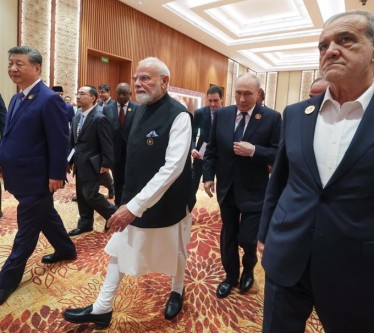
Leaders of India, China, Russia and Iran walk together during the BRICS Summit in New Delhi, highlighting the grouping’s expanding geopolitical significance. (Image Modi on X)
By TRH Foreign Affairs Desk
American outlets covering this weekend’s BRICS summit converged on a single throughline: India is walking an increasingly difficult tightrope between Washington and the bloc’s more anti-Western instincts — and hosting Iran’s president at the height of tension with the US only sharpened that read.
New Delhi, September 13, 2026 — As BRICS leaders gathered in New Delhi for the 18th summit, US-based outlets largely covered the event not as a story about the joint declaration’s contents, but as a test of how far India is willing to lean toward Russia, China and Iran while its relationship with Washington shows real strain.
The “Hedging” Frame
NPR set the tone early, describing a summit taking place “as wars and U.S. tensions test the bloc,” with Prime Minister Narendra Modi hosting Russian President Vladimir Putin, Chinese President Xi Jinping, and Iranian President Masoud Pezeshkian together in New Delhi.
CNBC went further in framing what the imagery itself was doing politically, noting that when Xi, Putin and Modi were photographed together in China the previous year — “smiling, holding hands and chatting animatedly” — the images went viral, and that this weekend’s meeting revived that same visual against “an increasingly complicated geopolitical backdrop.”
CNBC cited Indian foreign policy scholar Sanjay Bajpaee and analyst Aparna Shidore for a more measured read, both arguing that BRICS remains what Shidore called a “pragmatic club for limited purposes,” focused on development, trade and institutional reform rather than functioning as an explicit anti-American bloc — with Bajpaee adding that India specifically wants BRICS to promote a “non-Western” worldview without tipping into being “explicitly anti-Western.”
Even so, the same report noted the bloc’s divisions have surfaced “most obviously and most clearly” over security issues, pointing to Iran and the UAE sitting in the same grouping despite being on opposite sides of the Middle East war.
BRICS Delhi Summit 2026: India-China Thaw Signals New Global Order
The Iran Angle: A Very Public Embrace
Where US coverage sharpened considerably was on Iran specifically. Fox News Digital ahead of the summit flagged Iran-India relations as one of the weekend’s central storylines, previewing that Pezeshkian and Modi would “highlight trade, connectivity, energy cooperation and regional developments” in their bilateral meeting — a notably warm agenda given Iran’s isolation from Washington.
Fox quoted Harsh V. Pant of Observer Research Foundation describing India’s core challenge as “managing contradiction,” with Pant telling the outlet: “New Delhi is trying to keep the focus on practical cooperation — from energy security to connectivity and development — rather than ideological confrontation.”
CNBC reported that on the eve of the summit, Pezeshkian told a gathering of Indian religious leaders in New Delhi that “Tehran will not surrender to the U.S.,” declaring “Iran has successfully stood against Israel and the U.S.” — remarks CNBC noted came directly on the heels of President Trump’s own comment that Iran would have “wiped out Israel and the Middle East” and begun “hitting U.S. cities” had Washington not struck first.
Modi’s own posture in his bilateral meeting with Pezeshkian was comparatively restrained by contrast — CNBC reported Modi “underscored the need for peace” and urged resolution of the Middle East conflict “through dialogue and diplomacy” — but the optics of Iran’s president using an Indian platform to declare defiance of Washington, days before the summit even opened, was the detail US coverage kept returning to.
Fox News placed that warmth in a pointed frame, publishing alongside its summit coverage a separate piece headlined “From Bear Hugs to Handshakes: How India Lost Its Edge With Trump While Pakistan Quietly Gained Ground” — a juxtaposition that, whether intentional or not, cast India’s hosting of Pezeshkian as one more data point in a broader narrative of the US-India relationship cooling even as India’s BRICS-facing diplomacy stayed active.
The Declaration’s Iran Language, Read as a Signal
US wire coverage of the summit’s actual joint declaration reinforced that same reading. The Associated Press — whose reporting was picked up widely across US outlets — reported that BRICS leaders expressed concern over “deliberate attacks” on civilian infrastructure and nuclear facilities protected under IAEA safeguards, characterizing the language as “seen as indirect criticism of U.S. and Israeli strikes on Iranian nuclear facilities.”
The AP noted this marked a notable shift in tone: in May, BRICS foreign ministers had failed to even agree on a joint statement over the Iran war, forcing India to issue a more limited “chair’s summary” instead — meaning the New Delhi declaration’s language, however indirect, represented the bloc actually finding consensus language critical of Washington’s closest Middle East ally where it previously could not.
The Bigger Picture US Outlets Drew
Taken together, the throughline across NPR, CNBC and Fox News’s coverage wasn’t that India has abandoned its relationship with Washington — all three outlets were careful to frame India’s posture as continuity of its long-standing “strategic autonomy” doctrine, maintaining ties with Russia and Iran while still deepening cooperation with the US.
But the specific optics of this summit — Pezeshkian’s defiant remarks on Indian soil, the declaration’s IAEA language, and the summit’s timing just before Xi’s planned September 24 state visit to meet Trump — combined to produce US coverage that read New Delhi’s hosting duties this year as a genuinely harder balancing act than in previous BRICS cycles, one playing out against a US-India relationship American outlets themselves are now describing as under real strain.
RIC Bond: Modi’s Handshake with Putin, Xi Sends a Powerful BRICS Message
Follow The Raisina Hills on WhatsApp, Instagram, YouTube, Facebook, and LinkedIn




About The Author