How Chinese Media Covered BRICS Summit: “Right Side of History,” a Border Thaw With India, and Barely a Word on Iran
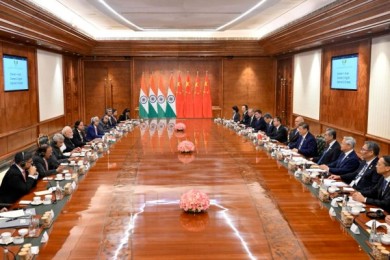
Prime Minister Narendra Modi and Chinese President Xi Jinping lead their delegations during bilateral talks on the sidelines of the BRICS Summit in New Delhi. (Image Chinese Embassy in New Delhi)
By TRH Foreign Affairs Desk
Where US outlets zeroed in on India’s balancing act and Iran’s defiant presence, China’s state press told a very different story: one of Global South solidarity, a warming Xi-Modi relationship, and pointed language about Western “unilateralism” — with almost none of the friction American coverage emphasized.
New Delhi, September 13, 2026 — Chinese state media’s coverage of the 18th BRICS Summit in New Delhi centered overwhelmingly on two threads: President Xi Jinping’s framing of BRICS as a vehicle for “the right side of history” against a backdrop of Western unilateralism, and a carefully cultivated narrative of thawing China-India relations following years of border tension. Notably absent from that coverage was almost any of the friction over Iran that dominated American reporting on the same event.
The Framing: “Right Side of History”
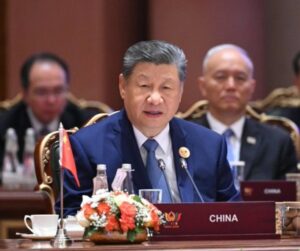
Xinhua’s dispatches from New Delhi centered squarely on Xi’s own rhetoric. The state news agency reported Xi told the summit’s opening session that BRICS countries should “firmly stand on the right side of history, strive to be a pioneer of the times, steer the international order toward greater justice and equity, and work together to build a community with a shared future for humanity.”
Xinhua credited Xi with calling on the bloc to pioneer “innovation-driven development,” including deeper cooperation on artificial intelligence and open-source technology.
A China Daily editorial, syndicated via PR Newswire, sharpened that framing considerably, describing “countercurrents of unilateralism and power politics” as “surging” globally, with “multilateralism and the international order… coming under strain.”
The editorial argued this environment should “further inspire the BRICS countries” to embrace Xi’s vision — language that, while not naming Washington directly, was consistent with China’s state media’s long-running practice of using “unilateralism” as shorthand criticism of US trade and foreign policy.
Global Times argued Xi’s remarks “underscor[ed] the unstoppable trend of multipolarity and the rising strength of the Global South” — framing that positions BRICS explicitly as a counterweight to a US-centered global order, even as the outlet stopped short of naming the United States as an adversary.
The Bigger Story for Chinese Media: A Border Thaw With India
If American coverage treated India’s diplomacy as a story about distance from Washington, Chinese coverage told a parallel story about closing distance with Beijing. Xinhua noted Xi’s trip marked his first visit to India since October 2019, and explicitly tied the summit to “sustained efforts by New Delhi and Beijing to stabilize relations following the 2020 border standoff” — citing recent patrolling arrangements along the Line of Actual Control, the resumption of direct flights, and eased business visa procedures as the diplomatic groundwork enabling Xi’s trip.
Global Times gave this theme its own dedicated headline treatment, reporting that the “Xi-Modi meeting lifts ties to new phase of confidence-building,” according to experts cited in its coverage. That framing represents a notable shift in tone from Chinese state media’s historically guarded coverage of India relations, and suggests Beijing’s press apparatus treated the bilateral thaw as being at least as newsworthy as the multilateral summit itself.
RIC Bond: Modi’s Handshake with Putin, Xi Sends a Powerful BRICS Message
What Chinese Coverage Left Out
The contrast with US coverage is sharpest in what didn’t appear. Xinhua’s, China Daily’s, People’s Daily’s and Global Times’ reporting reviewed for this piece made no substantive mention of Iranian President Masoud Pezeshkian’s defiant remarks to Indian religious leaders, nor of the joint declaration’s language on IAEA-safeguarded nuclear facilities that US wire coverage read as indirect criticism of American and Israeli strikes on Iran.
Where Xinhua’s own preview coverage did reference regional tension, it was folded into broader, non-specific language about BRICS “contributing stability and positive momentum to a world undergoing profound changes” — a formulation that acknowledges instability exists without assigning it to any particular actor or conflict.
Chinese coverage also emphasized China’s own institutional contributions to BRICS at a level of detail largely absent from American reporting: Xinhua’s preview pieces highlighted the BRICS Partnership on New Industrial Revolution innovation center Xi established in Xiamen in 2020, reporting it has “facilitated more than 100 cooperation projects, with a total investment of over 62 billion yuan” and launched scholarship programs for emerging-industry talent across BRICS nations — material that positions China not merely as a participant in the bloc, but as one of its principal institutional architects.
A Milestone Framing, With China’s Turn Next
Chinese state media also used the summit to mark BRICS’s 20th anniversary as a mechanism, with Xinhua noting the grouping now accounts for “nearly half of the world’s population, around 30 percent of the global economy and one-fifth of global trade.”
That framing set up the coverage’s forward-looking close: with India’s chairship concluding, Chinese outlets highlighted the leaders’ formal endorsement of Beijing hosting the 19th BRICS Summit in 2027 — a detail Xinhua and Global Times both treated as a natural culmination of Xi’s “right side of history” address, positioning China’s upcoming chairship as the next chapter in a narrative of accelerating Global South solidarity that Chinese media has been building across multiple summit cycles.
BRICS2026 in Eyes of Beijing and Washington
Chinese and American state and mainstream press covered the same two-day summit in New Delhi as almost entirely different events. Where US outlets read the summit through the lens of India’s uncomfortable balancing act and Iran’s provocative presence, Chinese state media read it as validation of a Beijing-aligned worldview: a multipolar order taking shape, a warming China-India relationship after years of border tension, and BRICS entering what Xinhua repeatedly called its “third golden decade” — with barely a mention of the frictions that anchored the American narrative of the same event.
How US Media Read the New Delhi BRICS Summit: India’s Balancing Act, and a Red Carpet for Tehran
Follow The Raisina Hills on WhatsApp, Instagram, YouTube, Facebook, and LinkedIn




About The Author