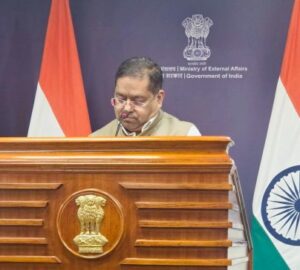
NSCN-IM Faces Biggest Internal Crisis in Decades as Eastern Flank Forms Provisional Govt
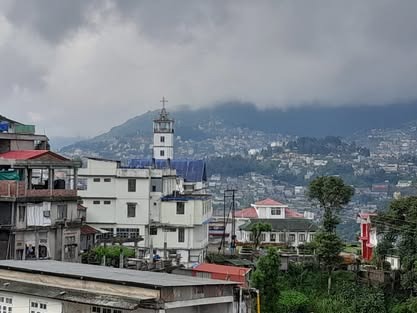
NSCN-IM Faces Biggest Internal Crisis in Decades as Eastern Flank Forms Provisional Government (Image Nirendra Dev)
By NIRENDRA DEV
Emergency meeting at Mt Horeb Camp empowers a provisional government under Lt Gen (Retd.) Hs. Ramsan, while accusing the Hebron leadership of abandoning the goal of Naga sovereignty.
Kohima, July 24, 2026 — The long-running Naga peace process has entered a critical phase, with the Eastern Flank of the NSCN/GPRN declaring the formation of a Provisional Government, a move that could deepen divisions within the NSCN-IM and potentially impact the nearly three-decade-old peace process.
In a statement issued after an Extraordinary Joint Emergency Meeting of Civil National Workers and Naga Army officers held at Mt Horeb Camp on July 21, the Eastern Flank announced the formation of a provisional government until a full-fledged government is constituted.
The meeting was chaired by Lt Gen (Retd.) Hs. Ramsan, Vice Chairman of the Eastern Flank.
The Eastern Flank further claimed that “the spirit of the 1997 ceasefire agreement had ceased to exist” following what it described as “the Government of India’s betrayal of the Framework Agreement.” This may open avenues of renewed violence in Nagaland and hills of Manipur.
The statement alleged that the Hebron headquarters leadership had failed to act on the directives issued by NSCN-IM General Secretary Thuingaleng Muivah after the Government of India allegedly failed to honour the Framework Agreement signed on August 3, 2015.
“The leadership at Hebron/GHQ failed to take the necessary steps as outlined in the statement issued by the Chief Political Negotiator and General Secretary Th. Muivah,” the statement said.
The Eastern Flank further claimed that “the spirit of the 1997 ceasefire agreement had ceased to exist” following what it described as “the Government of India’s betrayal of the Framework Agreement.”
“Therefore, we will continue both political as well as armed resistance to safeguard the sovereign existence of the Naga nation,” it stated.
The organisation also rejected the “Competencies” submitted to the Government of India by the NSCN leadership, alleging that they compromised the principle of Naga sovereignty by accepting a solution within the Constitution of India.
The statement accused the Hebron leadership of issuing expulsion orders against senior members to silence dissent and facilitate what it described as a “piecemeal solution.”
To lead the provisional government, the meeting unanimously empowered:
- Ikato I. Chishi Swu as Chairman.
- Lt Gen (Retd.) Hs. Ramsan as Vice Chairman.
- Lt Col (Retd.) Victor Angami.
- Lt Gen A. Raman.
- Detail Dani.
- Angyo Jacob Jingseya.
- Ngaranlini Jagoi, Advisor.
- Mrs Merry Ramsan, Advisor.
- Vitovi Yeputho, Advisor.
The statement said the members would be administered an oath of allegiance by an ordained minister.
Significantly, Ikato I. Chishi Swu is the son of late NSCN chairman Isak Chishi Swu, one of the organisation’s founding leaders.
The Eastern Flank also appealed to all Naga national workers and the wider Naga community to join the process of forming a “unified national government” committed to the ideals of the organisation’s founding fathers.
A major moment in the peace process
The development is being viewed as one of the most significant internal challenges to the NSCN-IM since the historic split between NSCN-IM and NSCN-K in 1988.
Unlike previous internal disagreements, the present crisis appears to stem from differences over the future course of negotiations with New Delhi after years of stalled peace talks.
Interestingly, the Eastern Flank did not directly criticise Th. Muivah. Instead, it argued that the leadership at Hebron failed to implement Muivah’s own November 7, 2024, statement, in which he reportedly warned that if political initiatives failed, the organisation would resume armed resistance.
Analysts believe this leaves open a narrow possibility of reconciliation, even as the differences within the organisation have become more pronounced.
The latest developments are also being viewed as evidence of growing frustration over the prolonged delay in concluding a final Naga political settlement.
The peace process, which formally began with the 1997 ceasefire after years of backchannel engagement initiated during the tenure of former Prime Minister P.V. Narasimha Rao, has remained deadlocked over key issues, including the demand for a separate Naga flag and constitution.
Security observers say the Eastern Flank’s assertion that the ceasefire has “ceased to exist” is likely to be closely monitored by security agencies, although it remains to be seen how developments unfold on the ground.
The statement was issued by Edward Sayai, Additional Secretary of the NSCN/GPRN.
Nagaland’s Next Stage: From Insurgency to Radical Regionalism
Follow The Raisina Hills on WhatsApp, Instagram, YouTube, Facebook, and LinkedIn




About The Author