India Extends the Hand: Why New Delhi and Dhaka Must Put Prosperity Above Politics
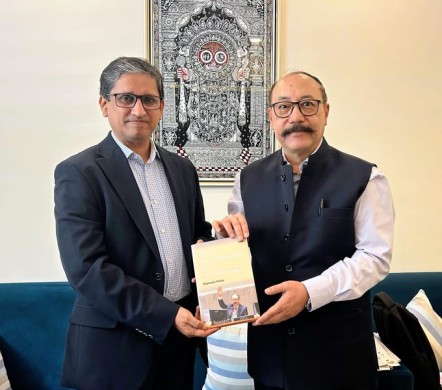
Rajya Sabha MP Harsh V. Shringla with Bangladesh High Commissioner in New Delhi Hamidullah Riaz. (Image Shringla on X)
By SIDHARTH MISHRA
India and Bangladesh do not have the luxury of estrangement. Geography binds them, history connects them and economics compels cooperation. As political transitions unfold in Dhaka and diplomacy gathers fresh momentum, both nations should ensure that shared prosperity not political personalities becomes the defining principle of their relationship.
New Delhi, July 24, 2026 — India and Bangladesh appear to be entering a new phase in their bilateral relationship, one defined less by political bitterness and more by pragmatic engagement. The latest indication of this came when New Delhi invited Bangladesh Prime Minister Tarique Rahman to attend the BRICS Summit in New Delhi on September 12-13 as a special guest.
Bangladesh is neither a member nor an observer of BRICS, making the invitation a significant diplomatic gesture that underscores India’s willingness to reset ties with its eastern neighbour. The invitation follows a series of carefully calibrated initiatives by New Delhi aimed at restoring confidence after relations hit their lowest point under Bangladesh‘s interim administration. It also comes amid reports that deposed Prime Minister Sheikh Hasina, who has been living in India since the collapse of her government in August 2024, intends to return to Bangladesh later this year.
Together, these developments offer both countries an opportunity to move beyond recent political turbulence and rebuild a partnership centred on shared economic interests. India’s invitation to Rahman is not an isolated gesture. It is, in fact, the second invitation extended by New Delhi within a few months. Prime Minister Narendra Modi had earlier invited Rahman to visit India when Lok Sabha Speaker Om Birla attended the Bangladeshi leader’s swearing-in ceremony in February.
Rahman instead chose Malaysia and China for his maiden foreign visits, a decision that sparked predictable commentary in India’s strategic circles about Bangladesh drifting towards Beijing. Such reactions, however, miss the larger picture.
Rahman’s choice of Malaysia and China was driven far more by economic compulsions than geopolitical realignment. Malaysia remains an important destination for Bangladeshi migrant workers, while China continues to be a major source of infrastructure financing and investment.
Recognising this reality, New Delhi appears to have chosen engagement over resentment. Rather than interpreting Rahman’s travel itinerary as a diplomatic slight, India has continued to keep its doors open. The invitation to the BRICS Summit demonstrates diplomatic maturity and confidence. It reflects an understanding that relationships between neighbours cannot be dictated by the sequence of official visits.
Why Kanwal Sibal Publicly Questioned India’s Bangladesh Envoy
If Rahman accepts the invitation, it will mark his first visit to India since assuming office and could become a turning point in bilateral relations. More importantly, it would reinforce the message that geography ultimately prevails over temporary political differences.
India’s recent diplomatic initiatives extend beyond summit invitations. The appointment of senior Bharatiya Janata Party leader and former Union minister Dinesh Trivedi as India’s High Commissioner to Bangladesh was widely interpreted as a signal of the importance New Delhi attaches to its relationship with Dhaka. Trivedi is among the very few political appointees entrusted with an ambassadorial assignment, underlining the political significance India accords to Bangladesh.
Dhaka has responded with a gesture of its own by deciding to appoint Foreign Secretary Asadullah Alam Siam as its next High Commissioner to India. The exchange of senior-ranking envoys suggests that both governments recognise the need to restore high-level political communication after a prolonged period of uncertainty.
These reciprocal appointments, coupled with India’s repeated invitations to Rahman, indicate that New Delhi is taking the initiative in rebuilding trust rather than waiting for circumstances to improve on their own.
This proactive approach deserves appreciation. For nearly two years, the presence of Sheikh Hasina in India has remained the most contentious issue in bilateral relations. Dhaka’s repeated requests for her extradition have complicated diplomatic engagement, while political debates surrounding her future have often overshadowed discussions on more substantive issues.
However, if Hasina indeed returns to Bangladesh later this year, one major source of friction could gradually disappear. Both governments should seize that opportunity to ensure that bilateral ties are no longer held hostage by the political fate of one individual.
Sheikh Hasina undoubtedly transformed India-Bangladesh relations during her tenure. Security cooperation deepened, connectivity expanded, and economic engagement reached unprecedented levels. Her contribution to bilateral relations deserves recognition.
Yet no enduring partnership between two sovereign nations can remain centred on one political personality. India’s relationship must be with Bangladesh as a nation, irrespective of which political party governs in Dhaka. Likewise, Bangladesh’s engagement with India should be guided by national interest rather than domestic political narratives.
China-Bangladesh Strategic Shift: Why India Should Be Concerned
The economic logic for stronger cooperation remains overwhelming. India is Bangladesh’s largest trading partner in South Asia. Bangladesh serves as India’s principal gateway to the Northeast. The two countries share over 4,000 kilometres of border, dozens of rivers, expanding electricity trade, railway links, inland waterways and growing digital connectivity. These shared interests cannot be replaced by any external partner.
Indeed, India’s greatest advantage is not financial but geographical. When crises emerge in the region, New Delhi invariably becomes the first responder because proximity permits immediate action. Whether during Sri Lanka’s economic collapse or natural disasters across South Asia, India has repeatedly demonstrated its capacity to provide timely assistance.
That reliability matters far more than symbolic diplomatic victories. The invitation to the BRICS Summit encapsulates this broader philosophy. Rather than dwelling on past grievances or reacting emotionally to Bangladesh’s external engagements, India is signaling its willingness to look ahead. It is inviting dialogue, encouraging cooperation and reaffirming that the future of bilateral relations lies in partnership rather than suspicion.
The ball is now in Dhaka’s court. Acceptance of the invitation would send a powerful message that both governments are prepared to turn the page. Even if differences persist on specific issues, mature neighbours must continue talking.
Ultimately, India and Bangladesh do not have the luxury of estrangement. Geography binds them, history connects them and economics compels cooperation. As political transitions unfold in Dhaka and diplomacy gathers fresh momentum, both nations should ensure that shared prosperity not political personalities becomes the defining principle of their relationship.
If India has taken the first step towards rebuilding trust, Bangladesh should respond in the same spirit. South Asia will be stronger when its two closest neighbours choose engagement over estrangement and economic partnership over political baggage.
(This is an opinion piece. Views expressed are the author’s own.)
India-Bangladesh Relations Need a Reset Beyond Sheikh Hasina
Follow The Raisina Hills on WhatsApp, Instagram, YouTube, Facebook, and LinkedIn




About The Author