Cabinet Clears Tough Paper Leak Law, But Experts Say Deeper Reforms Are Needed
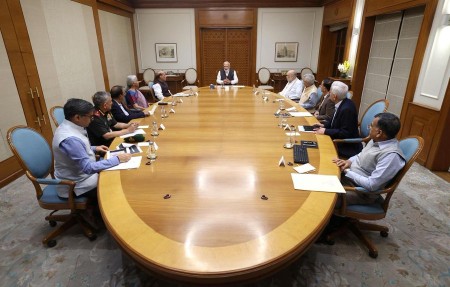
PM Narendra Modi chairs Cabinet Committee on Security amid US-Iran war (Image PIB)
By TRH Political Desk
Cabinet Backs 10-Year Jail for Paper Leaks, Experts Say Reform Must Go Beyond Punishment
New Delhi, July 24, 2026 — Even while Union Cabinet cleared a tough legislative proposal against paper leaks, experts warned that India needs to undertake institutional reforms to find a lasting solution. The Union Cabinet decision on Friday came after 26 days of students’ protests led by the Cockroach Janata Party (CJP).
Per sources the Cabinet gave its nod to the proposal for stringent measures against cases of paper leaks by proposing amendments to the Prevention of Paper Leak law. A maximum jail term of 10 years and a fine of up to ₹10 crore are among the key proposals approved by the Cabinet.
Prime Minister Narendra Modi had earlier announced setting up of fast-track courts. But the cases of paper leaks per experts have been traced to institutional gaps in the National Testing Agency, which largely banks on outsourcing and contractual staffing.
Modi’s announcement that the Centre will establish Fast-Track Special Courts (FTSCs) to ensure swift punishment in examination paper leak cases has triggered a wider debate over whether faster trials alone can resolve what many experts describe as a deeply systemic crisis.
Former Union Finance Minister P. Chidambaram argued that the government’s proposal addresses only one part of the problem and does little to strengthen the criminal justice system that ultimately determines whether offenders are convicted.
In a series of posts on X, Chidambaram pointed out that India already has 775 Fast-Track Special Courts dealing with various categories of offences.
According to data cited by him from the Ministry of Law, these courts are already burdened with more than 2.45 lakh pending cases.
“A Fast-Track Special Court is not merely a court building,” Chidambaram said, noting that each court requires judges, prosecutors, court staff, investigators, witnesses, bailiffs and sustained financial resources.
He identified judicial vacancies as the biggest bottleneck. “The most important constraint is that there are not a sufficient number of judges; many posts of judges are vacant,” he said.
Chidambaram maintained that creating additional fast-track courts would produce meaningful results only if vacancies are filled and the supporting judicial infrastructure is strengthened.
Former Education Secretary Anil Swarup, who has previously overseen major education reforms, echoed the concern while questioning whether the government’s emphasis should instead be on improving investigations.
In a post on LinkedIn, Swarup wrote: “The leaks are not likely to stop. The fast-track courts, even if they do come into existence, will release the culprits faster.”
“The key question is whether the right culprits are caught and whether the investigation is above board,” he added.
Recalling his observations made during earlier examination controversies, Swarup argued that the crisis is fundamentally institutional rather than legal. “The problem is systemic. Systems will be in place only if there is clear intent and an action plan,” he said.
He also criticised what he described as the government’s focus on ideological priorities over governance, arguing that unless investigators identify the masterminds behind organised examination leak networks, merely arresting lower-level operators would not eliminate the problem.
“By catching peripheral thieves, the dacoity in temples, including the temples of education, will not stop till you nail the real culprits and bring about systemic change,” Swarup wrote.
Former Railway Board official M.K. Gupta broadened the debate by linking the issue to India’s low conviction rates.
According to Gupta, weak investigations, poor evidence collection, delays in prosecution, hostile witnesses, political interference and inadequate criminal justice reforms collectively undermine the justice delivery system.
He argued that successive governments, irrespective of political affiliation, share responsibility for failing to implement meaningful police and judicial reforms.
The comments come at a time when the Centre has promised stringent legislation, fast-track courts and administrative reforms following nationwide protests over alleged examination paper leaks.
Political analysts say the emerging debate has now shifted from whether stronger laws are required to whether India’s investigative and judicial institutions possess the capacity to deliver timely and credible justice.
While the government’s latest proposals seek to reassure students that paper leak cases will be dealt with swiftly, critics argue that without strengthening investigations, filling judicial vacancies and dismantling organised cheating networks, the credibility crisis surrounding competitive examinations may persist.
Just 39 Permanent Posts: Parliament Reveals NTA Runs on Contract Staff Amid Exam Crisis
Follow The Raisina Hills on WhatsApp, Instagram, YouTube, Facebook, and LinkedIn




About The Author