Delhi Protest Policing: When Democracy Turns Into a Wrestling Championship
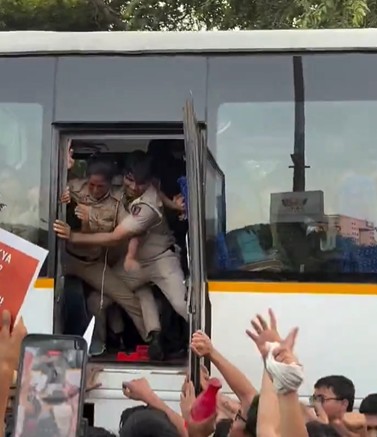
Delhi police personnel and protestors were locked in pitched battles (image video grab)
By AMIT KUMAR
When citizens take to the streets, the Capital sometimes looks less like the world’s largest democracy and more like a wrestling arena. Barricades become the boundary ropes, uniforms the team jerseys, and ordinary protesters unwilling contestants in a match nobody remembers buying tickets for.
New Delhi, October 5, 2026 — Welcome to the latest sporting spectacle in the national Capital: Dangal-e-Democracy, featuring Delhi Police, central security personnel, barricades, buses and citizens who apparently made the mistake of believing that a public protest should be visible in public.
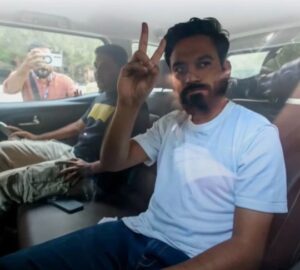
The action around India Gate, Janpath and the approaches to Jantar Mantar has offered a curious lesson in crowd management. As demonstrators demanding the resignation of Chief Election Commissioner Gyanesh Kumar attempted to march, police personnel moved to stop them. Detentions followed, and footage and reports of physical handling of protesters circulated.
One almost expects a referee to emerge from behind the barricades, blow a whistle and award points for the most technically accomplished removal of a demonstrator.
A protester approaches. A uniformed official advances. Arms are deployed. Balance is lost. The audience reaches for its phone. Three seconds later, the contestants are travelling in a police bus.
Professional wrestling, at least, advertises itself as entertainment. Democratic crowd management is supposed to be a little more serious.
The great name-badge mystery
Former IPS officer Yashovardhan Jha Azad raised an important question in a post on X. He highlighted the tension between the moral legitimacy of democratic protest and prohibitory orders, along with persistent complaints about personnel allegedly not wearing name badges and an insufficient presence of women officers and constables.
His suggestion that body cameras are now essential in metropolitan policing deserves particular attention.
Imagine that: a small camera recording what happens when the powerful uniform meets the inconvenient citizen. The technology is hardly futuristic. Yet it could make the wrestling commentary unnecessary. Instead of competing versions of who pushed whom, there could be a verifiable record.
Of course, cameras must work both ways. Footage must be preserved, independently reviewable and available through a fair process. A camera switched off at the crucial moment is merely an expensive accessory.
Prohibitory orders versus the right to protest
The legal argument is not that police orders can simply be ignored. Authorities have responsibilities to maintain public order, and lawful restrictions matter. But the existence of a prohibitory order should not end the democratic conversation about proportionality, accountability and the handling of peaceful dissent.
Delhi appears to have perfected the art of preparing for a demonstration as though an invading army were approaching. Barricades multiply, roads close, stations restrict access and security personnel assemble in impressive numbers. The citizen’s journey to express a grievance becomes an obstacle course before the protest even begins.
Perhaps the next step is to issue demonstrators helmets, knee pads and a rulebook. Protesters could be divided into weight categories, while the police receive points for every successful takedown. The medal ceremony could take place at India Gate, provided the authorities grant permission for the gathering.
The joke, however, has a serious point. Police personnel need protection and clear rules; protesters need their rights respected. Women officers should be adequately deployed wherever women are being detained, and every officer exercising coercive power should be identifiable.
Most importantly, body cameras and transparent procedures should protect both citizens and honest police personnel from false allegations as well as genuine misconduct.
Democracy is not a contact sport
The ultimate test of a democracy is not how efficiently it can prevent a crowd from moving. It is how responsibly it handles citizens who challenge those in authority.
A government may disagree with a protest. Police may enforce lawful restrictions. Neither proposition requires public order to resemble a wrestling championship.
Delhi has enough stadiums for sport. Its streets should not become arenas in which the citizen’s principal achievement is to survive the referee-free contest.
And if body cameras can help establish what really happened, perhaps they should be made standard equipment.
After all, in a democracy, the public should not have to rely on slow-motion replays from social media to discover who won the match.
Neha Bora Detention: AISA, CPI (ML) Question Delhi Police Over Unmarked Car
Follow The Raisina Hills on WhatsApp, Instagram, YouTube, Facebook, and LinkedIn




About The Author