Hundreds of French Schools Shut as Student Protests Over Classroom Conditions Turn Violent
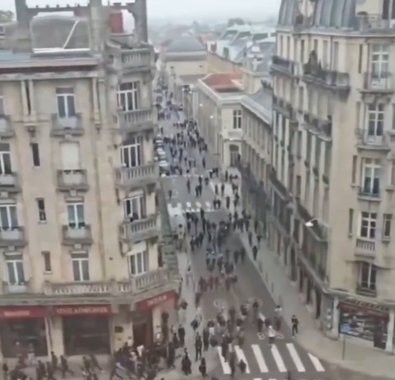
Student protests in France have turned violent (Image video grab)
By TRH World Desk
What began as demonstrations over underfunded high schools in the Paris region has spread nationwide within two weeks, drawing riot police, mass arrests, and a government scrambling to contain a crisis it didn’t see coming.
New Delhi, October 5, 2026 — France is facing its most disruptive student unrest in years, with riot police clashing with high school students in multiple cities and hundreds of schools shut or blockaded as a protest movement that began in the Paris region two weeks ago spreads nationwide.
According to France 24, the protests erupted in the Ile-de-France region around Paris last week before spreading across the country, with some 400 French schools closed as of Friday, October 2. The broadcaster reported riot police clashed with students in multiple cities that day as unions called for teachers to join a strike, with President Emmanuel Macron’s government working to contain protests that have grown “increasingly violent” over classroom conditions and education funding.
The movement’s core grievances are specific and have stayed consistent as it has spread: students are demanding the hiring of substitute teachers, increased resources, and better learning conditions — demands France 24 reported students raising directly outside schools including the Lycée Paul Eluard in Saint-Denis and the Lycée Voltaire in Paris. The unrest has not stayed confined to protests over education policy alone; France 24 noted it coincided with a broader day of strikes and demonstrations by public sector workers, including firefighters, reflecting wider frustration beyond the school system specifically.
The Scale of the Disruption
The numbers France 24 has tracked illustrate how quickly this moved from a regional dispute to a national crisis. From an initial wave of school closures in the capital region, the movement expanded to affect roughly 400 of France’s approximately 3,700 lycées nationwide within days. The broadcaster reported transport was suspended in some French cities as the school protests continued, and that riot police were deployed to confront student blockades at schools including the Lycée Deodat-de-Severac in Toulouse and Le Corbusier secondary school in Aubervilliers, north of Paris.
A Government Caught Off Guard
France 24’s reporting captures a government response still being worked out in real time, even as the unrest entered its second week. The broadcaster described officials “battling to contain increasingly violent protests,” with student representatives, after meeting with French Education Minister Édouard Geffray along with parents and school staff on Friday, calling for the protest movement to continue — but through non-violent means specifically, a distinction that itself reflects internal tension within the movement over tactics as images of arson and confrontations with police have come to dominate national coverage of the unrest.
France 24 also noted that while many of the demonstrations at individual schools have remained peaceful, it is the images of burning barricades and forceful policing that have shaped the public debate in France around the protests — a dynamic that has complicated the government’s efforts to distinguish, in its own public messaging, between the broader student movement and what officials have characterized as a smaller violent element operating within it.
With teachers’ unions now joining the movement through strike action and the unrest showing no clear sign of slowing as it enters a third week, the French government faces a dual challenge: addressing the underlying grievances over classroom staffing and resources that originally triggered the protests, while also containing the violence that has increasingly come to define national coverage of the movement.
France 24’s reporting suggests neither side — the government or the student movement itself — has yet settled on a clear path to de-escalation, even as both have publicly called for calm.
“Can We Explain Ourselves?” France’s School Revolt Tests Macron’s Government
Follow The Raisina Hills on WhatsApp, Instagram, YouTube, Facebook, and LinkedIn




About The Author