Modi Model: How Hindutva, Governance and Diaspora Perceptions Shape BJP’s Political Appeal
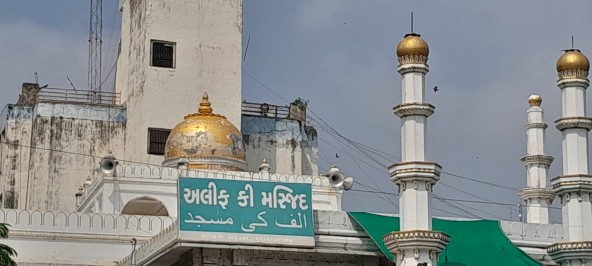
A visit to Gujarat last week offered an opportunity to speak with people associated with the Ayodhya movement and those who witnessed the aftermath of the 2002 post-Godhra violence. (Image Nirendra Dev)
By NIRENDRA DEV
Conversations over late-night chai near Ahmedabad’s Lal Darwaja explore the Ayodhya movement, the Gujarat riots, the BJP’s political rise and the multiple factors shaping Narendra Modi’s public image.
Ahmedabad, October 5, 2026 — A visit to Gujarat last week offered an opportunity to speak with people associated with the Ayodhya movement and those who witnessed the aftermath of the 2002 post-Godhra violence. Discussions over late-night chai near Ahmedabad’s busy Lal Darwaja turned into a debate on the Ram temple, Hindutva politics and the factors behind the enduring appeal of Prime Minister Narendra Modi.
One elderly Muslim participant from Saurashtra referred to the Liberhan Commission report, arguing that senior BJP leaders could not have been unaware of the Sangh Parivar’s intentions before the Babri Masjid demolition in December 1992.
The discussion also revisited the legal aftermath. On November 9, 2019, the Supreme Court awarded the disputed Ayodhya site for the construction of a Ram temple and directed that an alternative five-acre plot be provided for a mosque. The court had described the demolition of the Babri Masjid as an illegal act. On September 30, 2020, a special CBI court acquitted all 32 surviving accused in the criminal case, citing insufficient evidence to establish a conspiracy.
Prime Minister Narendra Modi laid the foundation stone for the Ram temple on August 5, 2020, fulfilling a longstanding BJP promise and marking a major symbolic moment for the party’s Hindutva-oriented support base.
The Ahmedabad conversations offered different explanations for the BJP’s political rise. One participant argued that the 2014 mandate had more to do with corruption than Hindutva, a view broadly supported by others. Some credited Modi with avoiding major economic scandals during his tenure, while others highlighted the role of religious figures and hardline campaigners in BJP electioneering.
One participant offered a provocative explanation: “Many so-called Sadhus or even hardliner campaigners among RSS leaders are now money-rich and also time-rich.”
Others pointed to the Indian diaspora’s perceptions of national prestige, the political impact of criticism directed at Modi and the changing public understanding of India’s democratic institutions.
A retired academician described the “Modi Model” as an extension of the earlier Gujarat Model, shaped by electoral victories, institutional countervailing powers and political power-sharing.
The debate also touched on retirement, longer working lives and the need for opportunities to reskill older professionals.
For the writer, the evening eventually brought personal memories of his mother, Minati Deb, who died within 36 hours of the Supreme Court’s Ayodhya verdict in November 2019. Recalling her advice that stories are most powerful when written with tears in the writer’s eyes, he reflected on the human costs and sacrifices associated with the Ayodhya movement.
The conversations offered no single explanation for Modi’s political appeal. Instead, they revealed how governance, Hindutva, corruption, national prestige and personal memories intersect in India’s political debate.
Inside Gujarat’s ‘Modinomics’: How UPI, GST and Infrastructure Changed Business
Follow The Raisina Hills on WhatsApp, Instagram, YouTube, Facebook, and LinkedIn




About The Author