Why Kanwal Sibal Publicly Questioned India’s Bangladesh Envoy
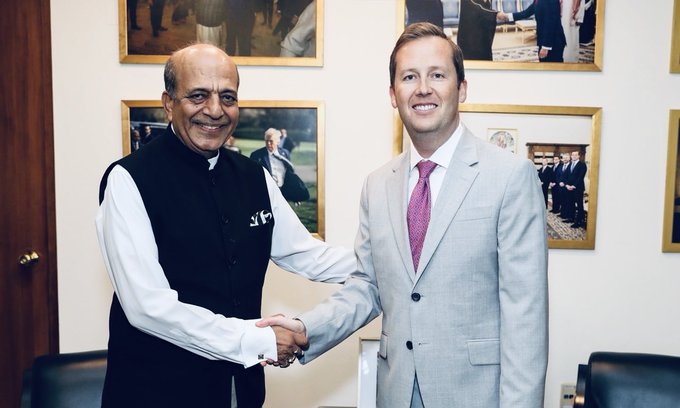
India's high commissioner to Bangladesh Dinesh Trivedi with US ambassador in India Sergio Gor. (Image Trivedi on X)
By TRH World Desk
Former Foreign Secretary Kanwal Sibal’s public exchange with High Commissioner Dinesh Trivedi highlights India’s long-standing sensitivity to third-party roles in South Asia and raises questions about Washington’s regional diplomatic mandate.
New Delhi, June 26, 2026 — A seemingly routine exchange of congratulatory messages on X between India’s newly appointed High Commissioner to Bangladesh, Dinesh Trivedi, and Sergio Gor, the United States’ Special Envoy for South and Central Asia, has evolved into a revealing public debate on the nuances of diplomacy, regional geopolitics and India’s strategic autonomy.
The discussion took a significant turn when former Foreign Secretary Kanwal Sibal, one of India’s most respected diplomatic voices, publicly questioned why India’s envoy in Dhaka would look forward to “working closely” with the US envoy in Bangladesh.
The exchange has exposed a deeper issue: how New Delhi should interpret Washington’s expanding diplomatic architecture in South Asia.
The Exchange
Sergio Gor congratulated Trivedi on his appointment, writing that he looked forward to working closely with India’s new High Commissioner in Bangladesh.
Trivedi responded warmly, thanking Gor and saying he too looked forward to working closely with him while expressing hope that the American envoy would soon visit Dhaka.
It was a perfectly courteous diplomatic response.
Yet Sibal saw something more.
“On what issues does our new HC in BD intend to work closely with the US ambassador to India?” he asked.
Trivedi appeared surprised by the question.
Referring broadly to international cooperation, he replied that countries work together during crises such as the COVID-19 pandemic and natural disasters, adding that he was responding only because of the respect he had for Sibal.
Sibal’s Larger Concern
Sibal’s subsequent explanation transformed the conversation from a social media exchange into an important discussion on diplomatic protocol.
His concern was not with Trivedi personally but with the institutional implications of Sergio Gor’s designation as US Special Envoy for South and Central Asia while simultaneously serving as Washington’s ambassador to India.
According to Sibal, India has never formally recognised such a regional mandate.
He argued that if the US envoy claims responsibility for South Asia as a whole, the position could be interpreted as giving Washington a coordinating role over India’s relations with neighbouring countries, including Bangladesh and Pakistan.
For Indian strategic thinkers, that raises uncomfortable historical parallels.
Echoes of the Holbrooke Era
Sibal explicitly invoked the memory of Richard Holbrooke, appointed by the Obama administration in 2009 as Special Representative for Afghanistan and Pakistan.
At the time, New Delhi strongly resisted any attempt to widen Holbrooke’s mandate to include Kashmir or India-Pakistan issues.
India’s position was clear: bilateral issues involving India could not become part of a third-party diplomatic framework.
Sibal argues that today’s arrangement risks creating a similar perception, albeit under a broader South Asia label.
His point is subtle but important.
If the American envoy routinely engages India’s ambassadors in neighbouring capitals under a regional mandate, it could gradually normalise the idea that Washington has an overarching coordinating role in South Asian diplomacy.
That would sit uneasily with India’s longstanding opposition to external mediation in the region.
From Tashkent to Trump’s India Envoy: Sergio Gor Raises Curiosity
Bangladesh’s Growing Strategic Importance
The timing of the exchange is particularly noteworthy.
Bangladesh has become one of the most strategically contested countries in South Asia. China has significantly expanded its economic and security engagement with Dhaka through infrastructure investments, defence cooperation and connectivity projects.
Meanwhile, the United States has also increased its diplomatic engagement in Bangladesh, citing democratic governance, economic cooperation and Indo-Pacific security.
India, for its part, regards Bangladesh as central to its “Neighbourhood First” policy and eastern security architecture. Against that backdrop, even routine diplomatic interactions acquire greater strategic significance.
Trivedi’s Political Appointment
Unlike most Indian High Commissioners, Dinesh Trivedi enters Dhaka with decades of political experience and Cabinet rank. His appointment itself signals that Prime Minister Narendra Modi attaches exceptional importance to Bangladesh at a time of regional political transition.
That makes every public statement from India’s envoy more closely scrutinised than would ordinarily be the case.
Diplomacy in the Age of Social Media
The episode also illustrates how diplomacy has changed in the era of social media. A brief message intended as diplomatic courtesy can instantly become the subject of strategic interpretation by former diplomats, policy experts and governments.
Traditionally, such discussions would have remained confined to confidential diplomatic channels. Today they unfold in public view, offering rare insights into competing schools of strategic thought within India’s foreign policy establishment.
Courtesy Versus Strategic Messaging
There is little evidence that Trivedi intended anything beyond diplomatic courtesy. His reply reflected standard diplomatic language welcoming cooperation on issues of common concern.
Yet Sibal’s intervention serves as a reminder that in international diplomacy, wording matters. Diplomatic protocol often carries strategic meaning beyond the text itself.
For India’s foreign policy establishment, the episode underscores a continuing principle that has guided New Delhi for decades: while India welcomes cooperation with partners, management of relations with its immediate neighbours remains a sovereign bilateral matter directed from New Delhi—not through external regional frameworks.
That debate, sparked by a handful of posts on X, reflects a much larger contest over influence, diplomatic mandates and strategic space in an increasingly competitive South Asia.
China-Bangladesh Strategic Shift: Why India Should Be Concerned
Follow The Raisina Hills on WhatsApp, Instagram, YouTube, Facebook, and LinkedIn




About The Author