Dharmendra Pradhan Resigns: Education Ministry Remains a ‘Hot Potato’ Under Narendra Modi
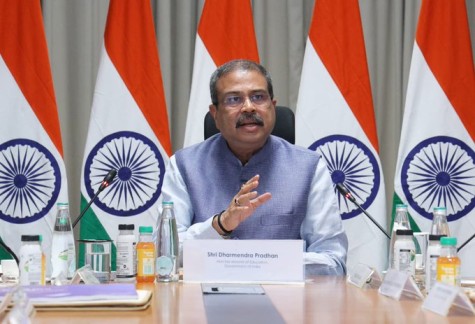
Union Minister Dharmendra Pradhan (Image Ministry of Education on X)
By NIRENDRA DEV
Smriti Irani to Dharmendra Pradhan — the Education Ministry has continued to remain one of the most politically contentious portfolios under successive BJP governments.
New Delhi, July 25, 2026 — With Dharmendra Pradhan on Saturday resigning after a raging student agitation, the spotlight is now on the key portfolio, which has seen several ministers in the last two decades. The Human Resource Development (HRD), now renamed the Ministry of Education, has long been regarded as a politically sensitive ministry under the BJP, both during Prime Minister Narendra Modi’s tenure and earlier under Atal Bihari Vajpayee.
Smriti Irani became HRD Minister on May 26, 2014, when Narendra Modi assumed office for the first time. Then a Rajya Sabha MP from Gujarat, she held the portfolio until July 5, 2016, when she was replaced by Prakash Javadekar. Neither Irani nor Javadekar is currently part of the Union Cabinet.
Following the BJP’s victory in 2019, Ramesh Pokhriyal ‘Nishank’, MP from Haridwar and former Uttarakhand Chief Minister, was appointed Education Minister on May 30, 2019. He remained in office until July 7, 2021.
The ministry was then handed over to Dharmendra Pradhan, who had earlier been heading the influential Petroleum Ministry.
During the Vajpayee government, Murli Manohar Joshi served as HRD Minister between 1998 and 2004. His tenure frequently attracted controversy over allegations of the “saffronisation” of education, particularly concerning NCERT textbook revisions, the introduction of Vedic studies, and what critics described as ideological appointments.
Fast-Track Courts Won’t Fix Paper Leaks, Says Analyst — “We’ve Tried This Before, and It Failed”
Earlier, during Vajpayee’s first 13-day government in 1996, the Education (HRD) portfolio remained with the Prime Minister himself.
Similarly, Prime Minister P. V. Narasimha Rao retained the Education portfolio for around 120 days in 1996 after Madhavrao Scindia resigned. Scindia stepped down after his name surfaced in the Jain Hawala case, although he maintained his innocence.
In contemporary India, many Hindus have become increasingly assertive about defending what they perceive as their civilisational and cultural rights. Such assertiveness should not automatically be equated with communalism.
However, any form of religious assertiveness carries risks if fringe elements are allowed to dominate the discourse. Just as sections of minority communities have, at times, fallen prey to radicalisation, similar dangers exist for extremist elements within the Hindu community.
Both the majority and minority communities share the responsibility of ensuring that religious rivalries do not deepen social divisions.
In this context, Smriti Irani’s 2016 speech in the Lok Sabha remains significant for the debate it triggered over school textbooks prepared during the Congress-led UPA government.
Quoting from her speech, Irani said: “I wondered, where do our kids learn from? This is a history book for students of Class IV — Teacher’s Reader. The author of this book is Teesta Setalvad. This book was commissioned during the UPA government under Kapil Sibal. We continue to perpetuate the colonial legacy of portraying ancient India as synonymous with Hindu India and medieval India with Muslim rule.”
Referring to the contents of the textbook, Irani further argued that passages dealing with Shivaji, Akbar, Aurangzeb, the 1984 anti-Sikh riots, communal violence, and Kashmir reflected what she described as a particular ideological perspective.
She questioned whether such material was appropriate for young schoolchildren and asked in Parliament: “Are we shocked that our students go to universities and say ‘Kashmir ki azadi tak jung ladenge’?”
The debate over school curricula, historical interpretation and ideological influence in education has remained one of the most contentious issues in Indian politics.
The controversy also raised broader political questions regarding textbook authorship, academic independence, and the relationship between activism, politics and education policy.
CJP Protests Force a Reckoning: Has Mainstream Media Failed India’s Public Interest?
Follow The Raisina Hills on WhatsApp, Instagram, YouTube, Facebook, and LinkedIn




About The Author