CJP Protests Force a Reckoning: Has Mainstream Media Failed India’s Public Interest?
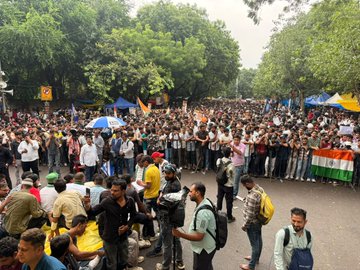
Has the CJP Protest Created India’s New Journalism Moment? Why Independent Reporters Are Winning Public Trust (Image CJP on X)
By TRH Op-Ed Desk
Analyst Manish Anand says the anger at Jantar Mantar isn’t really about reporters — it’s about years of media silence on jobs, healthcare, and exam leaks
New Delhi, July 25, 2026 — The Cockroach Janta Party’s (CJP) escalating protest movement has done more than put the government on the back foot — according to political analyst Manish Anand, it has forced a long-overdue conversation about the credibility of India’s mainstream media.
Speaking on the protests that have now spread from Delhi’s Jantar Mantar to Bihar, Patna, and Maharashtra following the July 20 Sansad Marg march and the heavy police response that followed, Anand in his monologue for The Raisina Hills argued that the confrontations between protesters and television reporters at the protest site are a symptom of a deeper institutional failure, not the cause of the unrest.
“Accountability isn’t reserved for the government alone — anyone operating in the public interest owes it too, and that includes the media,” Anand said. He argued that a news outlet’s legitimacy comes entirely from the public it serves, and that a press which stops centering people’s grievances and instead becomes “part of the narrative” it should be scrutinising will eventually face the same hard questions it has avoided asking of others.
“Where was mainstream media when papers were leaking?”
Anand’s sharpest criticism was reserved for what he called the media’s silence during the very crises that sparked the CJP movement — recurring examination paper leaks, cancelled exams, and irregularities in CBSE evaluation — while, he said, primetime coverage instead tracked the Prime Minister’s foreign trips, award ceremonies, and Mann Ki Baat broadcasts.
“If journalism becomes just a job — if newsrooms run by owners stay aligned with the establishment — public interest issues will keep getting sidelined, and that’s a loss not just for people today but for the country and its democracy in the long run,” Anand said, adding that a dependent media cannot sustain a healthy democracy.
Contractualisation, not just leaks, is the real crisis
Anand connected the paper-leak scandals to a structural problem he says has gone largely unreported: the contractualisation of India’s education and healthcare workforce. He pointed to National Testing Agency staffing, where he said over 70% of personnel are contractual, and cited former Education Secretary Anil Swaroop’s assessment that outsourcing is a key driver of examination irregularities.
He raised similar concerns about healthcare, noting doctor vacancies exceeding 30% at AIIMS Delhi and even higher shortfalls at newer AIIMS campuses in Rishikesh, Gorakhpur, Patna, and Darbhanga — even as, he said, infrastructure spending on these campuses continued uninterrupted. “There’s money for buildings and contractors, but not enough to make doctors’ and teachers’ jobs permanent — and that’s the real reason quality in education and healthcare keeps slipping,” he said, questioning why record GST collections haven’t translated into better public services.
A call for “people’s ownership” of media
Anand’s broader argument is that alternative and independent media — much of which has covered these issues on YouTube and other digital platforms for years — has done the job mainstream outlets avoided. He called on citizens to build ownership of new, independent media models rather than relying on channels he described as structurally dependent on establishment favour.
He also urged CJP supporters to distinguish between reporters doing their jobs and the channel ownership setting editorial agendas, arguing that real accountability lies with media owners, not field reporters. “Reporters aren’t the ones setting the agenda — hold the ownership accountable, and reform will follow,” he said.
(Manish Anand is a political analyst. Views expressed are his own.)
Fast-Track Courts Won’t Fix Paper Leaks, Says Analyst — “We’ve Tried This Before, and It Failed”
Follow The Raisina Hills on WhatsApp, Instagram, YouTube, Facebook, and LinkedIn




About The Author