American Blood in Jordan: The Iran War Just Got Harder to Sell as “Almost Over”
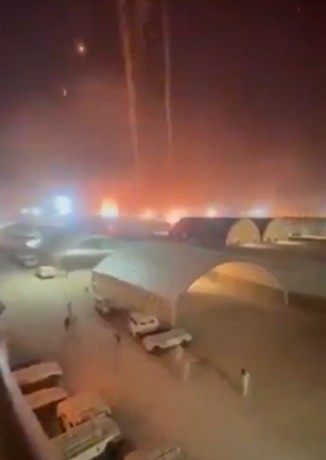
Iran cluster bomb attack in Jordan (Image video grab)
By TRH World Desk
Two U.S. service members killed, one missing, after Iran struck a base in Jordan. The death toll in the Iran war climbs to 16 as the interim deal collapses and Tehran calls Trump’s signature “worthless.”
New Delhi, July 19, 2026 — For a war the Trump administration has repeatedly suggested is nearing its endgame, Friday’s news landed like a gut-punch. Two U.S. service members were killed in Jordan and a third remains missing after Iran launched ballistic missile and drone strikes on a base there, U.S. Central Command confirmed. Four additional troops were hospitalized in Jordan and later discharged.
CENTCOM’s statement was terse: the personnel died “as U.S. Central Command (CENTCOM) and partner forces defended against Iranian ballistic missile and drone attacks.” One is still unaccounted for.
It’s a grim marker. With these losses, the U.S. military death toll in the Iran war has climbed to 16, with hundreds more troops wounded since fighting began. And it comes at a moment when the diplomatic track — the one piece of the story the White House could point to as evidence of progress — appears to be falling apart.
An interim agreement, reached roughly a month ago and billed as a step toward permanently ending the fighting, is now effectively dead. Iranian negotiators say Tehran is suspending its commitments to that framework.
In a statement read on state television, Iran’s Supreme Leader Mojtaba Khamenei escalated the rhetoric further, dismissing Trump’s signature as “worthless and invalid” and accusing Washington of repeated violations of prior agreements. He warned of “lessons” to come — not just from Iran, but from the network of regional proxies it calls the Axis of Resistance.
That’s a significant shift in tone from a leadership that, weeks earlier, had at least kept a channel open. The timing — Iran torching the interim deal within days of American deaths on its doorstep — makes the coincidence hard to ignore, even if no side has drawn a direct line between the two.
A President Who Keeps Promising an End That Doesn’t Arrive
Trump has spent the past week publicly signalling momentum. He told Fox News the strikes would continue “until I say it’s enough,” and in a primetime address that barely touched on Iran, he told Americans they’d see the results of the campaign “very, very shortly.” Asked about the Jordan deaths, he struck a more sombre note, calling it simply a very sad thing.
That’s a harder sell now. The war has already drawn in the largest American military buildup in the region since the 2003 invasion of Iraq, and more than 50,000 U.S. personnel are currently deployed across the Middle East. Fighting has centered increasingly on the Strait of Hormuz, the narrow waterway that historically carried roughly a fifth of the world’s crude oil — and which Iran has closed again, prompting the U.S. to reinstate a blockade on Iranian ports.
Even members of the administration’s own team are hedging on whether military pressure alone gets the job done. JD Vance, US Vice President, who has taken the lead on negotiations with Tehran, said this week that bombing campaigns can strip away radar and missiles but can’t fully secure a waterway that’s simply too easy to strike from the shore. His argument, in essence: at some point, this has to end at a table, not just from the air.
Congress Isn’t Staying Quiet
Criticism from Capitol Hill has sharpened alongside the casualty count. Washington Democratic Representative Adam Smith argued that the president’s war in Iran is producing what he called “perpetual global chaos” — a line that’s likely to get repeated as the death toll rises and the endgame stays undefined.
That criticism lands differently after American service members die defending a base in a country, Jordan, that isn’t even a direct combatant in the war. It underscores how far the conflict’s blast radius has spread beyond Iran’s own borders — into Jordan, into Lebanon, into Iraq’s Kurdistan region, where drone and rocket strikes this same week killed nine members of an Iranian Kurdish opposition group.
Not Just a New Entry in Sad Saga
Three things make the Jordan deaths more than just another grim entry in the casualty count:
– The diplomatic off-ramp just narrowed. The interim deal was the clearest evidence the war had a plausible exit. Iran walking away from it removes that pressure valve right when American forces are absorbing new losses.
– The regional spillover keeps widening. Jordan, Lebanon, and Iraqi Kurdistan have all seen deadly incidents tied to the broader conflict in the span of a single week, suggesting containment isn’t holding.
– The political cost is rising at home. Every American death makes it harder for the administration to frame this as a war that’s almost over, and easier for critics to frame it as one without a clear end state.
None of this means the war is unwinnable or that a resolution isn’t still possible. But “very, very shortly” is a phrase that gets harder to say — and harder to believe — every time it’s followed by another CENTCOM statement announcing American dead.
(This is a developing story. Casualty figures and diplomatic developments in the Iran war are subject to change as officials release additional information.)
US Strikes Collapse Chabahar Port Tower as Iran War Escalates
Follow The Raisina Hills on WhatsApp, Instagram, YouTube, Facebook, and LinkedIn




About The Author