Vikram-1 Reaches Orbit: India Joins Elite Private Space Club
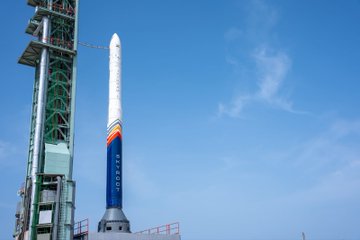
Vikram-1 rocket lifting off from Satish Dhawan Space Centre during Mission Aagaman (Image Skyroot)
By KUMAR VIKRAM
Vikram-1 Reaches Orbit: How One Rocket Launch Signals a Bigger Shift in India’s Space Programme
New Delhi, July 18, 2026 — For sixteen minutes on Saturday, a four-stage, carbon-composite rocket built by a nine-year-old Hyderabad startup did something no privately built Indian vehicle had done before. It flew.
Skyroot Aerospace’s Vikram-1 lifted off from the Satish Dhawan Space Centre in Sriharikota under the banner of Mission Aagaman, and by the time its final burn was complete, it had placed its payloads into a Low Earth Orbit roughly 450 kilometres above the planet. With the mission’s success, India became the third country in the world to demonstrate private orbital launch capability.
A Nine-Year Build-Up to Sixteen Minutes
The scale of what happened is easy to understate in a single sentence. The launch vehicle stood tall as a seven-storey building. A four-stage rocket engineered to complete powered flight in under sixteen minutes before releasing its payloads into orbit at a 60-degree inclination. The rocket is named for Vikram Sarabhai, the physicist widely credited as the architect of India’s space programme, and built largely from lightweight carbon composite materials.
The Researchers detailed the propulsion architecture behind the milestone: three solid-propellant stages paired with a restartable, liquid-fuelled Orbital Adjustment Module, a combination designed to let the company place satellites into precise, multiple orbital configurations for future commercial customers. It noted the mission carried technology-demonstration payloads from companies including Grahaa Space, Cosmoserve and DCubed, alongside Skyroot’s own SCOPE platform — a signal that Vikram-1 wasn’t just proving out Skyroot’s own hardware, but already carrying paying and partner cargo on its very first flight.
It’s also not Skyroot’s first trip to space, just its first to orbit. The company’s earlier suborbital rocket, Vikram-S, flew successfully back in November 2022 under Mission Prarambh — a technology-proving flight that the current mission builds directly on, according to India.com’s report.
The launch drew an immediate response from the top of government. Prime Minister Narendra Modi personally congratulated Skyroot Aerospace, calling the mission a landmark achievement for India’s growing space ecosystem. Modi phoned the Skyroot team and remarked that the achievement was “merely the beginning.”
India currently values its space economy at $8.4 billion, roughly 3% of the global market, with an official goal of growing that figure fivefold within seven years.
A Widening Field of Private Players
Vikram-1’s success is the most visible recent data point in a broader shift that has been building since 2020, when India first opened its space sector to non-government players. IBEF’s overview of the sector put a number on how much has changed since: more than 200 spacetech startups have emerged in that time, spanning launch vehicles, satellite manufacturing and space-data analytics.
Skyroot is far from working alone. Agnikul Cosmos is developing its own semi-cryogenic, 3D-printed rocket engine and, per IBEF, plans to launch from its own private launchpad at Sriharikota. Pixxel has built a name in hyperspectral Earth observation, with satellites capable of tracking crop health, pollution and climate conditions — a business that has attracted serious outside capital.
For all the policy momentum, the money hasn’t flowed in a straight line. New Space Economy cited Inc42 data showing Indian space-tech funding actually fell 35% year-on-year to $81 million in 2024, even as the number of deals rose, and separately noted funding had declined more than 53% versus 2023 by some measures — with late-stage capital, the kind companies need to move from prototype to operational hardware, remaining a persistent constraint.
Shubhanshu Shukla in Space Puts Trump and Modi Pact in Action
Follow The Raisina Hills on WhatsApp, Instagram, YouTube, Facebook, and LinkedIn




About The Author