Nagaland’s Next Stage: From Insurgency to Radical Regionalism
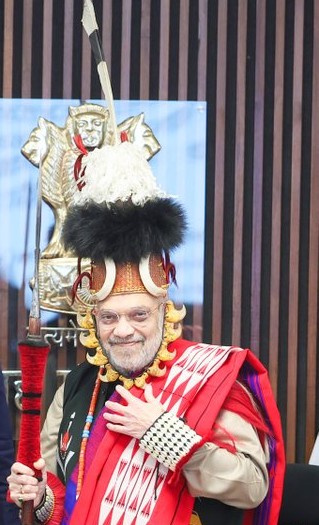
Union Minister for Home Affairs Amit Shah at the signing of tripartite Naga agreement in New Delhi (Image PIB)
Nagaland’s Next Stage: From Insurgency to Hard Regionalism — The New Governor Faces a Complex Inheritance
By NIRENDRA DEV
Kohima, March 9, 2026 — In the Naga peace process, truth is rarely the first casualty — because falsehood has long been treated as smart diplomacy, and propaganda as its indispensable tool. That foundational reality has not changed with the appointment of Nand Kishore Yadav as Nagaland’s new Governor. What has changed is the urgency.
Governor Yadav, Union Home Ministry mandarins, and the newly appointed North East advisor Ajit Lal will now need to sit together, exchange notes, and build a shared understanding of the Naga issue’s finer and most contentious aspects. The learning curve is steep. The margin for error is slim.
The Government of India’s Position: One Solution, One Platform
New Delhi has made its position unambiguous. The Government of India insists on a single solution framework — with all Naga groups sitting together, negotiating on a common draft, on a common platform. That common draft, in GoI’s formulation, must be based on both the Framework Agreement of 2015 and the Agreed Position of 2017.
The NSCN-IM, however, wants only the Framework Agreement acknowledged — effectively positioning itself as the sole legitimate custodian of the Naga cause and the only organisation capable of delivering a settlement.
“No one else.”
This is, as one well-placed insider notes, a stance rooted in a peculiarly Communist ideological framework — one that is fundamentally anti-democratic in its impulse. Inspired by the Chinese political model, it actively discourages dissenting views. The underlying message: My way is not just the best way. It is the only way.
Inclusiveness — A Word With Two Meanings
The concept of “inclusiveness” means entirely different things depending on who is using it. For the NSCN-IM and sections of the Naga movement, inclusiveness means that Nagas living outside the present state of Nagaland — in Manipur, Arunachal Pradesh, and Assam — must be accommodated within the scope of any political solution. This is the ideological foundation of the Nagalim concept.
For New Delhi, inclusiveness means that all Naga militant organisations must be given meaningful weight in the process. This thinking drove the decision to bring the Naga National Political Groups (NNPG) into the discussion framework in 2017, leading to the signing of the Agreed Position and the Status Paper on November 17, 2017 — a development the NSCN-IM did not welcome.
New Delhi’s frustration is articulate on this point: to question the government’s intentions on inclusiveness is, in effect, to keep the talks permanently stalled. GoI’s refrain remains consistent — Separate solutions will be no solution.
FNTA and Eastern Nagaland: A Development That Snubs the Nagalim Theory
The emergence of the Frontier Nagaland Territory Accord (FNTA) and the political aspirations of Eastern Nagaland’s tribes represent a development that has quietly but significantly undermined the Nagalim framework. It is now impossible to ignore the question: who is actually dividing the Nagas?
New Delhi denies the charge. From a national security and geo-strategic standpoint, sustaining divisions among Naga communities in sensitive border states serves no interest for the Government of India. The same, however, cannot be said for national political parties.
The scramble by both the Congress in its heyday and the BJP now to establish party bases in Nagaland and Naga-inhabited areas has not served long-term stability. Organic regional parties — genuinely rooted in democratic structures — should have been encouraged far more vigorously. They would have offered a natural counterweight to armed struggle. Instead, politicians, bureaucrats, business interests, and large contractors benefiting from Nagaland’s public funds have all actively promoted the mainstreaming of national parties at the expense of authentic regional political development.
Modi Government’s Intent: Path-Breaking, But Not Without Adhocism
In terms of intent, the Modi government’s record is mixed but not dismissive. Both the Framework Agreement and the Agreed Position were signed in genuine good faith. Significantly, Prime Minister Modi chose to have then-negotiator R N Ravi sign the Framework Agreement — a departure from convention, under which the Union Home Secretary would ordinarily sign such pacts. That choice signalled the political seriousness with which Modi approached the Naga issue.
The clear message embedded in both pacts is that their status is equal — neither supersedes the other.
The Civil Society Mirage
One lesson that Governor Yadav and advisor Ajit Lal must internalise quickly: expecting civil society alone to unite multiple Naga factions under a single umbrella will not work. It has never worked. Such exercises consume money, consume time, and primarily benefit political powerbrokers. The Political Affairs Committee and various other civil society mechanisms have tried and failed repeatedly. Underground leaders do not trust state politicians. State politicians do not trust underground leaders.
This does not mean the Government of India should abandon the effort. It means New Delhi must stop outsourcing it and start leading it directly.
The pointed remarks by NPF legislator K Azo Nienu on the floor of the Nagaland Assembly raise a critical question that deserves a serious answer: has the onus of bringing unity and delivering a solution now shifted entirely to ordinary, fed-up Nagas and the Concern Forum of Nagaland?
The Strategic Imperative — and What Shah’s Team Must Now Do
The Naga issue is not merely a political problem. Because Naga communities sit across key international border states, its unresolved status carries genuine national security and geo-strategic consequences. Home Minister Amit Shah’s team — now including Governor Yadav — must keep four things in mind:
The Government of India cannot continue to wait for civil society to deliver what it has consistently failed to deliver. The process of including all relevant issues — and all relevant groups — in the common draft is as important as the content of the draft itself. The note circulated around 2013–14 when former Nagaland Chief Secretary R S Pandey was handling the peace talks made an important observation: the politics of “overlapping Naga territory” is essentially the agenda of one or two specific Naga tribes seeking permanent mechanisms of political dominance across Manipur, Nagaland, and Arunachal Pradesh. New Delhi’s mandarins say this reality is not lost in the rhetoric around a Pan-Naga body.
Finally, the anti-India positioning adopted by sections of the Naga political establishment — linking the peace process to Hindutva controversies and Vande Mataram disputes — serves no constructive purpose. These are national political questions that national politics will address in due course. Conflating them with the Naga settlement process only deepens the deadlock.
The Government of India was visibly displeased in October 2025 when NSCN-IM chief Thuingaleng Muivah did not maintain appropriate decorum during his visit to Somdal village and parts of Manipur. The incident reportedly angered Prime Minister Modi personally.
The underlying attitude that irritated New Delhi has a name in Hindi: “Shanti ka theka Delhi ka responsibility hae” — as if only the Centre needs peace and must therefore pursue it even at the cost of national dignity.
Former Nagaland Chief Minister J B Jasokie once made a characteristically blunt observation in the 1990s: “Some communities are not good at even begging for funds and peace.”
The remark was harsh. It was also, in its own way, a challenge — that a people who demand their own solution must also demonstrate the will to pursue it.
(This is an opinion piece. Views expressed are author’s own.)
New Nagaland Governor: Modi’s Naga Policy Driven by Adhocism?
Follow The Raisina Hills on WhatsApp, Instagram, YouTube, Facebook, and LinkedIn




About The Author