Iran War’s Economic Bill: A Global Shock, Kyrgyz Ex-PM Warns
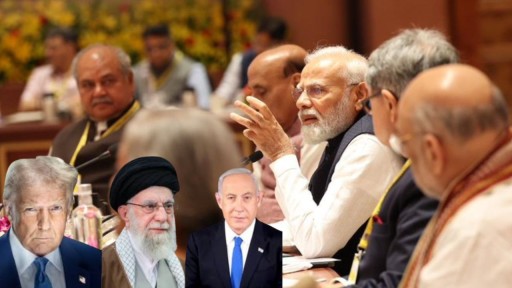
India challenge amid Middle East crisis. (Image X.com)
Iran War’s Hidden Economic Bill: $1 Billion a Day for the US, 72% Aviation Fuel Surge, and a Global Shock — Kyrgyz Ex-PM Warns
By TRH World Desk
New Delhi, March 9, 2026 — One week into the US-Israel military campaign against Iran, the world’s attention has been fixed on missiles, airstrikes, and battlefield developments. But former Kyrgyz Prime Minister Djoomart Otorbaev argues that the most consequential story is not being told on any military map — it is unfolding in global energy markets, financial systems, and national budgets from Washington to New Delhi to Seoul.
“Only one week into the war with Iran, the geopolitical headlines focus on missiles, airstrikes, and dramatic battlefield developments,” Otorbaev wrote on LinkedIn. He further stated that “the most important story is unfolding in the global economy.”
America Is Paying — More Than It Anticipated
The financial scale of the campaign has already surprised analysts. Citing The New York Times, Otorbaev notes that the first week of military operations cost Washington approximately $6 billion. Pentagon estimates place the daily burn rate at $1 billion per day.
“If the conflict lasts the four to six weeks expected by the White House, the total bill could easily exceed $30–40 billion,” Otorbaev writes — a figure that will land heavily on a US administration already managing significant domestic fiscal pressures.
Europe and Asia: The Collateral Economic Damage
The war’s second and, in Otorbaev’s assessment, far more consequential impact is the economic shockwave spreading through America’s allies. The trigger came swiftly.
When QatarEnergy suspended liquefied natural gas production amid regional escalation, European gas prices surged — hitting economies already vulnerable from the 2022 Ukraine war energy crisis. Otorbaev quotes former IMF chief economist Maurice Obstfeld, who warned that Europe and Asia’s heavy dependence on imported hydrocarbons makes them “extremely vulnerable to geopolitical shocks.”
The market reaction confirmed it. While the S&P 500 fell by only 2%, the South Korean stock market plunged nearly 20%. India’s rupee came under severe pressure against the US dollar. Otorbaev adds a striking data point: New Delhi already spends more than $32 billion annually subsidising domestic energy prices — a burden that will compound sharply if oil and gas remain elevated.
In Europe, Italy and Belgium — both heavily dependent on energy imports — are among the economies experiencing the strongest inflationary pressure.
Aviation and Logistics: The 72% Fuel Surge
Perhaps the most striking single statistic in Otorbaev’s assessment concerns the aviation sector. Aviation fuel prices in Europe have already surged 72%, approaching the extreme levels recorded in 2022 following Russia’s invasion of Ukraine.
The structural cause is clear. Iranian strikes and airspace restrictions have severely disrupted air cargo routes that relied on major hubs in the UAE and Qatar. Cargo aircraft flying from East Asia to Europe now face an extraordinarily narrow navigational corridor — blocked by Russian airspace to the north and the Iranian war zone to the south.
“The result: longer routes, higher fuel consumption, and rising logistics costs,” Otorbaev writes. The ripple effect on global supply chains — already under strain — is significant and likely to deepen.
Tehran’s Strategy: Make the War Economically Unbearable
Otorbaev identifies what he believes is Iran’s deliberate strategic logic. “Iranian officials describe their approach as making the war economically unbearable for their opponents,” he notes. “If that is the objective, the early indicators suggest it is working.”
The formula is not new, but its application is precise: avoid decisive military defeat long enough for economic pain to fracture the political coalition sustaining the campaign. Every day the Strait of Hormuz remains disrupted, every week aviation fuel climbs, and every percentage point added to European gas prices strengthens Tehran’s hand at any eventual negotiating table — even as its military infrastructure is degraded.
The Uncomfortable Truth
Otorbaev closes with a warning that transcends this specific conflict. “The uncomfortable truth is that modern wars are rarely confined to the battlefield. They ripple through energy markets, financial systems, supply chains, and national budgets,” he writes. “In this war, the missiles may be flying over the Middle East. But the economic shockwaves are hitting Washington, Brussels, Seoul, and New Delhi just as hard,” he added.
Follow The Raisina Hills on WhatsApp, Instagram, YouTube, Facebook, and LinkedIn




About The Author