NEET-UG 2026 Cancellation Raises Accountability Questions
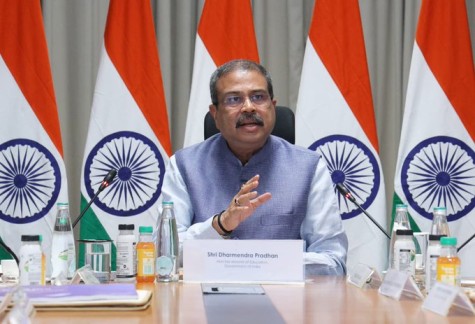
Union Minister Dharmendra Pradhan (Image Ministry of Education on X)
By TRH Op-Ed Desk
The cancellation of NEET-UG 2026 has reopened debate over exam leaks, NTA’s institutional weaknesses, and the Education Minister’s remarks on parliamentary oversight.
New Delhi, May 17, 2026 — India’s examination crisis has deepened once again. The NEET-UG 2026 — the national medical entrance test that determines the futures of over 22 lakh aspiring doctors — was cancelled days after it was held on May 3, following fresh allegations that its question paper had been circulating on WhatsApp before the exam. The National Testing Agency (NTA), the body mandated to conduct such examinations, stands at the centre of a storm that analysts say has been building for years — one that implicates systemic failure, political indifference, and a troubling contempt for parliamentary accountability.
Union Education Minister Dharmendra Pradhan announced at a press conference that the NEET-UG re-examination would be held on June 21, and that the exam would shift to a Computer-Based Test format from next year as part of structural reforms. Pradhan also stated that the government has “zero tolerance” toward irregularities and that students’ fees would be refunded. But the reassurances have done little to quell the fury.
THE REMARK THAT SHOOK CONSTITUTIONAL NORMS
The most explosive moment of the controversy came not from the paper leak itself — but from what the Education Minister said about parliament’s own oversight body.
When asked at the press conference about the Parliamentary Standing Committee on Education’s recommendations on the NTA — tabled in December 2025 — Pradhan said: “I do not want to go by the observations of the parliamentary committee. I will go by the Radhakrishnan committee. I will go by facts.” He added: “The Opposition members are in the parliamentary committee. You know better than me how they prepare the reports.”
Political analyst Manish Anand, speaking in a special episode of the YouTube channel of The Raisina Hills, called the remark constitutionally alarming. “Such a statement by a Union Minister has never been heard before,” Anand said, adding: “Parliamentary Standing Committees exist so that the executive is accountable to Parliament. The Standing Committee works year-round, meets stakeholders, hears all sides, and functions as a feedback channel.”
Its reports are presented in Parliament and adopted by consensus — with the ruling party always holding a majority of seats. “To say ‘I will not follow the Standing Committee because the Opposition is in it’ reveals either a complete ignorance of parliamentary democracy or an arrogance that should deeply worry every thinking citizen,” added Anand.
A PATTERN OF INSTITUTIONAL FAILURE
The Parliamentary Standing Committee’s December report had noted that in 2024 alone, of the 14 competitive examinations conducted by the NTA, at least five faced major issues; three — UGC-NET, CSIR-NET, and NEET-PG — had to be postponed, NEET-UG saw instances of paper leaks, and CUET results were delayed.
Manish Anand, analysing the structural roots of the crisis for The Raisina Hills, pointed to the NTA’s own composition as a core problem. “Three-quarters of the NTA’s staff are on contract,” Anand said. “You cannot expect permanent commitment from contractual employees. Permanent accountability demands permanent employment. The structural fault line was always there — the paper leak was its inevitable consequence,” he added.
The human cost of these failures is real and documented. Anand recalled the NEET 2024 leak: a student in Kerala studying MBBS received the leaked paper on WhatsApp, forwarded it to her father in Rajasthan, and by the time the breach was confirmed, the exam had already begun. Biology and chemistry questions matched the leaked paper. The scandal unravelled from there.
“Lakhs of students study day and night with complete honesty,” Anand said. “An exam mafia — embedded inside the system, in collusion with those who run it — sells question papers for lakhs of rupees. An honest student loses their future. Someone who paid for the paper becomes a doctor or an engineer. That is the injustice this country is tolerating,” he added.
THE ACCOUNTABILITY DEFICIT
The broader political question — why no minister has resigned across multiple NEET crises — remains unanswered. Anand drew a pointed contrast with earlier education ministers. “When Atal Bihari Vajpayee made Murli Manohar Joshi his Education Minister, Joshi was a PhD, a former professor at Allahabad University — a man of genuine academic standing,” Anand observed. “The credibility of the minister matters for the credibility of the ministry.”
Anand concluded with a structural warning: “Until accountability is fixed at the top — until the Prime Minister audits his Minister’s performance — no one will know whether the government is serious about education at all. When you reject the Standing Committee’s report, you have closed every window and door. You have decided that only your own view is correct. That approach may serve you. It will not serve the country. And ultimately, it is society — and our next generation — that will pay the price.”
Modi Govt’s Fuel Price Narrative Faces Scrutiny After Latest Hike
Follow The Raisina Hills on WhatsApp, Instagram, YouTube, Facebook, and LinkedIn




About The Author