From NEET to UPTET: How Paper Leaks Shook 6.5 Crore Aspirants in Modi Era
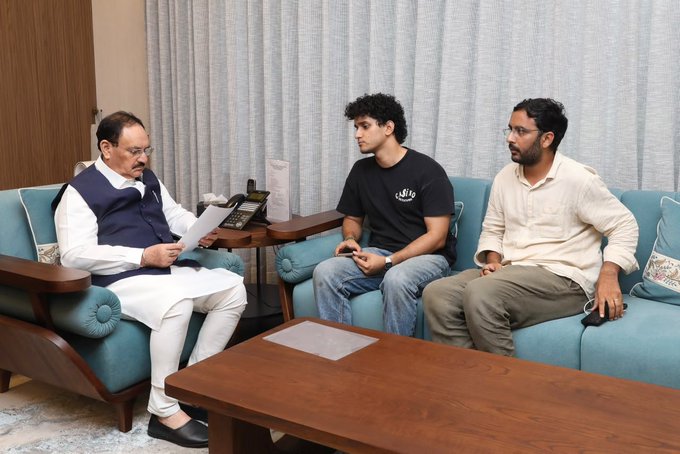
Union Minister JP Nadda meets CJP activists on Monday in New Delhi. (Image Nadda on X)
By PRADEEP KUMAR PANDA
Repeated examination paper leaks since 2014 have affected millions of students, raising questions over accountability, governance, and the credibility of India’s recruitment system.
Bhubaneswar, July 20, 2026 — For millions of young Indians, competitive examinations represent the gateway to a stable future — a ticket to medical college, government service, or engineering seats. Yet, for over a decade, this promise has been repeatedly shattered by a cascade of paper leaks, impersonations, and systemic fraud that have tainted the integrity of India’s examination ecosystem. Comprehensive analyses indicate that since the BJP-led NDA government assumed power at the Centre in May 2014, India has witnessed at least 89 suspected cases of paper leaks and related malpractices where FIRs were filed or examinations were cancelled. These incidents have collectively impacted an estimated 6.5 crore candidates, according to data compiled from reports by Newslaundry, The Wire, Indian Express, and other outlets.
While paper leaks are not a new phenomenon — instances of exam fraud date back decades across various political dispensations — the persistence and scale of the problem during the NDA era have turned it into a national crisis. Critics argue that despite promises of transparent governance and digital reforms, leaks have continued unabated, particularly in central examinations conducted by bodies like the National Testing Agency (NTA) and in BJP-ruled states. The government, for its part, highlights pre-2014 precedents, points to arrests, and cites the enactment of stringent laws as evidence of proactive measures.
A Persistent Scourge Across Regimes, But Surging in Volume
Exam irregularities in India predate the Modi government. Major scams, such as those involving state-level recruitment in the 2000s and earlier, exposed vulnerabilities in printing, distribution, and invigilation processes. However, post-2014 data reveals a troubling continuity and, in some analyses, an escalation. Estimates vary: some trackers document 89 suspected leak cases up to around 2026, while broader datasets cite 93+ incidents since 2017 or even 148+ fraud cases spanning 11 years. Central examinations under NTA and CBSE alone account for roughly 21 notable incidents during NDA rule.
The human cost is staggering. With 6.5 crore candidates affected, the leaks have disrupted careers, delayed livelihoods, and in tragic instances, contributed to student suicides amid despair and uncertainty. Aspirants for teaching, police, forest services, engineering, and medical professions have borne the brunt. Retests, when conducted, often push back timelines by months or years, exacerbating mental health burdens on an already stressed youth population.
Anatomy of the Leaks: Collusion and Digital Amplification
Most leaks follow a familiar pattern: collusion between printing press staff, examination centre officials, coaching institute networks, and political or bureaucratic intermediaries. Physical question papers are smuggled out, photographed, and circulated rapidly via WhatsApp groups and encrypted apps, reaching thousands before the exam bell rings. Impersonation rackets, where proxies sit for candidates, and tampering of answer sheets further compound the fraud.
States with frequent BJP governance or influence — Uttar Pradesh (11+ cases), Rajasthan, Gujarat, Madhya Pradesh, and Bihar — feature prominently in the lists. Yet, non-BJP ruled states have not been immune, underscoring that the malaise transcends party lines even as opposition parties spotlight central failures under the NDA.
Chronicle of Chaos: Major Incidents (2014–2026)
The timeline reveals a relentless drumbeat of disruptions:
2014–2015: The All India Pre-Medical Test (AIPMT, precursor to NEET) was leaked across multiple states, prompting the Supreme Court to order cancellation and a re-examination. In Uttar Pradesh, the Combined Pre-Medical Test (CPMT) faced similar tampering allegations and was scrapped.
2015–2016: The Vyapam scam in Madhya Pradesh, involving massive recruitment and medical admissions fraud, continued to unravel with investigations spanning years. Though roots predated full BJP state control, it overlapped significantly with the regime.
2016: Uttar Pradesh Public Service Commission (UPPSC) RO/ARO and Provincial Civil Services (PCS) exams were cancelled due to leaks. In Gujarat, a police constable recruitment paper was allegedly sold for exorbitant sums, with reports of BJP members among those arrested in related probes.
2017: Leaks in the Staff Selection Commission’s Combined Graduate Level (SSC CGL) exam triggered widespread protests. CBSE and NEET-related issues surfaced alongside board exam leaks in Himachal Pradesh and Maharashtra.
2018: A major blow came with CBSE Class 10 Mathematics and Class 12 Economics papers leaking, forcing re-examinations for lakhs of students. Gujarat constable recruitment faced renewed scrutiny.
2019–2020: Railway Recruitment Board (RRB), Bihar Class 10, Uttar Pradesh board, and Karnataka pre-university exams were hit.
2021: Uttar Pradesh Teacher Eligibility Test (UPTET) affected 21–40 lakh candidates and was cancelled. Rajasthan’s REET, Central Teacher Eligibility Test (CTET), and multiple state recruitments in Maharashtra and Gujarat also collapsed.
2022: Bihar Public Service Commission (BPSC) exam cancellation led to over 226 arrests. Other casualties included Uttarakhand Subordinate Services Selection Commission (UKSSSC), Odisha Junior Engineer, UP Lekhpal, and Rajasthan Forest Guard exams.
2023: Incidents spanned Telangana SSC, another REET cycle in Rajasthan, Bihar Police Constable, and cases in Assam and Maharashtra.
2024: The year brought one of the most contentious episodes — the NEET-UG scandal. Leaks traced to Hazaribagh and Patna involved school collusion, with the CBI identifying around 155 direct beneficiaries. The exam was reconducted amid massive protests, affecting over 23 lakh aspirants. UGC-NET was cancelled/postponed, and UP Police Constable recruitment faced cancellation. Multiple state-level cases added to the tally.
2025–2026: NEET-UG troubles lingered. In Maharashtra, the TET paper was reportedly smuggled from an Agra press in shoes and sold through coaching networks. Odisha OTET, Railway exams, and others continued the pattern.
UPSC and SSC have reportedly remained relatively insulated in recent years, per government claims, but the broader ecosystem remains vulnerable.
Sonam Wangchuk Offers Modi Govt an Escape Route to End the CJP Protest
Political Football and Public Outrage
Exam leaks have become potent election issues. In Rajasthan and Madhya Pradesh polls around 2023, opposition campaigns heavily featured the failures. The INDIA bloc has repeatedly accused the NDA of central mismanagement, particularly targeting the NTA, established to streamline testing but now mired in controversy. The BJP counters by referencing historical leaks under previous governments and emphasizing state-level responsibilities, noting that many incidents occur in opposition-ruled states as well.
Data, however, shows a concentration in BJP-governed heartlands alongside central lapses. This has fueled accusations of political patronage protecting kingpins within coaching mafias and bureaucratic networks.
Government Response: Laws, Arrests, but Limited Accountability
Authorities have not been entirely passive. Thousands of arrests have been made across cases, though conviction rates remain discouragingly low. High-profile cancellations and retests demonstrate damage control, albeit at the cost of further anxiety for candidates.
A landmark step was the 2024 Public Examinations (Prevention of Unfair Means) Act, which imposes stringent penalties — including hefty fines and imprisonment — on those involved in leaks and malpractices. Digital reforms, such as enhanced encryption of question papers and biometric verification at centres, have been rolled out in phases. Yet, implementation gaps persist, and senior officials rarely face meaningful repercussions. Critics argue that the focus remains on punishing foot soldiers while the masterminds — often entrenched in powerful networks — evade justice.
Broader Impacts: Eroding Trust and National Talent Pool
The ripple effects extend far beyond individual tragedies. A demoralized generation questions the meritocratic foundation of Indian institutions. Delayed careers affect family finances, mental health crises deepen, and the overall quality of professionals entering critical sectors — doctors, teachers, administrators — comes under scrutiny.
Economically, the costs of repeated re-examinations, security upgrades, and lost productivity run into thousands of crores. Socially, the crisis exacerbates inequalities: rural and lower-income students, who rely heavily on government exams, suffer disproportionately compared to those who can afford private coaching or international options.
The Road Ahead: Systemic Overhaul or Continued Rot?
Experts advocate comprehensive reforms: complete digitization with AI proctoring, decoupling coaching empires from exam preparation, insulating printing and logistics from local influence, and ensuring swift judicial processes with high conviction rates. Greater transparency in NTA operations, independent audits of exam bodies, and depoliticization of appointments could help restore faith.
As India aspires to become a developed nation by 2047, the examination system — the bedrock of selecting its future workforce — cannot remain a leaking vessel. The 89+ leaks and the plight of 6.5 crore aspirants serve as a stark reminder: without decisive, across-the-board accountability and technological fortification, the dream of equitable opportunity will remain just that — a dream deferred.
The youth of India deserve better. Their patience is wearing thin, and so is the nation’s tolerance for an exam system that repeatedly fails its most ambitious.
(This is an opinion piece. Views expressed are the author’s own.)
Cockroach Janata Party Lays Siege to Parliament, Govt Scurries for a Quick Fix
Follow The Raisina Hills on WhatsApp, Instagram, YouTube, Facebook, and LinkedIn




About The Author