Women Living Alone Are Building a New Life — and a New Publishing Market
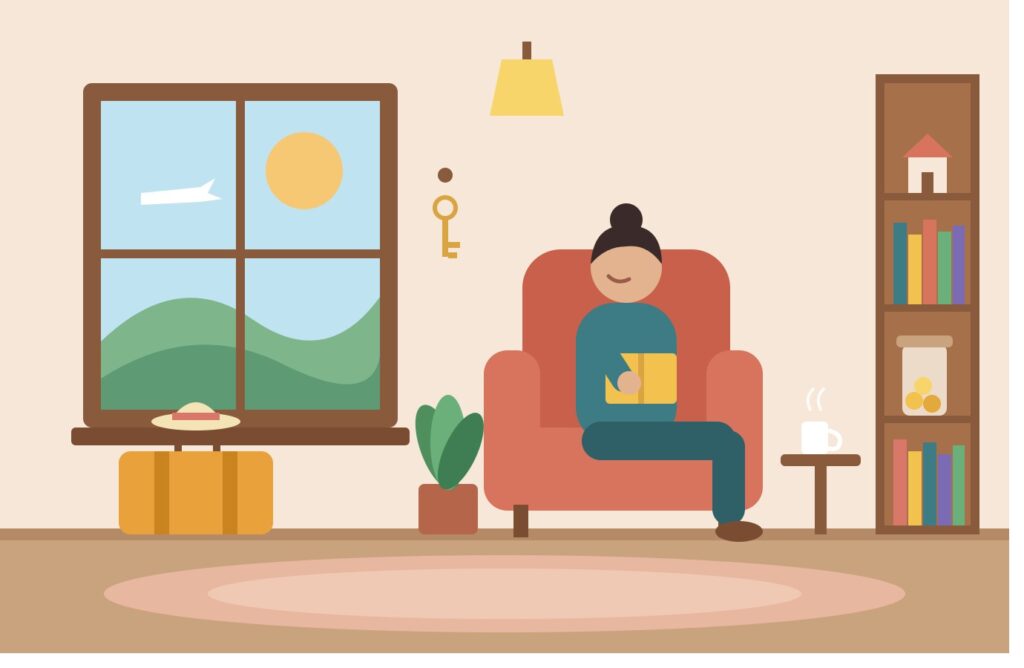
From financial independence to solo travel and home ownership, women living alone are shaping a growing lifestyle and publishing category. (A representative sketch)
By BHAWNA MALIK
From solitude and financial independence to solo travel, home ownership and ageing, women living alone are creating demand for a growing lifestyle and publishing category.
New Delhi, October 7, 2026 — On a Saturday morning, Amara, 34, makes coffee in a kitchen that is entirely hers. No one has rearranged her mugs. No one asks what the plan is. She puts on a record, opens the window and stays in her pyjamas until noon.
“People hear that I live alone and assume I’m waiting,” she says. “Waiting for someone to move in, to complete the picture. I’m not waiting. I’m living.”
That simple distinction is at the heart of a quiet social change. Across the world, more women are living alone. Some have chosen it. Others arrived there after divorce, bereavement, career moves or changing family circumstances. What many of them share is an irritation with the assumption that being single means being incomplete—or constantly available for matchmaking.
For years, the single woman has been portrayed as a woman “in transition”: waiting to settle down, waiting for a partner, waiting for her life to begin. But what if the opposite is true? What if living alone can become a period of discovery, independence and reinvention?
SOLITUDE IS NOT LONELINESS
Living alone and being lonely are not interchangeable. Loneliness is real and deserves to be acknowledged. A woman living alone may experience long evenings, the absence of someone with whom to share everyday news, or genuine concerns about safety. But solitude can also offer something increasingly rare: uninterrupted time with oneself.
After a long relationship, it can become a period of healing. After years of caring for children, parents or partners, it can be the first opportunity to ask: What do I actually want? Meenakshi, 41, left a ten-year marriage two years ago.
“Everyone said I should get back out there,” she recalls. “I needed to figure out who I was when nobody needed anything from me. That took longer than I expected, and it was worth every day.”
That is the emerging conversation around singlehood—not rejection of relationships, but the freedom to decide what kind of life one wants. Women who live alone often describe a different kind of confidence developing over time.
They learn to deal with a leaking tap—or find someone who can fix it. They learn to eat alone at a restaurant without constantly reaching for their phones. They learn how to manage money, organise a home, make decisions and build support networks. Most importantly, they learn to recognise the difference between peaceful silence and painful loneliness. Independence, however, does not mean isolation.
Many women deliberately maintain strong relationships with friends, siblings, neighbours and communities because they understand that autonomy works best when it is supported by connection. A woman can be socially fulfilled and romantically unattached. Both can be true.
And there is no universal timetable for being “ready” for another relationship. Some women may want companionship after months. Others may need years. Some may eventually discover that what they were missing was not a partner, but the freedom to choose their own life.
FROM SOCIAL TABOO TO PUBLISHING OPPORTUNITY
The changing conversation around women living alone is also creating a new readership. Books such as Sreemoyee Piu Kundu’s Status Single are particularly significant in the Indian context. Kundu built the book around her own experience and conversations with nearly 3,000 urban single women.
Other books and anthologies have similarly explored singlehood not as a deficiency but as a legitimate way of life. Single by Choice: Happily Unmarried Women!, edited by journalist Kalpana Sharma, brought together the experiences of 12 women aged between 26 and 72. Titles exploring themes such as eating alone, travelling alone, creating a home, enjoying solitude and building a fulfilling single life point to an important shift in readership.
The reader is no longer necessarily asking: “How do I find a husband?”
She may instead be asking: “How do I build a life?” The woman living alone needs more than inspirational stories. She needs practical knowledge. How does she manage money independently? How does she buy or rent a home? How does she build an emergency network? How does she travel safely?
How does she deal with loneliness when it genuinely arrives? How does she prepare for ageing? How does she create a home that reflects her own identity?
These questions open up an entire publishing ecosystem—from memoir and essays to self-help, financial literacy, mental wellbeing, travel, home management and later-life planning.
The subject can therefore move beyond a “women’s issue” into a women’s lifestyle market. International publishing is already reflecting this shift. Books such as Lucy Meggeson’s Shiny Happy Singles explore themes including living and travelling alone, solitude, friendships, financial independence and child-free life.
The possibilities are enormous: The Art of Living Alone, Financial Independence for Women, Solo Travel, The Joy of Solitude, Starting Again After Divorce, Widowhood Without Withdrawal, Ageing Alone but Not Isolated, Building Your Own Support System and The Solo Home.
These are not merely book titles. They represent questions emerging from a changing society.
The market cannot be treated as one homogeneous category. A 28-year-old professional living alone in Delhi has very different concerns from a 45-year-old divorced woman, a 60-year-old widow, a woman who has consciously chosen never to marry, or an older woman whose children have moved abroad.
Yet they may share one fundamental question: How do I create a meaningful life on my own terms? That question has social, psychological and economic implications.
Research on singlehood and “aloneness” in urban India has also begun examining how single women are often portrayed—as either vulnerable or threatening—rather than as individuals with agency and choices.
The cultural narrative is changing. And publishing is beginning to notice. The opportunity lies not in selling loneliness, but in understanding independence.
The single woman is not simply a demographic waiting to be paired. She is a reader, traveller, homeowner, professional, consumer, caregiver, investor, community member and, increasingly, a creator of her own narrative.
Perhaps that is the most important change. A woman living alone is no longer necessarily a woman waiting for life to happen.She may already be living the life she chose and the publishing industry would do well to listen.
Living Alone, Dying Alone: Why India’s Elders and Single Women Are Becoming Invisible
Follow The Raisina Hills on WhatsApp, Instagram, YouTube, Facebook, and LinkedIn




About The Author