India Has World-Class Infrastructure. But Where Is Our Civic Sense?
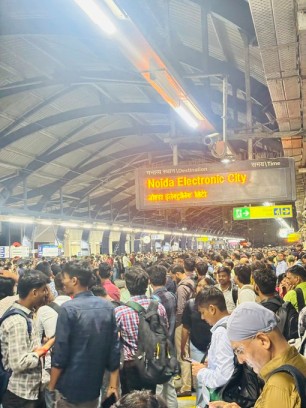
Crowded Delhi Metro station at Connaught Place on Monday evening! (Image X.com)
 By NARESH VATS
From Metro queues and bus tickets to traffic violations and public cleanliness, modern services can deliver lasting change only when citizens use them responsibly.
New Delhi, September 24, 2026 — In the long tradition of journalism, we are taught that the focus of writing and speaking must remain on the problems of the common people. Power, policies, and large projects matter only when they tangibly improve everyday life.
However, in the changing times, a new narrative has taken center stage—one that highlights grand development claims, world-class infrastructure, and impressive statistics. The assumption seems to be that once modern services are created, citizens will automatically become disciplined, responsible, and sensitive users of those services.
This is where the real question arises: Is providing services enough, or does true development also require a strong sense of civic responsibility among citizens?
Take the example of the National Capital Region. The Delhi Metro is widely recognized as a world-class urban transport system. There is no denying that the Metro has made commuting faster, safer, and more affordable for millions.
Yet, the daily experience inside the system often tells a different story—overcrowding, pushing and shoving, breaking queues, blocking doors, and occupying reserved seats meant for senior citizens and women. The problem here is not the quality of the service, but the manner in which it is used. The infrastructure is modern, but civic discipline remains weak.
This sense of disorder becomes even more evident during travel from IFFCO Chowk Metro Station in Gurugram to Manesar via private operator buses. In many cases, conductors do not issue tickets.
This is not merely a case of revenue leakage; it reflects a deeper apathy toward rules and systems. Passengers, too, often accept this casually, adopting a “no ticket, no problem” attitude. When both service providers and users ignore basic norms, disorder becomes normalized and accountability disappears.
The scene outside major transport hubs is equally troubling. Outside Metro stations, bus stands, and railway stations, auto-rickshaws are parked haphazardly, choking roads and blocking pedestrian movement.
Traffic rules are openly violated, and enforcement appears selective or ineffective. City walls are plastered with posters—political, commercial, and social—without any regard for public property or urban aesthetics. Cleanliness campaigns are visible on banners and hoardings, but rarely reflected in everyday behavior.
This brings us to a critical point: the issue is not merely about government intent, but about collective civic behavior. The current political discourse—particularly under the leadership of Narendra Modi —frequently emphasizes words like “service,” “duty,” and “responsibility.” Nationwide campaigns speak of civic duties and public participation.
Yet, on the ground, there is a visible gap between messaging and practice. The spirit of service cannot remain the government’s responsibility alone; citizens must also internalize the idea that public services deserve respect and responsible usage.
Civic sense is not a lesson that can be taught overnight. It is a social habit that develops over time—beginning at home, reinforced in schools, and practiced in public spaces. Standing in queues, buying tickets honestly, following traffic rules, respecting public property—these may seem like small actions, but together they define the quality of urban life.
When citizens view rules as an inconvenience rather than a shared commitment, systems are forced to become more punitive. Conversely, when people voluntarily follow norms, governance becomes smoother and more humane.
Here, the role of journalism becomes even more significant. It is not enough to merely praise infrastructure projects or criticize policy failures. Media must also shine a light on civic behaviour. Overcrowded Metro trains will not become orderly simply by adding more coaches. Bus systems will not improve merely by purchasing new fleets. City walls will not remain clean just because new campaigns are launched. Real change will occur only when citizens begin to see themselves as active stakeholders in public systems.
Being a responsible citizen is not about fear of law or penalties; it is about self-awareness and social responsibility. When we insist on buying tickets, respect queues, and follow rules, we are not just protecting our own rights—we are safeguarding the rights and time of others.
This is the true essence of citizenship. Development should not be measured solely by flyovers, Metro lines, or smart city labels, but by the level of civic discipline that makes these investments meaningful.
Therefore, India today needs a renewed public conversation—from services to citizenship. Governments must continue strengthening systems, improving enforcement, and expanding infrastructure.
At the same time, citizens must introspect and reform their everyday behavior. Only then can we claim that we have not just received modern services, but have also fulfilled our duties as responsible citizens. And it is only through this sense of responsibility that we truly become good citizens in a modern, democratic society.
(Author is a senior journalist with 28 years of experience in broadcast and print media. Currently, he runs Broadcast Mantra news portal.)
Follow The Raisina Hills on WhatsApp, Instagram, YouTube, Facebook, and LinkedIn




About The Author