Wigs, Flyovers, and “Truly Great Friendship”: Inside Trump’s Red-Carpet Treatment of Xi at the White House
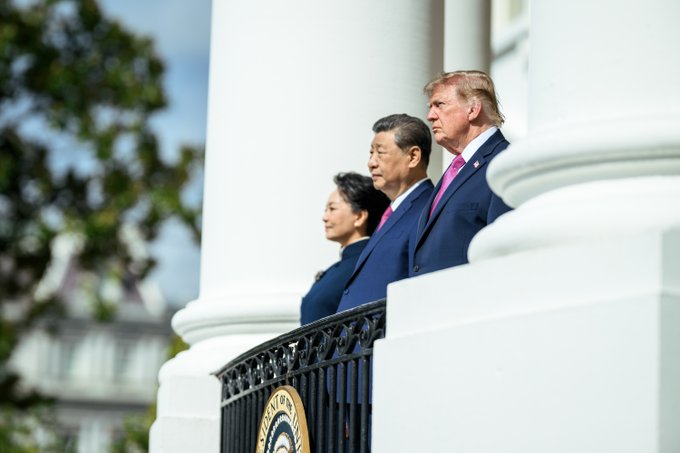
Wigs and tri-corner hats in the Rose Garden, a B-2 flyover, a personal airport greeting — Trump matched Xi’s Beijing spectacle move for move. (Image White House)
By TRH World Desk
Chinese President Xi Jinping made his first U.S. state visit in more than a decade, and President Trump appeared determined to match — and answer — the lavish reception Xi gave him in Beijing just four months earlier, producing one of the more theatrical high-stakes summits of his second term.
New Delhi, September 25, 2026 — U.S. President Donald Trump broke from his usual custom of greeting foreign leaders at the White House to personally welcome Xi and his wife, Peng Liyuan, at Joint Base Andrews when their plane landed Wednesday — the first time a sitting U.S. president has personally greeted a foreign leader at the base since 1962. ABC News described the airport greeting as “unusual for Trump” and reflective of “the pomp and circumstance surrounding the visit.”
That instinct to reciprocate carried through the full two days. Xi treated Trump to a tour of a Ming dynasty temple and a rarely-opened walled garden retreat during his May visit to Beijing, Trump answered with “a different kind of spectacle”: troops dressed in colonial wigs and tri-corner hats marching and playing music in a Rose Garden the media outlets described as “redesigned to look like a Trump golf club.”
The roughly 15-minute Rose Garden military review featured the U.S. Marine Corps silent drill platoon and band, capped by a flyover of a B-2 Spirit bomber and four F-22 Raptors — a display loud enough that “it caused Trump to flinch.”
“A Truly Great Friendship”
Trump leaned heavily into personal rapport throughout the visit. “From the time of my first election in 2016, President Xi and I have forged a friendship, a truly great friendship, actually, built on mutual respect and the vital interests of our people,” he said from the White House’s Grand Foyer.
Touring the newly redesigned South Lawn helipad with Xi, Trump referred to him as an “expert on stone” who “loves good granite,”— one of several lighter moments amid the formal diplomacy.
Trump also brushed off a pointed question with a line that drew notice for its timing: asked about a Wall Street Journal report that Chinese entities supplied Tehran with satellite imagery used in deadly attacks on U.S. troops in Jordan, Trump replied only, “They basically do what we do.”
Trump also “quipped that China has the friendliest press corps.” This came from him on the same day the White House was repeatedly denying access to American reporters despite a court order — access CNN, MS NOW, and Politico said was only restored afterward.
What the Leaders Actually Said
Beyond the pageantry, both men addressed substance, if guardedly. Following their Oval Office meeting, Trump told reporters simply, “We had a great meeting,” declining to detail whether Taiwan, AI, or jailed Hong Kong pro-democracy figure Jimmy Lai had come up.
On artificial intelligence, Trump said he wanted “to leave it exactly where it is,”— a notably noncommittal line, while Xi struck a more deliberate tone, saying the two countries share a “historic responsibility of advancing human development and progress” and must “strengthen communication,” adding AI’s development must remain “under human control.”
At Thursday’s state dinner — attended by tech leaders including Jeff Bezos, Sundar Pichai, Sam Altman, and Elon Musk — Xi said through a translator that the two sides had “sincere and in-depth exchanges” and “reached common understanding on many issues,” adding this had “added new substance to the constructive China-U.S. relationship of strategic stability.”
According to Chinese state media, Xi told Trump privately he hopes the U.S. will oppose Taiwan independence, and that China supports the U.S. and Iran returning to the 14-point memorandum reached in June.
A Summit Built for Optics
Foreign policy analysts were sceptical the spectacle would translate into substance. The Council on Foreign Relations’ James Lindsay called it “unlikely to produce any major breakthroughs,” noting Trump’s unusual embrace of Xi’s own preferred phrase — a “constructive relationship of strategic stability” — without clarity on what it actually commits Washington to.
The timing matters domestically: with midterms less than six weeks away, Trump has incentive to showcase economic wins, such as fresh Chinese purchases of American agricultural goods, from a summit whose real substance, on trade, Taiwan, and Iran, remains, by most accounts, still unresolved.
Follow The Raisina Hills on WhatsApp, Instagram, YouTube, Facebook, and LinkedIn




About The Author