Living Alone, Dying Alone: Why India’s Elders and Single Women Are Becoming Invisible
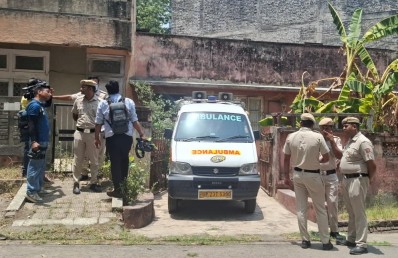
An ambulance in Old Rajinder Nagar comes to take away to elderly sisters who died alone. (Image Bhawna Malik)
By BHAWNA MALIK
India’s shrinking families and weakening neighbourhood bonds are leaving elderly people, widows and single women increasingly isolated—and sometimes dangerously vulnerable.
New Delhi, September 9, 2026 — When neighbours discover an elderly person’s body days after death, it shocks the nation. When an elderly couple is murdered inside the safety of their own home, headlines dominate the news cycle. When a single woman living alone is killed over a property dispute, there is public outrage—for a while. Soon, another tragedy takes its place.
These are not isolated incidents. They are warning signs of a deep social crisis that India can no longer afford to ignore. Behind every such tragedy lies a disturbing reality: growing loneliness, shrinking communities and the increasing vulnerability of people living alone.
India is witnessing a silent epidemic of isolation among senior citizens, widows, unmarried women and others who live independently. The question is no longer whether these incidents will happen again. The real question is whether society is prepared to prevent them.
A Society Growing Older—and More Isolated
India is ageing rapidly. Advances in healthcare have increased life expectancy, but they have not guaranteed companionship, emotional security or community support. Families are becoming smaller, children move away for education and employment, and urban lifestyles have weakened neighbourhood bonds.
For many elderly parents, the homes they built over decades have slowly become empty shells. Children may visit occasionally or connect through video calls, but screens can never replace a reassuring knock on the door or a caring conversation over a cup of tea.
A recent tragedy in Delhi’s Posh Locality New Rajinder Nagar brought this reality into sharp focus. Two elderly sisters-in-laws in their eighties were found dead inside their locked home only after neighbours noticed a foul smell coming from the house. There were no signs of forced entry or robbery. One reportedly died after a fall, while the other suffered a cardiac emergency and could not reach her pacemaker in time.
Ironically, the neighbouring house was vacant and there were no CCTV cameras. Beyond the unanswered questions surrounding their deaths lies an uncomfortable truth: many elderly citizens are living—and dying—in complete isolation.
Arvind Mehta, President of the Joint Forum of Residents, New Rajinder Nagar, summed it up poignantly: “We have gradually lost the spirit of community living. We no longer check on one another.”
Another heartbreaking incident in Maharashtra involved a 77-year-old retired defence employee who died after a fall. His bedridden wife, unable to seek help, reportedly died of hunger and thirst inside the same locked house.
These are not merely police cases. They are reminders that loneliness can become fatal.
The Silent Risks Faced by Single Women
For women living alone, the dangers are often even greater. Widows, divorced and unmarried women frequently become targets of property disputes, financial fraud and violent crime simply because criminals perceive them as isolated and defenceless. Living independently should never mean living without protection.
Psychologist Mamta Sharma explains, “Many elderly people and women living alone gradually develop fear and trust issues. Frequent migration, changing neighbourhoods and shrinking families reduce meaningful social interaction, leaving them increasingly isolated.”
Neelam Mishra (name changed), a single woman in her fifties, knows this loneliness all too well. After her father’s death in 2021, she realised that many people who had once enjoyed her generosity slowly distanced themselves. One close friend even remarked that her family discouraged visits because Neelam lived alone.
“That one sentence became my wake-up call,” she recalls. “I realised how quickly relationships can change when someone begins living alone.”
Sociologist Aparna Kumar describes loneliness as a public health concern that affects mental well-being, physical health and recovery from illness.
In India, however, loneliness has acquired another dimension—it has become a security concern.An elderly person who does not answer the phone may have suffered a medical emergency. A woman living alone may have become the victim of crime. Yet days can pass before anyone notices because no one is checking.
Social worker Ajit Singh observes, “In many apartment complexes, neighbours know delivery executives better than the people living across the corridor.”His words reflect the paradox of modern urban life. We are surrounded by people yet increasingly disconnected from them.
Why Are Elders Becoming Invisible?
Migration has separated generations. Joint families have given way to nuclear households. Retirement often reduces social interaction. The loss of a spouse leaves many emotionally shattered. Physical illness limits mobility, while the digital divide isolates those uncomfortable with smartphones and technology.
Perhaps the most heartbreaking reason is psychological.
Many elderly people fear becoming a burden. They hesitate to ask for help, suppress their emotional needs and gradually withdraw from society. At the same time, society celebrates youth while often overlooking the wisdom, experience and dignity of older generations.Isolation rarely happens overnight. It grows quietly until it becomes a way of life.
No government scheme alone can solve this challenge. The strongest safety net begins within neighbourhoods.
Resident Welfare Associations can maintain voluntary emergency contact lists for people living alone, organise weekly well-being calls and encourage volunteers to check on vulnerable residents.
Security guards can be trained to notice warning signs such as newspapers piling up, milk packets left outside or unusual inactivity.
Neighbourhood walks, book clubs, community kitchens, yoga groups and cultural gatherings may seem simple initiatives, but they rebuild something priceless—human connection.The objective is straightforward: every resident should be known by someone.
From Sympathy to Responsibility
Families remain the first line of care, but society cannot assume that every elderly person has active family support.
RWAs, local police, healthcare workers, volunteers, religious institutions and civil society organisations must work together to create compassionate neighbourhoods where no one feels abandoned.
Technology can help through emergency alert systems and wellness calls, but no app can replace the comfort of a caring neighbour knocking on the door.
A New Social Contract
India urgently needs a new social contract—one that recognises loneliness not as a private problem but as a shared community responsibility.
Every colony should know who lives alone—not to invade privacy, but to ensure no one is forgotten. Every elderly resident should have someone to call in an emergency. Every woman living alone should feel secure in her own home. Compassion must become as essential as security.
The true measure of a nation is not merely its economic growth or technological progress. It is how it treats those who are most vulnerable.
No elder should die unnoticed.
No woman should fear living alone.
No home should become a prison of silence.
Rakesh Mehta Is Gone: Remembering the Delhi Bureaucrat Who Tried to Make the City Work
Follow The Raisina Hills on WhatsApp, Instagram, YouTube, Facebook, and LinkedIn




About The Author