Rakesh Mehta Is Gone: Remembering the Delhi Bureaucrat Who Tried to Make the City Work
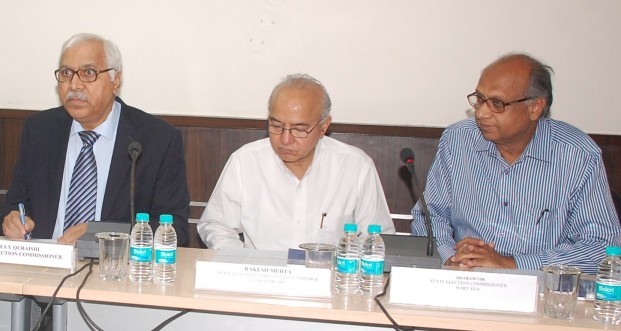
Former Delhi Chief Secretary Rakesh Mehta with CEC officials (Image PIB)
By MANISH ANAND
Former Delhi Chief Secretary Rakesh Mehta, who died by suicide at 75, leaves behind a legacy of administrative reforms, public transport expansion and an unusually open relationship with journalists and citizens.
New Delhi, September 9, 2026 — Throwing a bundle of files onto the floor, Rakesh Mehta asked: “What should be the price for the Janata thali.” The files had landed with a thud. Mehta asked honestly. He looked intently, expecting an answer. Mehta was of small height, but he left a legacy that remains insurmountable for Delhi’s bureaucracy. He was the Chief Secretary of Delhi, between 2007 and 2010. On Wednesday, Mehta died by suicide at the age of 75 at his Noida home.
“The Janta thali shouldn’t be priced above ₹15,” this writer told me, explaining that a lower price would mean rather making it free and higher may get in competition with other available options.
Mehta has just thrown a file to the floor that had examine the launch of Janata Thali by the Sheila Dikshit-led Congress government in Delhi. Dikshit wanted to do something for the poor working class in the city. The file had examined several options for pricing the thali.
“Why do you throw files onto the floor,” asked this writer.
“All bundelbaazi…,” he said. Mehta would dismiss a file under a minute, putting his signature for the formality and throwing the files to the floor.
Mehta was highly welcoming to journalists. Before journalists asked him questions, Mehta would reveal his set of queries. For him, journalists brought him undiluted feedback on Delhi government from the people. In the end, he will make journalists happy — giving each an exclusive story to go back.
“Beta, chai sir ke saath pioge ya mere saath,” Mehta’s PA would welcome journalists. Sometimes, he will say “today tea with me. Sir is busy in a meeting.”
The 2007-2010 period remains Sheila Dikshit’s most taxing and productive years at the helm of Delhi government. The pressure of hosting the Commonwealth Games in 2010 was felt in the Delhi Secretariat. The city had to grow significantly to host the athletes. The Chief Minister had taken the sporting event as a prestige issue.
But Mehta rarely felt the pressure. He knew his timeline and pressed forward the execution. The infrastructure for the Commonwealth Games took shape.
Before becoming Chief Secretary, Mehta had already revealed his acumen by heading the Municipal Corporation of Delhi, which is still known as the Mecca of incompetence, and Delhi Transport Corporation. Mehta sought to bring life to the MCD. He phased out those dangerous Blueline buses from Delhi and launched low-floor buses. Mehta had acquired an image of a change maker.
He faced a major public anger for pushing the Bus Rapid Transport System (BRTS), from Ambedkar Nagar to ITO, the busiest section, in Delhi. This project cost Sheila Dikshit the support of car-based commuters. They arguably turned vengeful, and cheered the arrival of the Aam Aadmi Party.
“At least, give time for the idea to fail. Why kill the idea even without trying. Delhi cann’t transform by doing nothing,” Mehta would say amid a massive media trial of the BRTS project.
“Frequent change of gear also consumes fuels. Giving a dedicated lane to buses makes a sense,” Mehta would reason.
The media spotlighted the car owners. Mehta was thinking of the low-income people who commuted with buses.
“Do you know how many people commute to their work places in cycles in Delhi,” Mehta asked one day. He thought of all sections of the people. On policy front, he sought to push space of pedestrians and cyclists.
Shiela Dikshit backed her Chief Secretary to the hilt. They were a team. In those three years, Mehta gave a major push to the expansion of Delhi Metro network and the transformation of Delhi’s buses.
Both Dikshit and Mehta knew that the national capital will choke if affordable and reliable mass transport was not offered to the people. Those three years were full of policy actions.
Journalists had massive access. They could actually stand outside the Cabinet meeting room and even hear what was being spoken inside. Mehta’s office was always welcoming. Journalists even saw Cabinet notes before the meetings.
Mehta had the people in his heart. He was a follower of Brahmakumaris. He had shunned animal products. As he would take black tea, Mehta wouldn’t promote his Vegan belief and ask journalists to take milk tea.
Mehta died at an age of 75. In his working life, he was a powerhouse. Media reports said that Mehta lived alone in the last five years. He reportedly suffered from mental stress. He also faced some unknown health ailments.
His death broke the heart of many. His dying by suicide further broke hearts of many. That he lived alone for past five years pained many.
While Delhi’s infrastructure has almost stagnated in the last 15 years and the city governance seems opaque and distanced from the people, Mehta’s legacy will prove to be a lamppost amid decaying morals of the Indian bureaucracy.
Follow The Raisina Hills on WhatsApp, Instagram, YouTube, Facebook, and LinkedIn




About The Author