Why India Won’t Broker Iran-US Peace — But BRICS Could Change the Equation
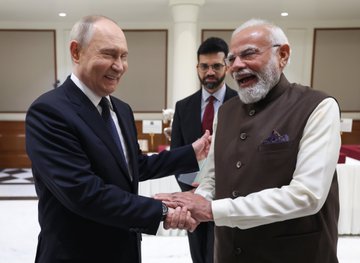
Prime Minister Narendra Modi with Russian President Vladimir Putin in New Delhi on Thursday. (Image Modi on X)
By NIRENDRA DEV
India is choosing strategic pragmatism over diplomatic adventurism as the Iran-US confrontation intensifies, with the BRICS Summit potentially creating space for dialogue.
New Delhi, September 9, 2026 — India has stayed away from the adventurism of attempting to broker peace between Iran and the United States. The approach is pragmatic and largely driven by one overriding consideration: Donald Trump remains perhaps the most unpredictable protagonist on the global geopolitical chessboard.
New Delhi appears to understand that getting directly involved in an Iran-US peace initiative could carry considerable strategic risks, particularly when the outcome of any such effort could be altered by Washington at short notice.
Yet Sept. 12, 2026, could prove to be a semi-historic occasion.
The United Arab Emirates, which has reportedly been under sustained Iranian fire for months, is expected to be represented in the same room as Iranian President Masoud Pezeshkian and other regional and sub-regional leaders.
Prime Minister Narendra Modi will host the BRICS Summit, with Russian President Vladimir Putin and Chinese President Xi Jinping also expected to attend.
Xi’s expected presence is significant. The Chinese president had stayed away from the 2023 G20 Summit hosted by India in New Delhi, and his participation in the BRICS gathering has consequently generated expectations of potentially important diplomatic engagements.
India, however, is being careful not to overstate what the summit can deliver.
MEA spokesman Randhir Jaiswal, speaking at the ministry’s regular briefing on Tuesday, Sept. 8, said the Russia-Ukraine conflict would be among the issues that could come up during bilateral discussions.
“As for the ongoing conflict between Russia and Ukraine — this is one of the many issues that will come up during the bilateral discussions,” Jaiswal said.
It was a carefully calibrated briefing.
Sanna Marin’s Ukraine Remark Revives Finland’s Complicated War History With Russia
Jaiswal also cautioned against speculation over the participation of individual leaders, saying, “We will update you on the participation (of nation/Govt heads). But at this point, I would say that please wait for an update from our side.”
At the same time, he made one point clear: Modi is expected to hold bilateral meetings with several leaders on the sidelines of the summit.
“Our Prime Minister will hold bilateral talks with numerous leaders during the BRICS summit. Detailed information regarding the specific leaders and timing of the meetings will be provided,” Jaiswal said.
Meanwhile, the US-Iran confrontation continues to carry serious implications for global energy and maritime security.
The conflict has affected shipping around the Strait of Hormuz, while oil prices have remained elevated, with Brent crude trading around the $97-a-barrel level at the time of writing.
For India, this is not merely a geopolitical issue. Any prolonged disruption around the Strait of Hormuz could have direct consequences for energy security, import costs, inflation and the country’s broader economic outlook.
This is where BRICS becomes relevant.
In Washington and several Western policy circles, BRICS is often described as too broad and internally diverse to produce consensus on major geopolitical questions. The grouping now encompasses a large and increasingly diverse set of countries, with full members and partner countries representing markedly different strategic and economic interests.
More than 30 countries have reportedly expressed interest in joining or deepening their engagement with the grouping.
Among countries seeking greater involvement are Pakistan and Bangladesh from South Asia, as well as Türkiye, Azerbaijan, Algeria, Venezuela, Colombia, Bahrain, Cambodia, Laos and several African countries.
The partner-country framework includes nations such as Belarus, Bolivia, Cuba, Kazakhstan, Malaysia, Nigeria, Thailand, Uganda, Uzbekistan and Vietnam, which can participate in BRICS-related cooperation without enjoying the full rights of members.
Asked about Bangladesh Prime Minister Tarique Rahman’s participation in the summit, Jaiswal said he had “no update”.
New Delhi is not opposed to the expansion of BRICS. But India wants such expansion to follow a criteria-based approach.
There is another red line for India: BRICS should not evolve into an explicitly anti-Western or anti-American bloc.
New Delhi wants BRICS to remain primarily an instrument for economic cooperation and a platform through which emerging economies can coordinate their interests. At the same time, India has an interest in strengthening the Russia-India-China, or RIC, framework, particularly against the backdrop of growing tensions over US trade and tariff policies.
The Iran-US confrontation, however, illustrates the limits of diplomatic optimism.
A so-called “Islamabad Memorandum” was signed on June 17 by Trump and Pezeshkian, according to the account being discussed in diplomatic circles, with Qatar, Oman, Türkiye, Saudi Arabia and Egypt reportedly playing intermediary roles.
The agreement involved 14 points. Yet after roughly 50 days, it expired on Aug. 17.
That experience offers an important lesson: brokering a document is considerably easier than sustaining a political settlement.
This is perhaps why the protagonists seeking to revive a peace process now appear uncertain about what can realistically be achieved.
There are other complications.
Chinese companies have reportedly supplied Iran with dual-use components and equipment related to radar, navigation and other capabilities. At the same time, several Gulf states have expressed concern over Iranian missile attacks and the wider consequences of the conflict.
Civilians have been killed and injured across the region, adding another layer of complexity to any diplomatic effort.
For India, the answer lies in balance.
New Delhi has strong strategic and economic reasons to maintain its relationship with the United States. At the same time, Russia remains a critical strategic partner, while China is India’s principal geopolitical and security competitor.
Unlike Beijing and Moscow, which frequently use international platforms to criticise Washington and Israeli actions, India has largely preferred calibrated diplomacy.
Its approach has included backchannel engagement and advocacy for maritime safety, dialogue and de-escalation without publicly assuming the role of mediator.
This is not diplomatic timidity.
It is strategic pragmatism.
India understands that opportunism may occasionally produce a signed ceasefire, but it does not necessarily outperform conviction when conviction produces nothing at all.
For New Delhi, therefore, the BRICS Summit is less about grandstanding as a global peacemaker and more about creating diplomatic space.
The real opportunity may lie not in announcing an India-brokered Iran-US peace deal, but in quietly bringing competing powers and regional actors into the same diplomatic ecosystem.
That may ultimately be India’s strongest card: balance without adventurism, engagement without overreach, and diplomacy without claiming ownership of a peace process that it cannot control.
Jaishankar’s Warsaw Message: Why India Says Ukraine War Must End Through Negotiations
Follow The Raisina Hills on WhatsApp, Instagram, YouTube, Facebook, and LinkedIn




About The Author