Jaishankar’s Warsaw Message: Why India Says Ukraine War Must End Through Negotiations
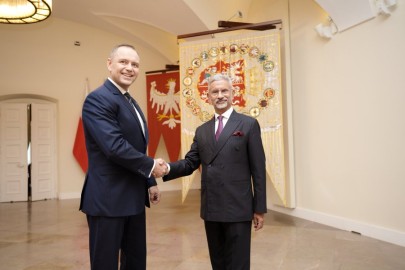
EAM S. Jaishankar with Polish President Karol Nawrocki on Friday in Warsaw. (Image Jaishankar on X)
By TRH Foreign Affairs Desk
After meeting Polish Foreign Minister Radosław Sikorski in Warsaw, S. Jaishankar stressed India’s engagement with both Russia and Ukraine and said the Ukraine conflict must be resolved through negotiations, not trade restrictions.
New Delhi, September 4, 2026 — External Affairs Minister S. Jaishankar’s remarks in Warsaw after meeting Polish Deputy Prime Minister and Foreign Minister Radosław Sikorski carry a message that goes beyond the immediate India-Poland bilateral agenda.
Coming soon after his visit to Kyiv, Jaishankar’s Warsaw interaction underlined a central element of India’s diplomatic position on the Russia-Ukraine conflict: New Delhi remains willing to engage with both Moscow and Kyiv, but does not accept the argument that India’s energy purchases from Russia should be treated as a substitute for diplomacy.
Jaishankar said India has been in “continuous touch” with both the Ukrainian and Russian sides and is examining ideas that could contribute to mitigating the conflict and, ideally, bringing the war to an end.
The formulation is significant.
India is not positioning itself as a mediator in the traditional sense, nor is it publicly unveiling a formal peace proposal. Instead, New Delhi appears to be preserving diplomatic space with both sides while arguing that the pathway to ending the conflict ultimately runs through negotiations.
‘The solution is not in trade’
The sharpest part of Jaishankar’s Warsaw remarks came when he was asked about India’s continuing purchase of Russian energy.
His response was unequivocal: “The issue is a conflict, it’s a war, and the solution to that is not in trade, the solution to that is in negotiations.”
That statement captures the fundamental Indian argument. Jaishankar was asked the same question in Ukraine. His answer was almost the same.
For New Delhi, the Russia-Ukraine conflict is fundamentally a political and security crisis. Economic pressure may influence calculations, but it cannot by itself substitute for negotiations between the parties to the conflict.
India’s position is also shaped by a straightforward national-interest calculation. As one of the world’s largest energy consumers, India has repeatedly emphasised the importance of securing affordable and reliable energy supplies.
Consequently, New Delhi does not appear prepared to accept a framework in which its energy purchases automatically become a test of its geopolitical alignment.
From Kyiv to Warsaw
The sequence of Jaishankar’s European engagements is itself noteworthy.
He travelled to Kyiv before arriving in Warsaw. In Warsaw, he spoke about India’s continuing engagement with both Russia and Ukraine.
This creates a diplomatic narrative in which India is attempting to keep multiple channels open rather than choosing one geopolitical camp.
That approach is becoming increasingly important as the Ukraine conflict intersects with wider questions involving European security, energy, supply chains and the future architecture of international relations.
For Poland, the war is an immediate European security concern. For India, it is also an important test of strategic autonomy.
The difference in geographical perspective does not necessarily prevent cooperation. Instead, it makes sustained political dialogue more important.
India-Poland relations acquire a wider strategic dimension
Jaishankar and Sikorski also reviewed progress under the 2024-28 Joint Action Plan, agreed during Prime Minister Narendra Modi’s visit to Poland.
Jaishankar described the progress as a “very solid” report card, pointing to stronger trade and investment ties and expanding cooperation in defence, mining and energy.
The bilateral agenda is also moving into newer areas, including space, digital technologies, artificial intelligence, semiconductors, cybersecurity, critical minerals and clean coal.
That is where the Warsaw visit becomes more than a Ukraine-focused diplomatic stop.
India and Poland are gradually building a relationship around areas that will define economic and strategic competitiveness in the coming decade.
Critical minerals, semiconductors, cybersecurity and supply-chain resilience are no longer merely economic subjects. They have become instruments of strategic power.
The European equation
India’s engagement with Poland is particularly relevant because Warsaw has emerged as an important voice on European security.
New Delhi, meanwhile, has built a reputation for maintaining working relationships across geopolitical divides.
The challenge is obvious.
India wants strong relations with Europe and the United States while retaining its longstanding strategic relationship with Russia. Europe, particularly countries closer to the conflict, views the Russia-Ukraine war through a much more immediate security lens.
Jaishankar’s Warsaw message therefore represents a balancing act.
India is effectively saying that strategic autonomy does not mean diplomatic isolation.
New Delhi can engage Poland and other European capitals on security, technology, defence and supply chains while maintaining its own assessment of how the Ukraine conflict should end.
The energy argument will remain difficult
There is unlikely to be any easy resolution to the debate over Indian purchases of Russian crude.
European governments and policymakers may continue to argue that revenues from Russian energy exports have implications for Moscow’s capacity to sustain the war.
India’s counterargument is that global energy markets cannot be separated from the realities of affordability, availability and the needs of developing economies.
Jaishankar’s Warsaw response therefore does something politically useful for New Delhi: it separates the question of what India buys from Russia from the question of how Russia and Ukraine should end their war.
Whether Western governments fully accept that distinction is another matter.
But India clearly intends to defend it.
New Delhi keeps the diplomatic door open
The most important part of Jaishankar’s remarks may ultimately be what he did not say.
He did not announce an Indian peace initiative.
He did not present India as a formal mediator.
He did not suggest that New Delhi had abandoned its energy relationship with Moscow.
Instead, he stressed continuing communication with both Russia and Ukraine and India’s interest in ideas that could contribute to reducing the conflict.
That is classic Indian diplomacy: keep the channels open, avoid premature commitments and preserve room for manoeuvre.
The Kyiv-Warsaw sequence reinforces that approach.
India’s message is that it is prepared to talk to everyone, but it will decide its own interests and its own diplomatic priorities.
And as the Ukraine war continues to reshape European security, that space for independent diplomacy could become one of India’s most valuable strategic assets.
Sanna Marin’s Ukraine Remark Revives Finland’s Complicated War History With Russia
Follow The Raisina Hills on WhatsApp, Instagram, YouTube, Facebook, and LinkedIn




About The Author