Old Monk Goes to Court: When a Rum Became a Matter of Legal Spirit
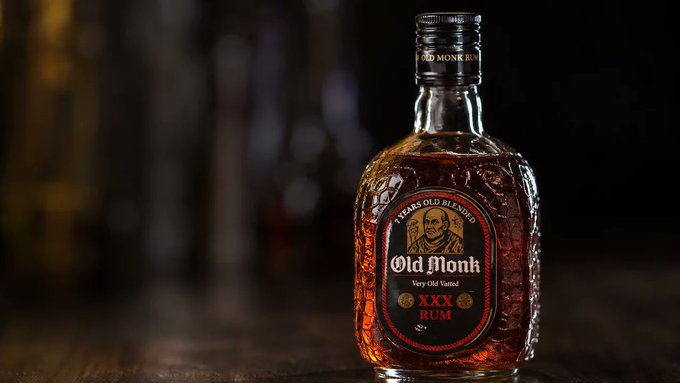
Is Old Monk Really Rum? FSSAI, Bombay HC and the Great ‘Rum-Flavoured Spirit’ Debate (Image BengalBytes on X)
By KUMAR VIKRAM
FSSAI has challenged Old Monk’s classification as rum, while its maker has agreed to revise labels after Bombay High Court questioned the “7 years old blended” claim and disclosure of added flavours.
New Delhi, September 4, 2026 — There are some names in India that need no introduction.
Gandhi.
Nehru.
Sachin.
And, in a very different department of national memory, Old Monk.
For generations, Old Monk has occupied that peculiar corner of Indian life where nostalgia, winter evenings, hostel stories, army canteens, bachelor parties and unsolicited advice from friends have occasionally met.
But now the old monk has found himself in an entirely new setting: the Bombay High Court.
And the question before the court is not merely whether the monk is old.
It is whether he is, legally speaking, rum.
The Food Safety and Standards Authority of India (FSSAI) has told the Bombay High Court that Old Monk, in its current composition, cannot be sold as rum and could instead be described as a “rum-flavoured spirit.” The regulator’s objection centres on the use of neutral spirit and rum flavouring.
That is quite a philosophical development.
After all, if something has spent decades being called one thing, changing its name is rarely a simple matter.
Ask any Indian who has tried to change a WhatsApp group name.
The original name always survives somewhere.
The monk meets the regulator
The dispute began after FSSAI objected to the composition and labelling of certain alcoholic products, including Old Monk. The manufacturer, Mohan Meakin, approached the Bombay High Court challenging the regulatory action.
The court proceedings then took the matter from the bottle to the label—and eventually, rather intriguingly, to the contents of the bottle.
FSSAI’s position is that the product’s principal component is neutral, unmatured spirit, with matured rum spirit accounting for less than 5% of the blend. The regulator also objected to the way added flavours were disclosed.
Suddenly, the familiar bottle acquired a new legal vocabulary.
“Old Monk” remained Old Monk.
But “rum” became a matter for lawyers.
And “7 years old blended” became something that apparently needed to be shown the door.
Seven years? Not so fast
The most entertaining part of the saga may be the famous “7 years old blended” description.
The Bombay High Court raised concerns that an ordinary consumer could understand the wording as suggesting that the entire product had been aged for seven years.
The company subsequently agreed to remove the “7 years old blended” claim from the packaging. It also agreed to make the disclosure of added flavours more prominent.
For Old Monk, therefore, the court battle has produced an unusual form of ageing.
The bottle may lose “seven years”.
But it has gained something else: legal experience.
The fine-print problem
There is another delicious irony here.
For years, consumers have been told to read the fine print.
But in this case, the Bombay High Court itself questioned whether the fine print concerning added flavours was sufficiently legible for consumers.
In other words, the consumer was apparently expected to read something that the court thought might be difficult to read.
This is where Indian bureaucracy and Indian packaging seem to have discovered a common hobby: writing important things in very small letters.
The court’s concern was not simply what the label said, but whether an ordinary consumer could actually understand the information being provided.
Is Old Monk having an identity crisis?
The most fascinating part of the episode is the question of identity.
For consumers, Old Monk is Old Monk.
For the manufacturer, it is a long-established product with a familiar market identity.
For the regulator, however, classification depends upon what is actually in the bottle and whether the product satisfies the applicable standards.
And for lawyers, naturally, the difference between these positions can generate several pages of submissions.
Thus the old monk has acquired a modern identity crisis: Am I rum?
Am I rum-flavoured spirit?
Am I seven years old?
Or am I simply old enough to know that labels can get you into trouble?
The court has not declared the monk guilty
It is important not to confuse the regulatory dispute with a judicial finding that Old Monk is unsafe to consume.
The proceedings concern the product’s classification, composition and labelling, including the regulator’s objections to how the product is described to consumers.
The Bombay High Court has so far not granted the company urgent interim relief against the sales restriction. The manufacturer has submitted revised labels, while FSSAI has sought time to examine them.
So the legal monk is still meditating.
The final answer has not yet arrived.
From barroom legend to courtroom exhibit
There is something quintessentially Indian about the entire episode.
A product that has lived comfortably in popular culture for decades has suddenly found itself being dissected through regulatory terminology.
The conversation has moved from: “How old is the Monk?”
to:
“What percentage of the blend actually qualifies as matured rum?”
That is quite a journey.
And somewhere in Mumbai, one suspects, generations of consumers are watching the proceedings with the same expression usually reserved for a complicated family dispute: “We thought we knew him.”
Perhaps that is the real lesson of the Old Monk affair.
In modern India, even a cultural icon is not beyond paperwork.
A monk may be old.
A brand may be legendary.
A label may be familiar.
But eventually, somebody in authority may ask the most uncomfortable question of all: “Please show me what is actually inside the bottle.”
And that, dear readers, is when the Old Monk stops being merely a drink.
He becomes a case file.
(Consuming liquor is injurious to health. This write up in no way promotes drinking.)
Follow The Raisina Hills on WhatsApp, Instagram, YouTube, Facebook, and LinkedIn




About The Author