Three Indians Missing as Missiles Turn Gulf of Oman Into War Zone

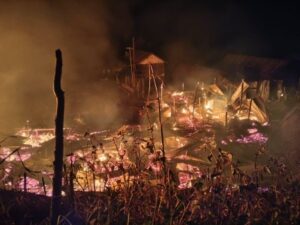
Settebello tanker strike by the US navy in Gulf of Oman. (Image video grab)
By TRH World Desk
Within 48 hours, two merchant vessels came under attack in the Gulf of Oman, leaving three Indian sailors missing and triggering dramatic rescue operations that pulled 45 others from burning ships.
New Delhi, June 10, 2026 — Forty-eight hours. Two vessels. Forty-five Indian sailors pulled from burning ships. Three still missing at sea. The Gulf of Oman has become ground zero for a maritime crisis that is no longer just a geopolitical abstraction — it is now a flesh-and-blood emergency for India’s seafaring community.
On June 8, the Palau-flagged oil tanker MT Marivex was disabled by a US Navy strike off the coast of Oman. A distress call captured by the Forward Seamen’s Union of India told the horror plainly: “This is motor tanker Marivex. We have fire on board and vessel is sinking.”
The caller reported that a missile had struck the engine room, blowing a hole in the ship’s hull. All 24 Indian crew members were ultimately rescued, airlifted by Omani naval helicopters in a swift operation coordinated through the Maritime Rescue Coordination Centre in Mumbai.
As Gulf News reported, the Indian Embassy in Muscat said it had “established direct contact with the seafarers” and expressed gratitude for Oman’s rapid response.
Less than 24 hours later, history repeated itself. On June 9, US Central Command said it had disabled the M/T Settebello — another Palau-flagged chemical and oil products tanker — in the Gulf of Oman after the crew “repeatedly failed to comply with directions from American forces.” Gulf News reported that British maritime security firm Vanguard Tech confirmed the tanker had “transmitted a distress call stating that its engine room had been struck by a missile.”
Of the 24 Indian crew aboard, 21 were rescued. Three remain unaccounted for, with search and rescue operations continuing under coordination by Omani authorities.
India’s response has escalated sharply. New Delhi summoned US Chargé d’Affaires Jason Meeks to lodge a formal protest — a rare and pointed diplomatic act. The Ministry of External Affairs condemned the Settebello strike in unambiguous terms, calling for an end to attacks on commercial shipping and the immediate restoration of free navigation through international waterways.
The context matters. As Khaleej Times noted, Iran has “largely blocked shipping through the Strait of Hormuz since the outbreak of war with the United States and Israel on February 28,” causing a staggering 90–95% drop in traffic through one of the world’s most critical energy arteries. Washington justifies its vessel-interdiction operations as enforcement of sanctions against Iranian oil exports. But the two tankers — while blacklisted by the US Treasury’s Office of Foreign Assets Control — were crewed overwhelmingly by Indian nationals who were, in every legal and moral sense, civilian workers.
Arab News captured the unsettling contradiction at the heart of the crisis: Indian officials confirmed the tankers were not Indian-owned, and India has not endorsed sanctions-busting. Yet Indian lives are the ones being lost in waters set ablaze by superpower confrontation.
This is a defining test for Indian diplomacy. New Delhi has long prided itself on strategic autonomy — maintaining warm ties with Washington while refusing to be conscripted into Western sanctions regimes. But when Indian sailors are drowning in the Gulf of Oman because of a US blockade, that balancing act becomes painfully harder to sustain. The question India’s foreign policy establishment must now answer is no longer philosophical: how long can New Delhi stay silent when its citizens are caught in someone else’s war?
Follow The Raisina Hills on WhatsApp, Instagram, YouTube, Facebook, and LinkedIn




About The Author