Opinion: It’s Time Delhi’s 2015 CAG Power Audit Was Made Public
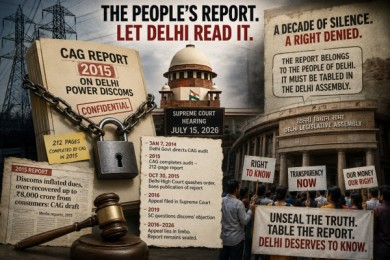
SC Stay on Delhi Discom Audit Revives Demand to Release Sealed 2015 CAG Report (A representative image)
By SIDHARTH MISHRA
As the Supreme Court examines the legality of auditing Delhi’s private power distributors, the larger constitutional question is whether a completed 2015 CAG report should finally be placed before the Delhi Assembly and the public.
New Delhi, July 6, 2026 — The Supreme Court’s decision to stay the ongoing Comptroller and Auditor General (CAG) audit of Delhi’s private power distribution companies has once again pushed an old controversy back into public focus. The hearing scheduled for July 15, 2026, is not merely about whether the CAG can audit the city’s discoms. It also revives a much larger democratic question of what should happen to a CAG audit that was completed more than a decade ago but has never been placed before the people of Delhi?
The Delhi government has an opportunity and indeed a constitutional obligation to answer that question. Rather than limiting its arguments before the apex court to defending the legality of a fresh audit, the government should make a specific prayer seeking permission to declassify and table the 2015 CAG report in the Delhi Assembly. That report belongs not to any government, political party or private company. It belongs to the citizens of Delhi.
The history of this extraordinary document is remarkable. On January 7, 2014, the then Aam Aadmi Party government directed the CAG to audit the accounts of Delhi’s three private electricity distribution companies, citing, among other reasons, the Delhi government’s 49 per cent equity stake in these entities. Unlike earlier attempts, the audit actually proceeded. The CAG completed its exercise, resulting in a confidential report running over 200 pages.
Contemporaneous media reports suggested that the draft report had raised serious questions regarding the financial practices of the discoms, alleging that inflated claims may have enabled recovery of nearly ₹8,000 crores from consumers. Those reports, however, referred to an unpublished draft and were never officially confirmed because the report itself was never released. The discoms strongly disputed those claims, and the matter has remained sub judice ever since.
The more significant fact is that Delhi’s citizens have never had the opportunity to examine what the constitutional auditor actually concluded. Before the report could be placed in the Assembly, litigation intervened. The Delhi High Court prohibited its publication during the pendency of the proceedings. On October 30, 2015, the High Court went further, quashing the very order directing the audit and holding that where the Delhi Electricity Regulatory Commission (DERC) already regulates tariffs and undertakes financial scrutiny, there was no scope for a parallel CAG audit under the existing statutory framework. The court described the government’s decision as ‘populist.’
CAG vs Regulators: Supreme Court’s Delhi DISCOM Case Could Set a National Precedent
The Delhi government, the CAG and residents’ body URJA challenged that judgment before the Supreme Court. Notices were issued in 2016. Even in 2019, the Supreme Court questioned why the discoms were resisting the audit. Thereafter, the appeal slipped into judicial silence.
For over a decade, therefore, a completed constitutional audit has remained sealed inside court records, never debated by legislators, never scrutinised by the public, and never contributing to policy reform. This creates an unusual democratic anomaly.
The very institution entrusted by the Constitution to audit public finances has completed an exercise whose findings remain inaccessible to the public in whose interest the audit was undertaken. A CAG report achieves its constitutional purpose only when it is laid before the legislature, examined by elected representatives and debated in the public domain. Until then, it remains merely a confidential file.
The present litigation provides the ideal occasion to correct this anomaly. Interestingly, the legal questions before the Supreme Court today substantially overlap with those arising from the earlier proceedings. The 2015 Delhi High Court judgment questioning the CAG’s jurisdiction forms the intellectual foundation of the 2026 ruling of the Appellate Tribunal for Electricity (APTEL), which similarly held that entrusting the audit to the CAG was inconsistent with the statutory framework governing electricity regulation.
The Supreme Court is therefore effectively dealing with two proceedings separated by a decade but revolving around the same legal issue, whether the CAG possesses the authority to audit Delhi’s private discoms despite the existence of DERC. The difference is that one case concerns a completed audit while the other concerns a proposed audit that presently stands stayed.
This peculiar situation presents the Court with an opportunity to resolve both matters comprehensively. However, irrespective of how the Court ultimately settles the legal issue of future audits, there is a compelling case for allowing the already completed 2015 report to enter the public domain.
Disclosure of the report would not prejudice the legal question of whether similar audits may be conducted in future. The constitutional validity of future audits can continue to be adjudicated independently. But preventing citizens from accessing an audit already completed serves little public purpose.
If portions of the report require redaction to protect legitimately confidential commercial information, the Court can certainly permit limited redactions. What should not remain under perpetual seal are the auditor’s conclusions concerning matters affecting millions of electricity consumers.
The Delhi government should therefore adopt a broader constitutional approach before the Supreme Court. Instead of treating the litigation merely as a contest over institutional jurisdiction, it should emphasise the public’s right to know. It should respectfully request the Court to permit declassification of the 2015 CAG report and allow it to be tabled before the Delhi Legislative Assembly, where it can undergo scrutiny through the established legislative process.
Transparency does not imply guilt, nor does publication amount to condemnation of any party. It merely allows facts collected by India’s highest constitutional audit institution to enter democratic discourse. For eleven years, Delhi’s electricity consumers have been asked to wait while legal proceedings continued. Justice delayed may sometimes be unavoidable. Public accountability delayed for more than a decade is much harder to defend.
The report was prepared in the name of the people of Delhi. It is time it was returned to them.
(This is an opinion piece. Views expressed are the author’s own.)
Why the Supreme Court’s CAG Audit Stay Isn’t a Win for Delhi Discoms
Follow The Raisina Hills on WhatsApp, Instagram, YouTube, Facebook, and LinkedIn




About The Author