The Fist That Buried a Supreme Leader
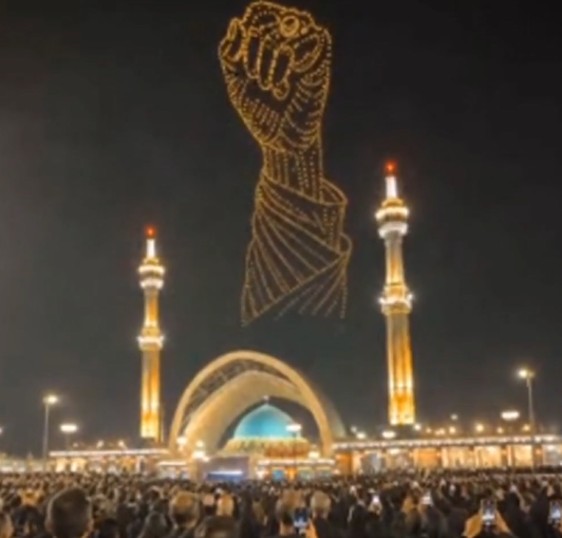
Iran's week-long funeral for Ayatollah Ali Khamenei is being used to project unity, resilience and defiance after the US-Israeli war. Here's the symbolism behind it. (Image X.com)
By TRH World Desk
A week-long funeral, a giant clenched fist, and millions of mourners. Iran’s farewell to Ayatollah Ali Khamenei is as much about political messaging as it is about mourning, projecting resilience after the US-Israeli war and signalling continuity under Mojtaba Khamenei.
New Delhi, July 5, 2026 — Tehran this week has been staging something Iran has not seen since 1989: a funeral built to outlast the man in the coffin. Ayatollah Ali Khamenei, killed on February 28 in the opening strike of the US-Israeli war on Iran, is being laid to rest across five cities and seven days, with authorities projecting between 15 and 20 million mourners — a scale organisers have openly compared to the burial of Ruhollah Khomeini, the Islamic Republic’s founder, thirty-seven years ago.
But the image dominating this funeral is not the coffin. It is a fist.
In his first message to the nation as Iran’s new Supreme Leader, Mojtaba Khamenei — who has not appeared in public since he was reportedly wounded in the same February strike that killed his father — said he saw his father’s body with a raised, clenched fist. That single detail has since been elevated into the funeral’s official emblem. A giant statue of the fist, framed by imagery resembling ballistic missiles, now stands in Tehran’s Enghelab Square. Banners across the capital, printed in Arabic, English and Farsi, carry the week’s slogan: “We must rise.”
Iran also paired delegations with politically surcharged verse from the Quran. That delivered messages to Saudi Arabia, Qatar, Lebanon, and Turkey, besides the three Iran supported groups — Hezbollah, the Houthis, and the Hamas. For Saudi Arabia, the verse read: two armies met in a battle, one believing and the other not.
The symbolism is doing real political work. A Tehran taxi driver, quoted by Iranian state media, called the fist a sign that “all our fists are clenched” against Iran’s enemies. IRGC commander Ahmad Vahidi told state television that the fallen leader’s “pure blood” marked another turning point against what he called the “global infidel front.” These are not incidental quotes — they are the funeral’s intended message, amplified through banners, statues and state broadcasts: defiance, continuity, and a promise of retaliation, delivered to a domestic audience and to the wider network of Iran-aligned groups — Hezbollah, the Houthis, Hamas — whose representatives were present in Tehran.
What is unambiguous is the political calculation underneath the imagery. This funeral doubles as a demonstration that Iran’s clerical system survived a decapitation strike — that killing a Supreme Leader did not break the state built around him. Pakistan’s prime minister Shehbaz Sharif attended in person. Russia sent a former president. China, India and Iraq sent officials. European governments, by contrast, were reportedly not invited, underscoring how the funeral has become a marker of where countries stand in a fractured post-war order, not merely a religious rite.
Iran’s domestic politics complicate the narrative of unanimous mourning. Human rights groups have documented that the same security apparatus now orchestrating this funeral was responsible for killing thousands during anti-government protests in late 2025. Some Iranians interviewed by foreign media described attending less out of grief than fear of being seen not to. That tension — a state projecting unity through a fist while suppressing dissent with the same fist — is the more difficult story sitting beneath the funeral’s imagery, and one state media will not tell.
For Washington and Israel, meanwhile, the calculus that produced the February strike was framed as removing a hostile leader before he could inflict greater damage. Whether decapitating Iran’s leadership achieves that strategic aim, or instead hardens the very defiance the fist now symbolises, is precisely the question this funeral — deliberately, calculatedly — leaves hanging in the air over Tehran.
Why Iran Believes It Has Gained Leverage After US-Israel Attacks
Follow The Raisina Hills on WhatsApp, Instagram, YouTube, Facebook, and LinkedIn




About The Author