Iran War ‘Greatest Disaster in American History’: Brig. Anderson
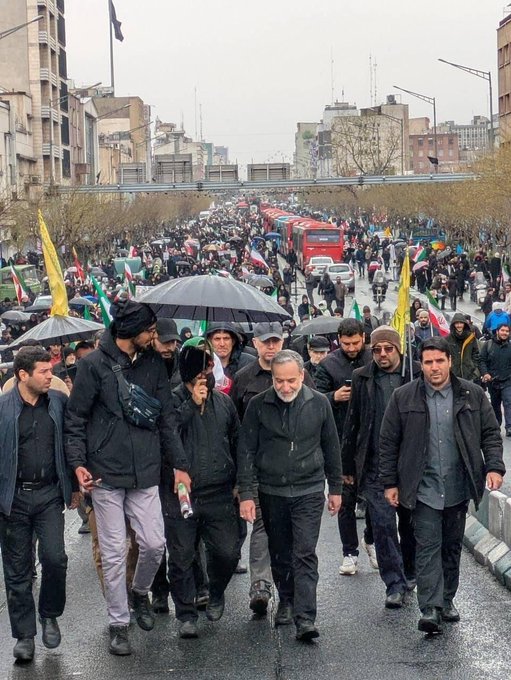
Iran's Foreign Minister Seyed Abbas Araghchi during International Quds Day walk (Image X.com)
Brig. Gen. Steve Anderson tells MSNBC Trump has “stuck his hand in a hornet’s nest with no way out” as IRGC hunts missing airman
By TRH World Desk
New Delhi, April 4, 2026 —A retired U.S. Army general has delivered a damning verdict on America’s war with Iran, calling it the greatest geopolitical disaster in the nation’s history, as a desperate race unfolds to recover a downed combat systems officer before Iranian Revolutionary Guard forces close in.
Brigadier General Steve Anderson (Ret.), speaking to MSNBC, warned that the United States has no clear exit from a conflict that is rapidly escalating in cost, casualties, and strategic consequence.
“This is the greatest geopolitical disaster, I believe, in the history of America,” Anderson said, adding: “Donald Trump has stuck his hand in the middle of a hornet’s nest. He doesn’t know how to get it out, and we’ve got a long way to go.”
A Race Against Time
Anderson detailed the severe logistical challenges facing U.S. rescue forces, noting that Iran’s geography places the downed airman far from any American base — stretching supply lines and loiter capacity to their limits.
“They are a long ways away from any American bases,” he said, adding: “They’re going to have to have extensive logistics capability to essentially loiter and look for this guy.”
The general outlined the likely rescue architecture: Pave Hawk helicopters providing recovery capability, A-10 aircraft delivering close air cover, an HC-130 functioning as airborne command and refuelling platform to extend helicopter endurance, and MQ-9 Reaper surveillance drones blanketing the search area.
He noted one potential advantage for the missing officer. “My understanding is this weapons systems officer probably has a set of night vision goggles, and that would give him some advantages to staying alive in a contested area,” Anderson said — pointing out that darkness had begun to fall over the operational zone.
The IRGC Factor
Anderson was blunt about what capture would mean. The Islamic Revolutionary Guard Corps, he warned, has every incentive to find the airman first.
“There would be tremendous political advantage — I mean, there already is with two shoot downs today — but to be able to capture someone and have a hostage would be tremendous political points for the regime,” he said.
The warning comes as security analyst Babak Taghvaee confirmed two A-10C+ Thunderbolts and an F-15E were lost over Iran on the same day, with one A-10 crashing in Kuwait after its pilot ejected during a search and rescue operation — itself a sign of how aggressively Iranian air defenses continue to operate despite official U.S. claims they had been destroyed.
An Impenetrable Fortress
Anderson’s assessment reinforces a growing consensus among military analysts that Iran has proven far more resilient than the administration projected. With Iran firmly controlling the Strait of Hormuz, U.S. aircraft losses mounting into the billions, and diplomatic options exhausted, the general’s warning of a long road ahead carries the weight of hard operational reality.
‘US Loses Multiple Aircraft’ Over Iran’: Pentagon Faces Outrage
Follow The Raisina Hills on WhatsApp, Instagram, YouTube, Facebook, and LinkedIn




About The Author